

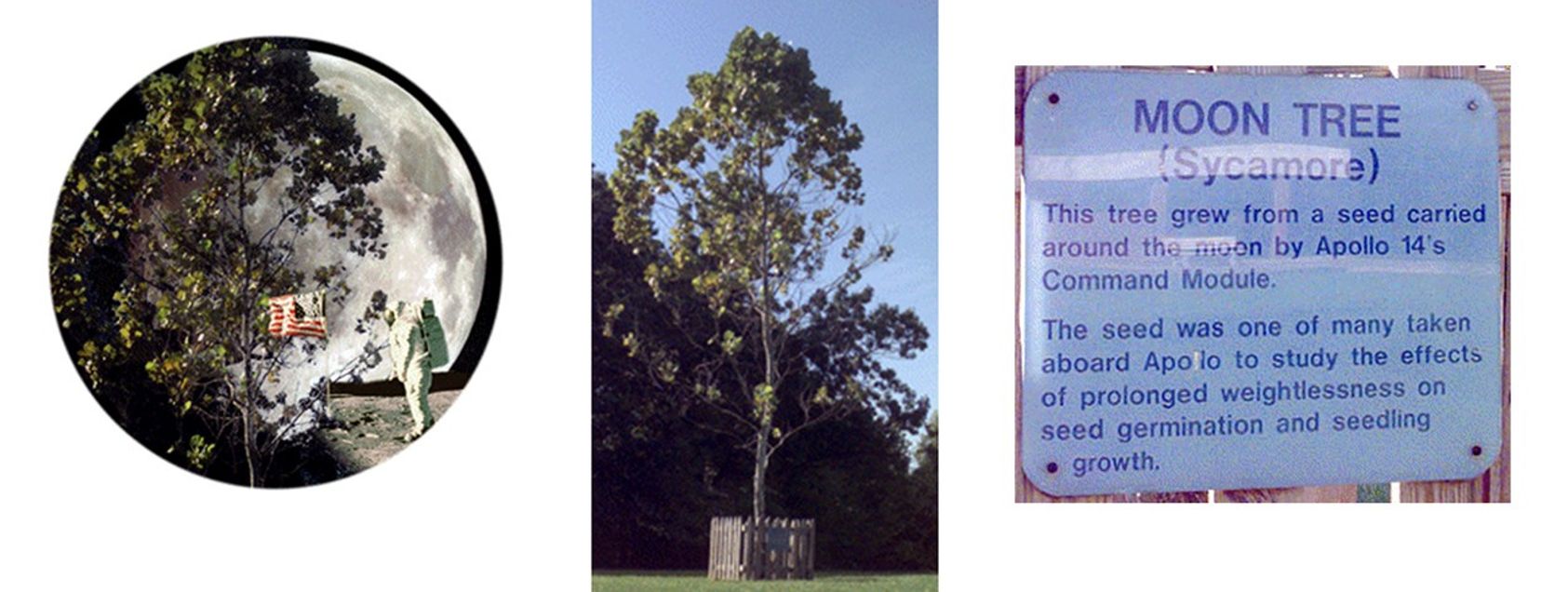
2,000 Seeds Orbited the Moon in 1971 & Most of Them Are Now Lost
On February 5, 1971, Apollo 14 landed on the lunar surface. Most people remember Alan Shepard swinging a makeshift golf club on the Moon’s surface, sending two balls sailing through the airless expanse. Fewer remember what was happening 60 miles overhead, where command module pilot Stuart Roosa circled the Moon with a secret cargo tucked inside his personal kit. Roosa carried no scientific instruments. No complex machinery. Just seeds.
Hundreds of them, sealed in plastic bags inside a metal canister, orbited the Moon 34 times while Shepard and Edgar Mitchell explored below. Nobody knew then that these tiny passengers would spark a mystery that would last more than five decades. Nobody knew that most of them would simply vanish.
Before He Reached for the Stars, He Fought Fires on Earth
Stuart Roosa’s path to space began in smoke and flame. Born in Durango, Colorado, in 1933, he spent his early twenties jumping from planes into burning forests as a U.S. Forest Service smoke jumper. He later joined the Air Force, became a test pilot, and earned selection to NASA’s astronaut class of 1966.
Ed Cliff, Chief of the Forest Service, remembered Roosa from those firefighting days. When Cliff learned his former smoke jumper would orbit the Moon, he saw an opportunity. He contacted Roosa about carrying tree seeds into space as part of a joint NASA and Forest Service experiment.
Stan Krugman of the Forest Service selected seeds from five species native to American soil. Loblolly pine, sycamore, sweetgum, redwood, and Douglas fir would represent Earth’s forests on humanity’s third lunar landing mission. Workers classified and sorted somewhere between 500 and 2,000 seeds, sealing them in small plastic bags before placing them inside a metal canister. Control seeds remained on Earth for later comparison.
Roosa kept the seeds in a small canvas pouch that stayed with him throughout the mission. While Shepard hit golf balls and Mitchell collected rock samples, those seeds completed orbit after orbit around the Moon, absorbing radiation and experiencing microgravity that no tree had ever known.
Coming Home to Chaos
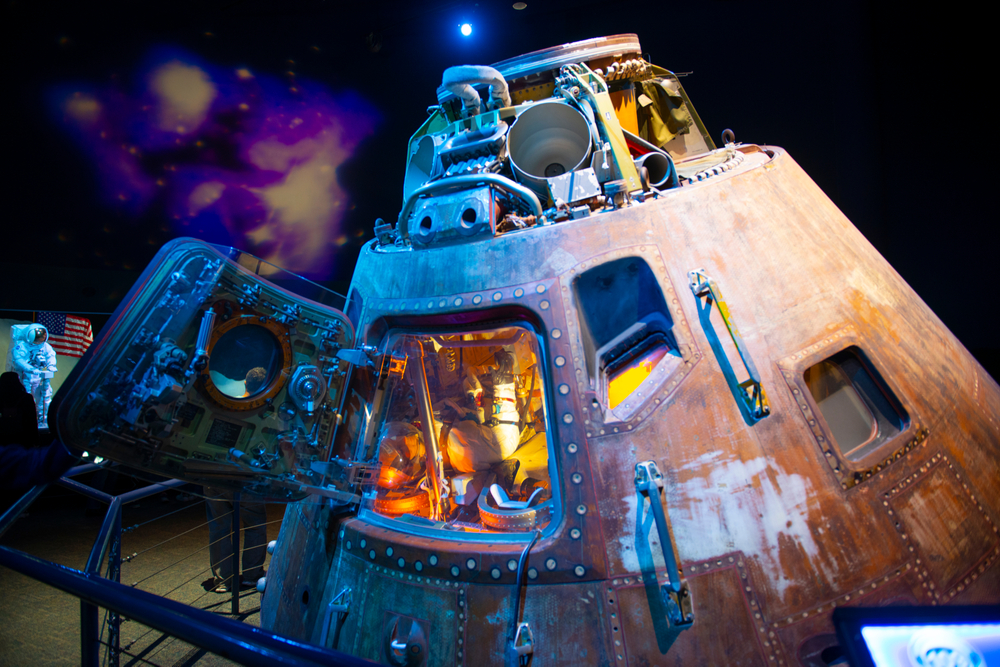
Apollo 14 splashed down on February 9, 1971. America celebrated another successful lunar mission. But inside a decontamination chamber, disaster struck the seeds.
Post-mission protocols required everything returning from space to undergo decontamination procedures. During this process, something went wrong. Pressure changes inside the vacuum chamber proved too much for the sealed bags.
“Unfortunately, the seed bags burst open during the decontamination procedures after their return to Earth, and the seeds were scattered about the chamber and exposed to vacuum, and it was thought they might not be viable,” NASA later explained.
Scientists collected what they could from the chamber floor. Expectations remained low. Seeds exposed to a vacuum rarely survive. Most assumed the experiment had failed before it truly began.
Life Finds a Way
Stan Krugman refused to give up. He gathered the scattered seeds and attempted germination at facilities in Houston. What happened next surprised everyone.
Seeds began to sprout. Against all predictions, many seeds survived their traumatic reentry into Earth’s atmosphere and their accidental vacuum exposure. Green shoots pushed through the soil, reaching toward the grow lights in a Houston laboratory. Yet joy turned to frustration when inadequate facilities caused many early seedlings to wither and die.
A year passed before the remaining seeds received a second chance. Forest Service stations in Gulfport, Mississippi, took charge of sycamore, loblolly pine, and sweetgum seeds. Placerville, California, received redwood and Douglas fir. Both locations had proper equipment for nurturing delicate seedlings.
Patience and care paid off. Around 450 seedlings grew into healthy young trees, ready for planting. Scientists placed some beside Earth-bound control trees to compare their growth. After more than four decades of observation, researchers found no detectable difference between Moon trees and their terrestrial siblings. Seeds that traveled a quarter million miles grew exactly like seeds that never left the ground.
America’s Bicentennial Gift
By 1975, America was preparing to celebrate its 200th birthday. Forest Service officials saw a perfect opportunity to distribute their lunar seedlings.
Moon trees went to state forestry organizations across the country. A loblolly pine took root on the White House lawn. Washington Square in Philadelphia received one. Valley Forge, where George Washington’s troops once suffered through a brutal winter, welcomed another. Trees were also planted in the International Forest of Friendship in Atchison, Kansas, and at various universities and NASA centers across roughly 40 states.
International recipients joined the celebration. Brazil and Switzerland planted Moon trees. Emperor Hirohito of Japan received one as a gift from the American people.
President Gerald Ford sent telegrams to many recipients, each carrying the same message about their new arboreal treasures.
“This tree which was carried by Astronauts Stuart Roosa, Alan Shepard and Edgar Mitchell on their mission to the moon, is a living symbol of our spectacular human and scientific achievements,” Ford wrote. “It is a fitting tribute to our national space program which has brought out the best of American patriotism, dedication and determination to succeed.”
Communities planted their Moon trees with pride. Local newspapers ran stories. Ceremonies marked the occasions. And then, slowly, something strange happened. People forgot.
Vanishing into History
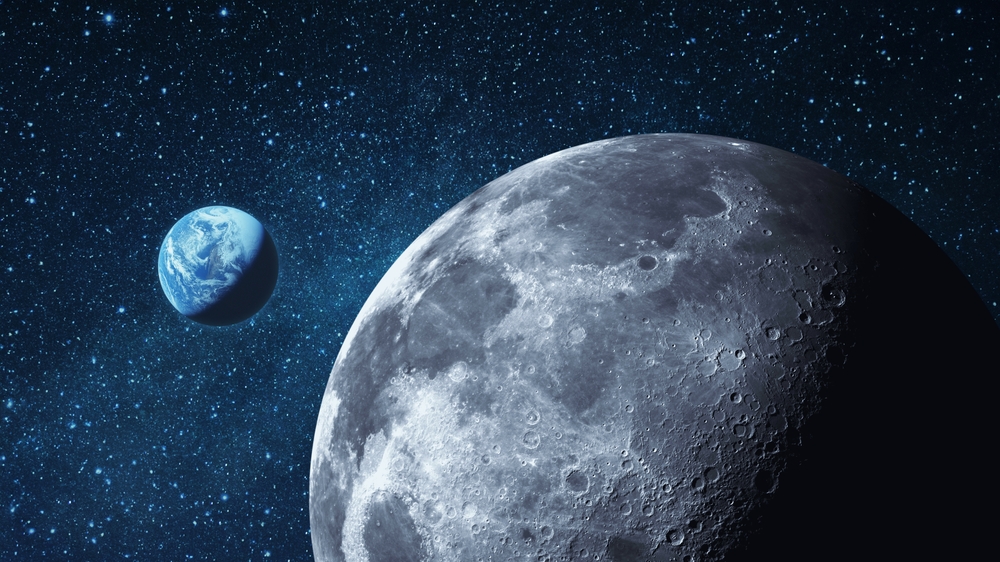
Moon trees had one fatal flaw. Most were planted without identifying markers, plaques, or signs explaining their origins. No formal registry existed. No systematic tracking followed their progress. State forestry departments changed leadership. Records were lost or discarded. Memories faded.
By the 1990s, most Moon trees had become anonymous. They stood in parks, schoolyards, and government buildings, looking exactly like ordinary trees. Passersby walked beneath their branches without knowing those limbs had grown from seeds that once circled the Moon.
Stuart Roosa never saw his trees properly cataloged. He passed away in December 1994, leaving behind a legacy scattered and largely forgotten across America and beyond.
A Third Grader Changed Everything
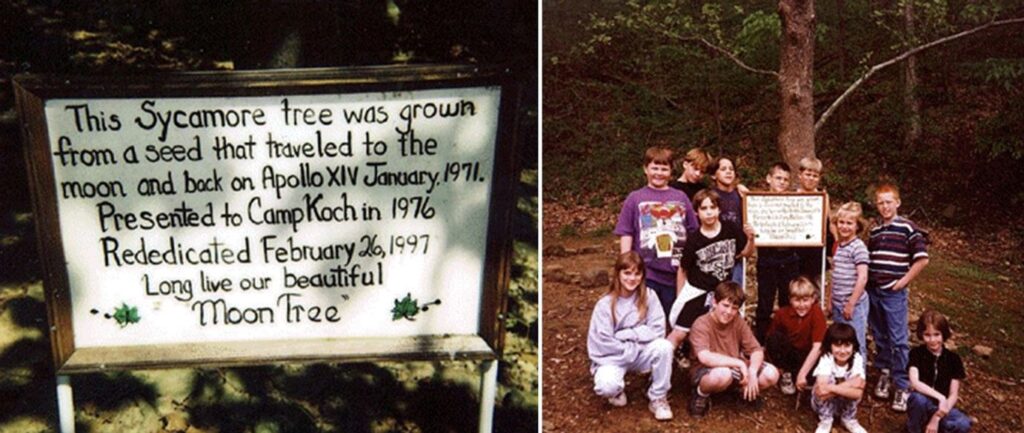
In 1996, a third-grade teacher in Cannelton, Indiana, asked NASA a simple question. Her students had heard about a Moon tree growing locally at Koch Girl Scout Camp. Was it real? Could NASA confirm its origins?
NASA scientist Dave Williams received the inquiry and realized nobody had ever compiled a complete list of Moon tree locations. He began searching.
Williams scoured archival newspaper clippings from the 1970s. He contacted state forestry departments, universities, and government agencies. He asked the public for tips. Slowly, a database took shape.
His efforts located approximately 110 original Moon trees. Nearly 30 of them had already died in the decades following their planting, victims of disease, storms, development, or simple neglect. More than 300 remained missing, their locations unknown, their stories untold.
A Daughter’s Mission
Rosemary Roosa grew up watching her father become an astronaut, orbit the Moon, and carry seeds into space. She understood what those trees meant to him and what they could mean to future generations.
In 2011, she founded the Moon Tree Foundation to honor her father’s legacy. Her mission centered on distributing second-generation Moon trees grown from seeds and cuttings of original specimens. If first-generation trees were disappearing, she would create new ones to carry the story forward.
Rosemary successfully distributed 12 second-generation Moon trees to various locations. When Hurricane Irma destroyed the original Moon tree at Kennedy Space Center in 2017, second-generation trees replaced it. Her father’s experiment continued living, even as original specimens fell.
Artemis Picks Up Where Apollo Left Off
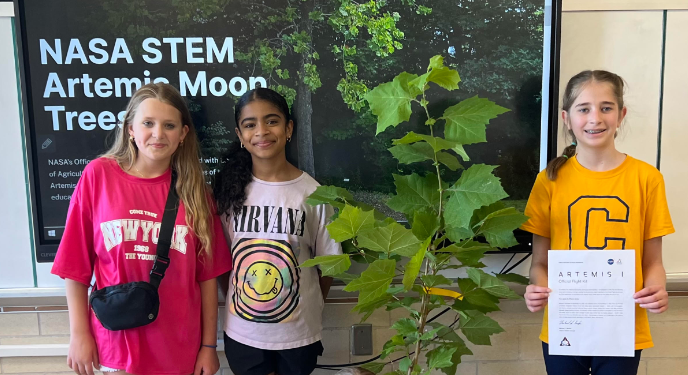
In 2022, NASA decided to try again. Artemis I, an uncrewed mission, carried approximately 1,000 tree seeds beyond the Moon and back. Unlike Roosa’s seeds, which orbited relatively close to the lunar surface, Artemis seeds traveled 2.3 million kilometers on their journey.
Mission planners learned from Apollo’s mistakes. Giant sequoia seeds replaced coast redwood, as sequoias grow better in parks and public spaces. More importantly, NASA committed to tracking every single seedling.
Artemis Moon tree seedlings have been planted at 236 sites across America. Many went to schools, where students could watch them grow while learning about space exploration. Unlike their Apollo predecessors, these trees will not vanish into anonymity.
Adria Gillespie, a district science coach at Greenfield Union School District in California, witnessed the effect firsthand. “Through class visits to the tree, students have gained a lot of interest in caring for the tree,” she noted, “and their curiosity for the unknown in outer space sparked them to do research of their own to get answers to their inquiries.”
Roots That Reach Beyond Earth
Stuart Roosa spent his youth jumping into wildfires to save forests. He spent his career reaching for the Moon. In carrying those seeds aboard Apollo 14, he connected both worlds in a way nobody fully appreciated at the time.
Today, somewhere between 80 and 100 original Moon trees still grow across America and around the world. Most remain unmarked, their extraordinary origins known only to those who remember local ceremonies from half a century ago. Second-generation trees are spreading, carrying DNA that once experienced lunar orbit. Artemis seedlings are taking root in schoolyards, where children learn that exploration means more than rockets and astronauts.
If you happen to know where a lost Apollo Moon tree grows, NASA still wants to hear from you. Somewhere out there, trees that circled the Moon stand quietly, waiting to be recognized. Their branches reach toward the same sky their seeds once traveled through, silent witnesses to one of humanity’s greatest adventures.
Perhaps one grows up in your town. Perhaps you have walked beneath it, never knowing what made it different from every other tree in the park. Perhaps it is time to look a little closer at the trees around you and wonder which ones carry secrets from space.