

Scientists Revive a Forgotten Idea to Solve One of the Universe’s Biggest Mysteries
Somewhere in the back of your mind, a question forms that you may never have asked out loud. Why is any of it here? standing under a midnight sky, staring up at billions of stars. You feel small. You feel wonder. Why do stars burn? Why do galaxies spin? Why does your heart beat and your lungs breathe? Why does anything exist at all?
I want you to sit with that question for a moment. Because scientists have been wrestling with it for generations, and now, a team of physicists in Japan may have found an answer hiding inside an idea that the scientific world abandoned over 150 years ago.
In 1867, a British physicist named Lord Kelvin proposed something unusual. He imagined atoms as tiny knots twisted into an invisible substance called the aether. Picture a sailor tying rope into loops and tangles, except Kelvin believed nature itself was doing the tying at the smallest scales of reality.
His idea turned out to be wrong. Atoms are made of protons, neutrons, and electrons. No aether exists. Science moved on.
But here we are, more than a century and a half later, watching researchers dust off that old concept and apply it in a way Kelvin never could have imagined. Their work suggests that knotted structures in the fabric of space itself may have determined whether you and I would ever exist.
Why Does Anything Exist at All?
When the universe exploded into being during the Big Bang, it should have created equal amounts of two things. Matter and antimatter. You probably remember matter from science class. Matter is you, me, trees, oceans, planets, and everything you can touch. Antimatter is its mirror twin. Same mass, opposite charge.
When matter meets antimatter, they destroy each other completely. They vanish in a flash of pure energy. No survivors. If the Big Bang made equal amounts of both, then everything should have cancelled out. Every particle should have found its opposite and annihilated. All that would remain is a universe of empty radiation.
No stars. No planets. No life. No, you are reading these words right now. Yet here we are. Look around. Matter won. But how?
Scientists have calculated the odds. Everything you see in the cosmos today exists because, for every billion matter-antimatter pairs that destroyed each other, just one extra matter particle survived. One in a billion. A margin so thin you could miss it if you blinked.
And nobody could explain where that tiny advantage came from. Our best models of physics fall short by orders of magnitude. Something happened in the first moments of creation that tipped the scales, and for decades, that something remained a mystery. Until now.
Two Symmetries Nobody Studied Together
Muneto Nitta, a professor at Hiroshima University in Japan, leads a research center dedicated to studying knotted structures across different fields and scales. Working alongside Minoru Eto and Yu Hamada, he set out to answer the matter-antimatter puzzle by looking in a place others had overlooked.
“This study addresses one of the most fundamental mysteries in physics: why our Universe is made of matter and not antimatter,” Nitta said. “This question is important because it touches directly on why stars, galaxies, and we ourselves exist at all.”
Two mathematical symmetries have floated around in physics for decades. Each one solves a different piece of the puzzle. One is called B-L symmetry, which stands for Baryon Number Minus Lepton Number. It explains why ghostlike particles called neutrinos have mass even though they barely interact with anything. Neutrinos pass through entire planets without leaving a trace.
Another symmetry is called Peccei-Quinn symmetry. It solves a problem involving neutrons and electric fields that I will spare you the details of. But in doing so, it predicts a particle called the axion, which happens to be a leading candidate for dark matter.
Both symmetries have been studied for years. But nobody thought to combine them. Nobody asked what would happen if they existed together in the early universe. Nitta’s team did exactly that. And what they found surprised them. “Nobody had studied these two symmetries at the same time,” Nitta said. “That was kind of lucky for us. Putting them together revealed a stable knot.”
Frozen Cracks in Spacetime
To understand what happened next, imagine the universe as a pot of water coming to a boil, except running in reverse. Right after the Big Bang, everything was unimaginably hot. As the cosmos expanded, it cooled down. And as it cooled, its symmetries started to break.
Think of water freezing into ice. If you freeze water slowly and evenly, you get smooth ice. But if conditions are chaotic, you get cracks, bubbles, and fractures. Something similar may have happened to space itself.
As the universe’s symmetries shattered, they may have left behind thin, threadlike defects called cosmic strings. Picture cracks running through the fabric of reality. Though thinner than a proton, just an inch of cosmic string could weigh as much as a mountain. These hypothetical objects have never been observed directly, but many cosmologists believe they may still be out there, stretching and tangling as the universe expands.
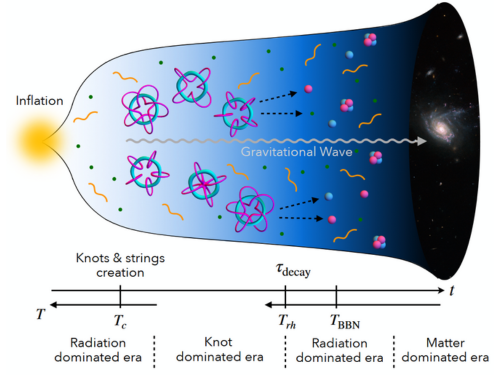
Now here is where Kelvin’s ghost returns. When B-L symmetry broke, it produced one type of string. When Peccei-Quinn symmetry broke, it produced another type. Alone, each kind of string would have been unstable. Loops would have shrunk and snapped. Energy would have scattered.
But together, something remarkable happened. One type of string gave the other something to hold onto. Energy flowed between them, balancing the tension that would normally tear them apart. And when they linked together, they formed stable, tangled structures. Knots. Cosmic knots, woven from the broken symmetries of a newborn universe.
When Knots Ruled Everything
I want you to picture the universe a fraction of a second after its birth. Radiation fills everything. Light and energy dominate the cosmic stage.
But radiation has a weakness. As space expands, radiation stretches. Its wavelengths get longer, and it loses energy. Over time, it fades.
Knots played by different rules. Like matter, they held onto their energy far more stubbornly. While radiation weakened, the knots stayed strong. And eventually, they overtook everything else.
For a brief period in cosmic history, tangled energy fields dominated the universe. Knots were the main event. Everything else was background noise. But that reign did not last.
Quantum Tunneling Unravels Everything
Even the most stable knots could not survive forever. Deep in the quantum world, particles do not follow the rules you might expect. They can slip through barriers that should be impossible to cross. Physicists call it quantum tunneling.
One by one, the cosmic knots began to unravel through this strange process. And when they collapsed, they released a shower of particles. Among those particles were heavy right-handed neutrinos, ghostly and massive. And these neutrinos held a secret.
When they decayed into lighter particles, they did not treat matter and antimatter equally. They showed a slight preference. A whisper of favoritism. And that whisper made all the difference.
Yu Hamada, one of the study’s authors, described what happened in simple terms. “In this sense, they are the parents of all matter in the universe today, including our own bodies, while the knots can be thought of as our grandparents.”
Every atom in your body, every star in the sky, every grain of sand on every beach traces its ancestry back to the decay of those ghostly neutrinos. And those neutrinos came from the collapse of cosmic knots. You are the great-grandchild of tangled spacetime.
Math That Matches Reality
Scientists are skeptical by nature. A beautiful idea means nothing if the numbers do not add up. So Nitta’s team ran the calculations.
They tracked how efficiently the knots produced right-handed neutrinos. They measured how heavy those neutrinos needed to be. They calculated how hot the universe would become when everything decayed.
And the numbers worked. Their model predicted that the universe reheated to about 100 GeV after the knots collapsed. That temperature happens to be the exact threshold where matter-making processes shut down. Any colder, and the reactions that convert neutrino imbalances into matter would stop working.
By a stroke of cosmic timing, the knots collapsed and reheated the universe to precisely the right temperature. And the matter-antimatter imbalance we observe today emerged naturally from the equations. No fine-tuning. No special pleading. Just two symmetries, tangled strings, and the physics that follows.
A Fingerprint Written in Gravitational Waves
Here is where the story gets even more exciting. If the universe really passed through a knot-dominated era, it would have left evidence behind. Collapsing knots would have disturbed spacetime itself, sending ripples outward that we call gravitational waves.
Those ripples would still be echoing today, mixed into the background hum of the cosmos. And the knot collapse would have shifted that hum toward higher frequencies in a way that future detectors might be able to measure.
Observatories like LISA in Europe, Cosmic Explorer in the United States, and DECIGO in Japan are being built to listen for exactly these kinds of signals. Within the next decade or two, they may confirm or rule out whether knots once ruled the universe. For the first time, a question as abstract as why does matter exist? may become testable.
Listening for Echoes of Our Origins

I want to leave you with something to carry with you. Over 150 years ago, Lord Kelvin imagined that the building blocks of nature might be knots. He was wrong about atoms. But he may have stumbled onto something far grander. Knots may not be what atoms are made of. But knots may be why atoms exist at all.
Science is full of discarded ideas that turn out to hold hidden truths. Concepts that were abandoned too soon. Visions that were ahead of their time.
So the next time you stare up at the night sky and wonder why any of it is there, remember the cosmic knots. Remember the broken symmetries and tangled strings. Remember the right-handed neutrinos and their faint bias toward matter. You are here because something held together just long enough to tip the balance. And maybe, just maybe, that something was a knot.