


She Scheduled Surgery to Remove a Tumor and Discovered a Baby Growing Behind It
Sometimes life writes stories so unbelievable that if you saw them in a movie, you would dismiss them as fiction. Sometimes the universe reminds us that medicine, science, and everything we think we know still cannot explain certain moments. Sometimes a woman walks into a hospital expecting one thing and walks out with something she had stopped believing was possible.
Suze Lopez went to Cedars-Sinai Medical Center in Los Angeles to have a massive tumor removed. She left with a healthy baby boy in her arms.
But how she got from point A to point B is a story that will make you question everything you thought you knew about hope, about giving up, and about the stubborn persistence of life itself.
Seventeen Years of Waiting
Picture yourself at 41 years old. Picture yourself as a nurse who has spent decades caring for others in emergency rooms. Picture yourself carrying a 22-pound ovarian cyst that has been growing inside you for years, causing pain and irregular periods, and discomfort that has become your new normal. Now, picture yourself having prayed for 17 years for a second child.
Suze Lopez had a daughter in her early twenties. After that, conceiving again became impossible. Year after year, she and her husband, Andrew, hoped. Year after year, nothing happened. And with a giant growth occupying space in her abdomen, the hope eventually faded into acceptance.
When she scheduled surgery at Cedars-Sinai to finally remove the cyst, motherhood was the last thing on her mind. She just wanted the pain to stop. She just wanted her body back.
A Test That Changed Everything
Before any surgery, hospitals run standard tests. Blood work. Scans. And for women of childbearing age, a pregnancy test. Lopez took the test without thinking twice about it. Why would she? At 41, with a massive cyst, with nearly two decades of failed attempts behind her, pregnancy was not even on her radar. When the results came back positive, nobody celebrated. Not yet.
“Because of the large ovarian cyst that had been growing for years, it could have been a false positive, even ovarian cancer,” Lopez later explained.
At her age, with her medical history, a positive pregnancy test often signals something far more sinister than a baby. Ovarian cancer can trigger false positives. So can large cysts. Lopez and her doctors had every reason to assume the worst.
But Lopez waited. Three days passed. And when she felt ready, she surprised her husband, Andrew, with the news during a date night at a Dodgers baseball game. Whatever the pregnancy test meant, she wanted to share the moment with him. They snapped a selfie together, holding up a Dodgers onesie, allowing themselves to feel a flicker of joy. And then the pain hit.
Racing to the Hospital
During the game, Lopez began experiencing severe abdominal pain. Something was wrong. Andrew rushed her to Cedars-Sinai, where she arrived with dangerously high blood pressure.
Dr. John Ozimek, medical director of Labor and Delivery, and his team immediately went to work. They stabilized her blood pressure. They ordered an MRI. Blood work. An ultrasound. What those scans revealed would stun every doctor in the room. Lopez was pregnant. But her uterus was empty.
Her baby, a nearly full-term boy, was growing in her abdomen. Near her liver. With his bottom resting on top of her uterus. Behind the massive 22-pound cyst that she had been planning to have removed.
“We then discovered a nearly full-term baby boy in a small space in the abdomen, near the liver, with his butt resting on the uterus. A pregnancy this far outside the uterus that continues to develop is almost unheard of,” Dr. Ozimek said.
For years, Lopez had watched her belly grow. She assumed the cyst was getting bigger. In reality, a baby was pushing that cyst forward from behind, making it look like the tumor was expanding. She had been carrying her son all along. She just never knew it.
A Pregnancy That Should Not Exist
What Lopez had was called an abdominal ectopic pregnancy. And if you have never heard of it, there is a reason. In a normal pregnancy, a fertilized egg implants in the uterus, where it can safely grow. In an ectopic pregnancy, the egg implants somewhere else. Most ectopic pregnancies, about 95 percent, occur in the fallopian tubes. Abdominal ectopic pregnancies, where the baby develops among the organs of the abdomen, account for only about one percent of all ectopic cases. And almost none of them survive.
When a baby grows outside the uterus, the placenta cannot develop properly. It attaches to organs, to blood vessels, to tissue that was never meant to support life. Catastrophic bleeding becomes a constant threat. Fetal death is the expected outcome. For a baby to survive to full term in these conditions defies medical explanation.
Dr. Michael Manuel, a gynecological oncologist at Providence Cedars-Sinai Tarzana Medical Center, had spent his entire career in medicine. He had seen rare cases. He had handled complex surgeries. But when he looked at the scans of Suze Lopez, he was looking at something he had never encountered. In his entire career, he had never even heard of a baby making it this far into such a pregnancy.
Thirty Experts, One Mission
Cedars-Sinai assembled a team of about 30 specialists. Maternal-fetal medicine experts. Gynecological oncologists. Anesthesiologists. Nurses. Surgical technicians. Every available expert who might be needed filled the operating room to near capacity. On August 18, they attempted something extraordinary.
Dr. Manuel would lift the massive dermoid cyst out of the way. Dr. Ozimek would quickly deliver the baby. Neonatal specialists would immediately assess the newborn. And then the team would turn their attention back to Lopez, removing the cyst and handling whatever complications arose.
Because complications were guaranteed. With a placenta attached inside the abdomen, with blood vessels feeding into organs rather than uterine tissue, bleeding was inevitable. Severe bleeding. Life-threatening bleeding.
Cedars-Sinai is California’s only Level IV Maternal Care hospital, a designation earned for providing comprehensive care for the highest-risk pregnancies. If any hospital could pull off what Lopez needed, it was here. But even with the best team, the best equipment, and the best preparation, nobody could promise that both mother and baby would survive.
Ryu Enters the World
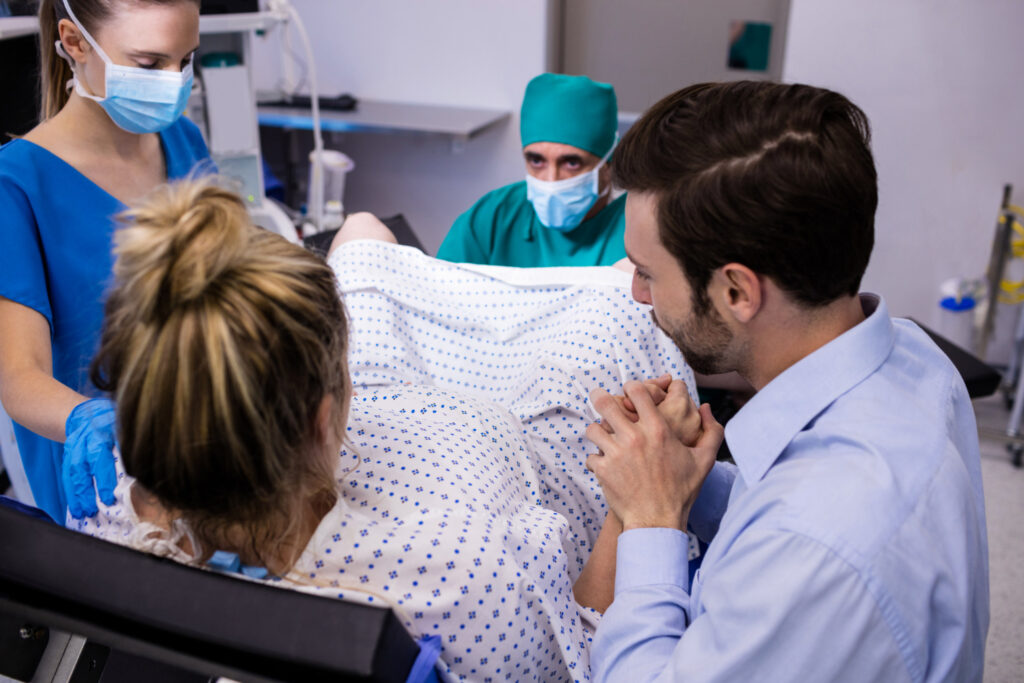
When Dr. Ozimek delivered the baby, the room held its breath. And then came the cry. Ryu Lopez entered the world weighing eight pounds. He had a full head of hair. He was, against every odd, alive. But the celebration lasted only seconds. Immediately after delivery, Lopez began hemorrhaging. Blood poured from the surgical site. Every second mattered.
Anesthesiologist Dr. Michael Sanchez had already powered up a special machine designed to deliver blood products at maximum speed. In the minutes that followed, the team used 11 units of blood to stabilize Lopez. For reference, a typical blood donation is about one pint, or one unit. Suze Lopez needed eleven.
The specialized training, the preparation, the machine that Sanchez had ready before the first incision, all of it saved her life. Meanwhile, in the Neonatal Intensive Care Unit, doctors assessed baby Ryu with cautious optimism. A baby who develops outside the uterus faces serious risks. Lung development was a primary concern. Would his lungs function? Would he be able to breathe on his own? Dr. Sara Dayanim, a neonatologist with Cedars-Sinai Guerin Children’s, had prepared for the worst. But Ryu surprised everyone.
He came out of anesthesia quickly. He was feisty. He fought. By the next day, doctors removed his breathing tube. Within two weeks, Ryu had hit every survival benchmark. He had defied every expectation.
A Guardian Angel in Scrubs
As Lopez recovered, one nurse became her constant companion. Carmen Chavez, assistant manager of the Maternal-Fetal Care Unit, checked on her constantly. She sat in on consultations with doctors, making sure Lopez and her family understood every piece of medical information during an overwhelming time. She even helped the family break the news about the pregnancy to Lopez’s teenage daughter, Kaila.
Lopez is a nurse herself. She knows what good care looks like. And she still calls Carmen Chavez her guardian angel. Sometimes healing is about more than medicine. Sometimes it is about a person who shows up, again and again, simply because they care.
A Gift Named Jesse
Andrew Lopez watched the entire delivery from inside the operating room. He saw what his wife endured. He saw his son emerge from an impossible situation.
When asked about the experience, he described it as both tough and amazing. His wife and son are both his miracles. Ryu’s middle name is Jesse, which means “gift from God.” Andrew chose that name for a reason.
For 17 years, he and Suze had prayed for a second child. For 17 years, the answer seemed to be no. And then, hidden behind a tumor, growing in a place where babies cannot survive, their answer finally arrived.
Every Day Is a Gift
Suze Lopez could have easily missed her miracle. If she had not scheduled that surgery. If she had skipped the routine pregnancy test. If she had assumed the positive result was just cancer or a false reading. If she had waited even a little longer to go to the hospital when the pain started. So many points where the story could have ended differently. But it did not.
When Lopez reflects on everything that happened, she does not focus on the medical odds or the rarity of her case. She focuses on something simpler. “I appreciate every little thing. Everything. Every day is a gift and I’m never going to waste it. God gave me this baby so that he could be an example to the world that God exists—that miracles, modern-day miracles, do happen.”
What Suze Wants You to Know
Life does not follow our timelines. It does not care about medical statistics or probability or what experts say is possible. Sometimes, after you have given up, after you have accepted that something will never happen, life surprises you in ways you could never predict.
Seventeen years is a long time to wait. Seventeen years is a long time to hope. Most people would have stopped believing. Most people would have closed that chapter and moved on. But somewhere in Suze Lopez’s body, without her knowledge, without any medical explanation, life persisted. A baby grew where babies cannot grow. A child survived what children do not survive.
Maybe you have been waiting for something for years. Maybe you have stopped believing it will ever happen. Maybe you have accepted that some doors are permanently closed. Read Suze Lopez’s story. Look at baby Ryu, healthy and thriving after an impossible beginning. And then ask yourself if maybe, just maybe, the story is not over yet.