

What If the Universe Feels Faster Because We’re Sitting in a Cosmic Hole?
There are moments when science stops feeling like numbers and equations and starts feeling personal. Moments when discoveries about the universe do not just change what we know, but quietly question how we see ourselves within it. This is one of those moments.
For nearly a century, humanity has believed it was slowly unraveling the story of how the universe expands. Yet today, astronomers find themselves facing a cosmic contradiction, one that suggests the universe may be behaving differently depending on where you stand. And unsettlingly, it raises a deeper question. What if the universe feels like it is speeding up because of where we are?
According to new research shared at the Royal Astronomical Society’s National Astronomy Meeting in Durham, Earth and the entire Milky Way may sit inside a vast cosmic void, a massive region of space that is emptier than the rest of the universe. Not a hole in the dramatic sense, but a subtle absence. A quiet imbalance. And that absence might be distorting how we perceive the universe’s expansion.
This idea does not just challenge a long standing scientific tension. It invites us to reflect on something more human. How perspective shapes reality, and how location, cosmic or personal, can change the story we think we are living in.
The Hubble Tension: When Measurements of the Universe Disagree
In 1929, astronomer Edwin Hubble introduced what would become one of the most important ideas in modern cosmology: the universe is expanding. The rate of that expansion is described by the Hubble constant, a number meant to tell us how fast galaxies are moving away from each other.
But here is the problem. When scientists calculate this number by looking at the early universe using relic light left over from the Big Bang, they get one answer. When they measure the expansion by observing nearby galaxies in the more recent universe, they get a faster one. Both methods are precise. Both are trusted. Yet they do not agree.
This discrepancy is known as the Hubble tension, and it has become one of the most persistent puzzles in cosmology. For years, scientists have debated whether it points to unknown physics, hidden errors, or something even more fundamental about how we understand the universe.
Now, a growing body of evidence suggests the explanation might be simpler and more unsettling than expected.
How an Empty Region Could Skew Expansion
At its core, the local void hypothesis is not about rewriting the laws of the universe, but about reexamining the environment in which our measurements are made. It proposes that our region of space is not representative of the universe as a whole, and that this difference in environment subtly shapes what we observe.
In this scenario, the Milky Way resides within a large scale region of lower matter density. Because gravity responds to differences in density, matter does not remain evenly distributed. Instead, material slowly migrates away from emptier regions and toward denser surrounding areas. Over long periods of cosmic time, this process accentuates the contrast between the void and its exterior.
The consequence is not a change in the fundamental expansion of the universe, but a change in local motion. Galaxies within the void experience an additional outward velocity caused by gravitational imbalance. This motion is layered on top of the overall cosmic expansion and affects observations made from within the void itself.
What makes this hypothesis distinct is its restraint. It does not invoke new particles, unknown forces, or revisions to gravity. It relies entirely on known physics applied to an uneven cosmic landscape. The implication is simple but profound. Measurements made from a non average region of space may carry a built in bias, even when the instruments and methods are precise.
If correct, the local void hypothesis reframes the question entirely. The issue is no longer whether our equations are wrong, but whether our vantage point is incomplete. It suggests that understanding the universe requires not only better measurements, but a clearer awareness of where those measurements are made.
Using the Big Bang’s Echo as a Cosmic Ruler
What gives this idea weight is not speculation, but data—specifically, ancient sound waves known as baryon acoustic oscillations, often described as the “sound of the Big Bang.”
These sound waves traveled through the hot plasma of the early universe for a brief time before becoming frozen in place as the universe cooled and neutral atoms formed. Today, they act as a kind of cosmic ruler, allowing astronomers to measure how the universe has expanded over time.
Dr. Banik explains their importance: “They act as a standard ruler, whose angular size we can use to chart the cosmic expansion history.”
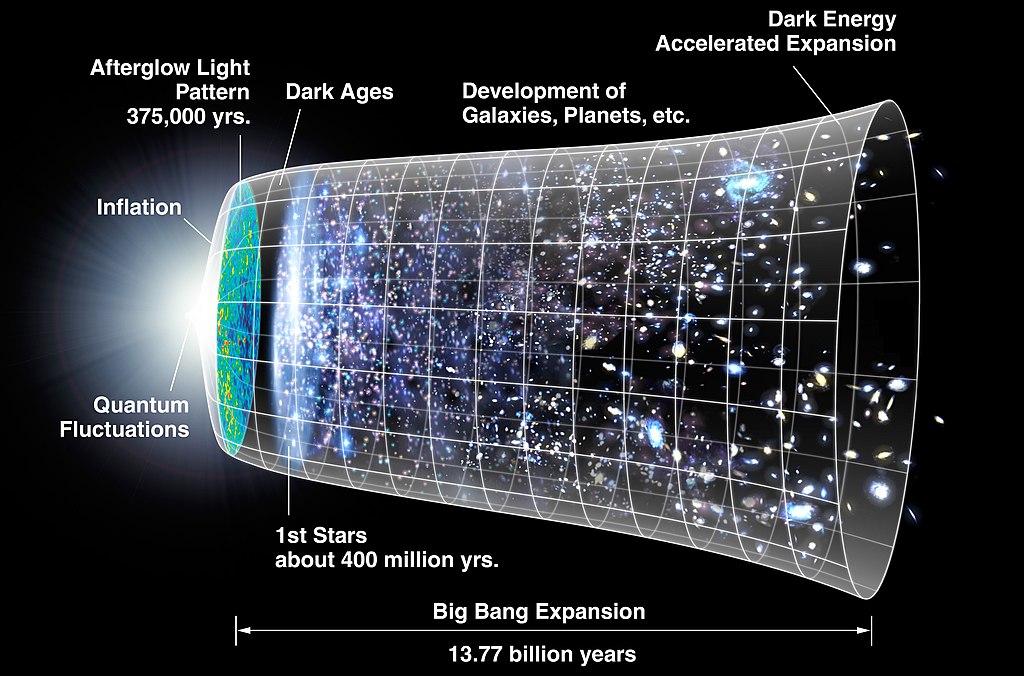

New analysis presented at the 2025 meeting shows that when scientists account for a local void, the relationship between these sound waves and observed redshifts begins to make sense. The void slightly distorts how we interpret distance and motion, adding an extra redshift caused by gravitational effects on top of the expansion itself.
After examining all available baryon acoustic oscillation measurements from the past 20 years, the results were striking. According to the research, a void-based model is “about one hundred million times more likely than a void-free model” designed to match observations from the Planck satellite.
That’s not a subtle preference. That’s a dramatic shift.
Why a Massive Void Challenges the Standard Model
The standard model of cosmology is built on a simple expectation that when you zoom out far enough, the universe should look broadly similar in every direction. Matter can clump on small and medium scales, but on the largest scales those differences should average out. This idea is not a philosophical preference. It is a practical foundation that allows cosmologists to translate observations from one region into conclusions about the universe as a whole.
A void large enough to influence our measurements pushes directly on that foundation. Modern cosmology, including the Lambda Cold Dark Matter framework, does predict voids because gravity amplifies small early irregularities into today’s cosmic web. But it also predicts limits on how extreme these voids should be over very large distances. The larger the region you consider, the more the model expects fluctuations to smooth out. A region on the order of a billion light years across that is also significantly underdense is unusual enough that it forces researchers to ask whether it is a rare statistical outlier or a sign that some modeling assumptions need refinement.
There is also a consistency challenge that comes with scale. A void of this size would not only affect local recession speeds. Any large departure from average density can leave fingerprints across several kinds of observations, because the distribution of matter shapes gravity, and gravity shapes how light and motion are perceived over vast distances. This is why the debate is not only about whether a void could exist, but whether it can exist without creating new mismatches elsewhere in the standard picture.
That is the real reason the idea remains controversial even when it seems to relieve one pressure point. The standard model is not one equation. It is a connected system. If you introduce a very large local departure from average density, you gain a possible explanation for a specific discrepancy, but you also take on a demanding burden of proof. The broader network of observations still has to remain coherent. The challenge is to show that a massive local void can fit inside the standard model without weakening the overall consistency that made the model successful in the first place.
An Independent Way to Trace Expansion
To further test the void hypothesis, researchers are turning to another method called cosmic chronometers.
This approach involves studying galaxies that have stopped forming stars. By analyzing their light, astronomers can determine the types of stars they contain and estimate their ages. Massive stars burn out quickly, so their absence reveals how long a galaxy has existed in its current state.
When scientists combine a galaxy’s age with its redshift, which refers to how much its light has been stretched during its journey, they can calculate how much the universe has expanded during that time. This provides an independent record of cosmic expansion that can confirm or challenge the void model.
It is a patient method. A quiet one. Sometimes the universe only reveals its secrets to those willing to listen carefully.
From Cosmology to Consciousness: Why Perspective Matters
Here’s where this story stops being just about astronomy and starts becoming something more reflective.
If we truly live inside a cosmic void, then our measurements of the universe are shaped by absence. By what isn’t there. And that idea feels deeply human.
How often do we misjudge our lives because of where we’re standing? How often does our environment—our upbringing, our culture, our pain—warp how fast things feel like they’re moving, how heavy life seems, how urgent everything becomes?
From inside the void, the universe looks like it’s rushing away. But step outside that perspective, and the story changes.
Standing Still While the Universe Teaches
This research does not claim to have the final answer. Science rarely does. Instead, it reminds us that certainty often dissolves when we widen our view.
The universe may be 13.8 billion years old. It may be expanding at a steady pace. Or it may be teaching us something subtler. Context matters, and even the most precise measurements are shaped by where they are made.
As we continue to explore the cosmos, perhaps the deeper lesson is this. Before we assume reality is speeding out of control, we should ask where we are standing.
Because sometimes the universe is not moving faster.
We are simply inside a quiet space that makes everything feel that way.
Featured Image from Shutterstock