


Doctors Just Found Something Strange in the Blood of Long COVID Patients — And It Could Change Everything
There are moments in science when something hidden finally comes into view.
For millions of people living with Long COVID, people who have been told their fatigue is stress, their brain fog is anxiety, their symptoms are psychological, this moment may feel different. Because now, researchers are pointing to something tangible. Something physical. Something visible under a microscope.

Doctors have identified unusual microscopic structures in the blood of patients with Long COVID. And if the findings continue to hold up under further research, they could reshape how we understand and treat this condition.
This is not hype. It is early science. But it is science that demands attention.
The Hidden Structures Lurking in the Blood
The researchers set out to answer a focused question: is there a measurable blood based difference between people with Long COVID and healthy individuals. They analyzed samples from 50 Long COVID patients and 38 healthy volunteers drawn from two separate cohorts in France and South Africa, strengthening the reliability of the comparison.
Using imaging flow cytometry and fluorescence microscopy, they examined blood components at a microscopic level to identify structural abnormalities. Their analysis centered on microclots, which can exist at low levels in healthy individuals but become concerning when elevated in number and size.
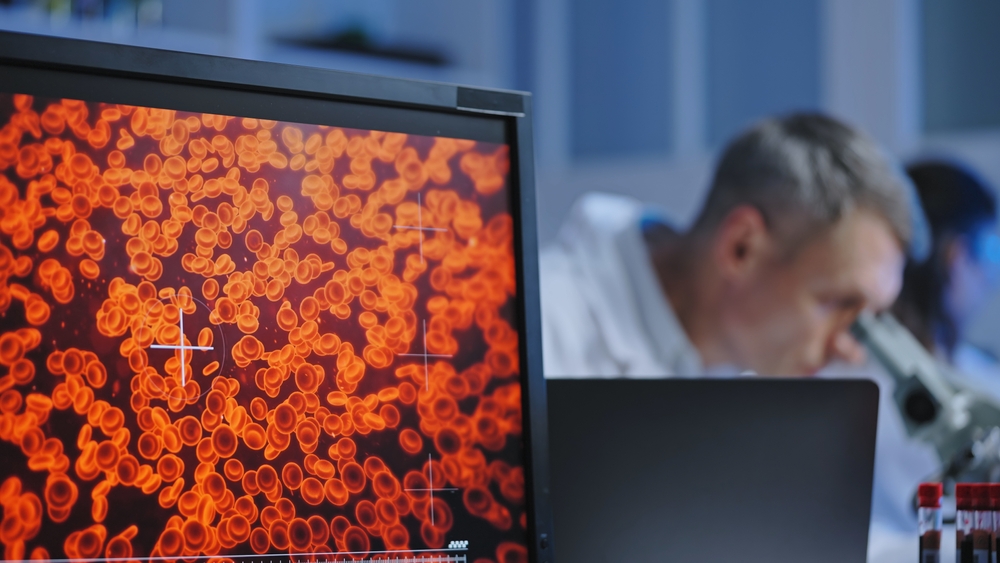
In the Long COVID group, microclots were markedly increased, showing a 19.7 fold rise on the median compared with healthy controls. The clots were also larger. This is not a subtle shift. It is a measurable divergence between groups.
Microclots operate at the level of capillaries, the smallest blood vessels responsible for oxygen and nutrient exchange. Even small obstructions at this scale can interfere with tissue level function when widespread. The findings do not yet establish causation, but they do establish association. For a condition often described as invisible, the researchers documented a consistent, physical pattern in the blood.
DNA Webs That Should Not Be There
But the story does not stop with microclots. Researchers also observed elevated levels of NETs, sticky webs of DNA and enzymes released by neutrophils, a type of white blood cell. NETs are not inherently harmful. In fact, they are part of the immune system’s defense strategy. They trap and neutralize pathogens.
Under normal circumstances, NETs are deployed and then quickly dismantled. However, when they persist or are overproduced, they can contribute to clotting and inflammation. The most surprising discovery was that the NETs appeared to be physically embedded within the microclots.

This association had not previously been documented in this specific context. Some interaction between NETs and clotting is expected because the sticky mesh facilitates clotting. But the effect was much more pronounced in patients with Long COVID.
Geneticist Alain Thierry, who led the study, explained in the published paper, “This finding suggests the existence of underlying physiological interactions between microclots and NETs that, when dysregulated, may become pathogenic.”
In other words, when the body’s defense system becomes unbalanced, what was once protective may turn harmful.
Why These Clots May Be So Hard to Break Down
The concern is not only that microclots appear more frequently, but that their composition may make them unusually resistant to removal. In normal clotting, fibrinogen is converted into fibrin, forming a mesh that is later dismantled through fibrinolysis. In Long COVID, however, research from Dr. Etheresia Pretorius’s group indicates that the fibrin involved may adopt an amyloid form, a misfolded protein structure that is inherently more resistant to breakdown.
When fibrin takes on this amyloid architecture, it becomes more rigid and less responsive to the enzymes responsible for clot dissolution. Evidence also suggests that components of SARS CoV 2 can interact directly with fibrinogen and fibrin, promoting amyloid like structures and delaying plasmin action, a key step in fibrinolysis. In addition, microclots have been reported to trap alpha 2 antiplasmin, a natural inhibitor of clot breakdown, further slowing clearance.
Taken together, this points to a layered resistance: altered clot structure combined with interference in the normal enzymatic process that dissolves clots. The body may still clear these microclots gradually, but at a much slower rate than typical fibrin clots. That persistence offers a biologically plausible explanation for how symptoms could endure even after the acute infection has resolved.
The Diagnostic Breakthrough: 91 Percent Accuracy
The researchers did more than document structural differences. After anonymizing the samples, they used an artificial intelligence system to determine whether the microclot and NET related features could distinguish Long COVID patients from healthy individuals. The system identified patients with 91 percent accuracy.
This level of classification suggests a consistent biological signature rather than random variation. For a condition that often lacks clear laboratory confirmation, that distinction is significant. It points toward the possibility of a biomarker based diagnostic approach grounded in measurable thromboinflammatory patterns.

As the study authors wrote, “This study shows a robust association between biomarkers indicative of thromboinflammatory activity and long COVID.” They continued, “The discovery of these biomarker linkages not only presents a possible novel diagnostic methodology but also novel therapeutic targets, offering prospects for future markedly improved clinical management.”
If validated in larger populations, this framework could support objective diagnosis and more precise clinical research design, moving Long COVID closer to standardized medical evaluation.
What This Means And What It Does Not
Scientific progress often moves in increments rather than leaps, and this study represents a meaningful increment rather than a final answer. The findings establish a measurable thromboinflammatory pattern in Long COVID, but they do not yet define a single unifying mechanism or confirm that altering these blood features will automatically reverse symptoms. Association provides direction for investigation, not proof of direct causality or immediate clinical translation.
The current data are based on a defined sample size and specific laboratory techniques, which means replication in larger and more diverse populations is essential. Independent validation will determine how stable these biomarker patterns remain across age groups, severities of illness, time since infection, and coexisting medical conditions. Without that broader confirmation, the findings remain promising but preliminary.

Therapeutically, interest in targeting clotting and platelet pathways is growing, yet large scale randomized clinical trials are still lacking. Early exploratory studies have reported symptom improvement in some patients using carefully monitored anticoagulant and antiplatelet strategies, but these approaches carry real bleeding risks and cannot be generalized without rigorous safety data. In addition, interventions that rapidly restore blood flow must consider the possibility of reperfusion related oxidative stress, which can complicate recovery in vulnerable tissues.
A Larger Reflection: Listening to Invisible Illness
When a condition leaves no clear signal on standard testing, patients often face doubt alongside their symptoms. Long COVID has exposed that gap between lived experience and measurable evidence, echoing patterns seen in other chronic inflammatory and fatigue related illnesses where clinical tools have lagged behind biology. The identification of consistent blood based abnormalities does not solve the condition, but it narrows that gap and reinforces that persistent symptoms warrant investigation rather than dismissal.
Medical understanding advances by improving detection, not by assuming absence when tools fall short. As methods become more precise, patterns that once escaped notice can enter clinical focus. The emergence of reproducible thromboinflammatory features suggests that part of Long COVID operates at a scale standard evaluations were not designed to capture. That shift strengthens the case for continued research, careful listening, and a disciplined commitment to evidence as it evolves.
What You Can Do Right Now
If you are living with persistent symptoms after COVID 19 infection, this research offers something powerful: evidence that your experience may have measurable biological underpinnings.

But beyond validation, there are practical steps grounded in broader inflammation science that may support recovery while research continues:
- Work with qualified medical professionals. Emerging treatments targeting clotting pathways must be medically supervised due to bleeding risks.
- Support cardiovascular and metabolic health. Regular, physician approved movement and nutrition strategies that reduce systemic inflammation are foundational.
- Manage stress physiology. Chronic stress amplifies inflammatory pathways. Practices such as sleep optimization, breathwork, and evidence based stress reduction can support immune balance.
- Stay informed from credible sources. Follow peer reviewed research and established medical institutions rather than anecdotal cures.
These are not quick fixes. They are long term investments in resilience.
The Deeper Lesson
This research marks a shift in perspective. An infection may resolve, yet its effects can persist within immune and vascular systems that recalibrate slowly and sometimes imperfectly. What lingers is not imagined weakness but measurable imbalance that requires careful study rather than assumption.
The value of these findings lies in disciplined observation. Subtle molecular changes, when sustained, can shape daily function in significant ways. Identifying consistent blood based abnormalities reframes Long COVID as a condition anchored in detectable physiology, not abstraction.
Scientific progress depends on refining what can be measured. As patterns move from invisible to observable, they move from speculation to investigation. That transition does not complete the story, but it grounds it, and grounded understanding is where meaningful medical progress begins.
What this means, then, is that the field is moving toward measurable biology and away from abstraction. What it does not mean is that a standardized test or universally accepted treatment is already in place. The research provides a structured framework for future studies, offering a pathway toward clearer diagnostics and safer targeted therapies, but the work of confirmation and refinement is still ahead.
Featured Image from Shutterstock