


They Weren’t Supposed to Help—But What These Dolphins Did Changed How We See Compassion Forever
There are moments in life that don’t just inspire you, they interrupt you. They stop your routine thinking, your привычка of seeing the world in black and white, and they whisper something deeper: maybe we have been wrong about what it means to care.
Out there, far from our cities and screens, in the vast silence of the ocean, a story unfolded that did not ask for attention but demanded reflection. No headlines, no applause, no social media posts. Just a choice. A choice to protect. A choice to show up. A choice that did not benefit them in any obvious way. And if I am being honest with you, it raises an uncomfortable question: If they can do this, what is stopping us?
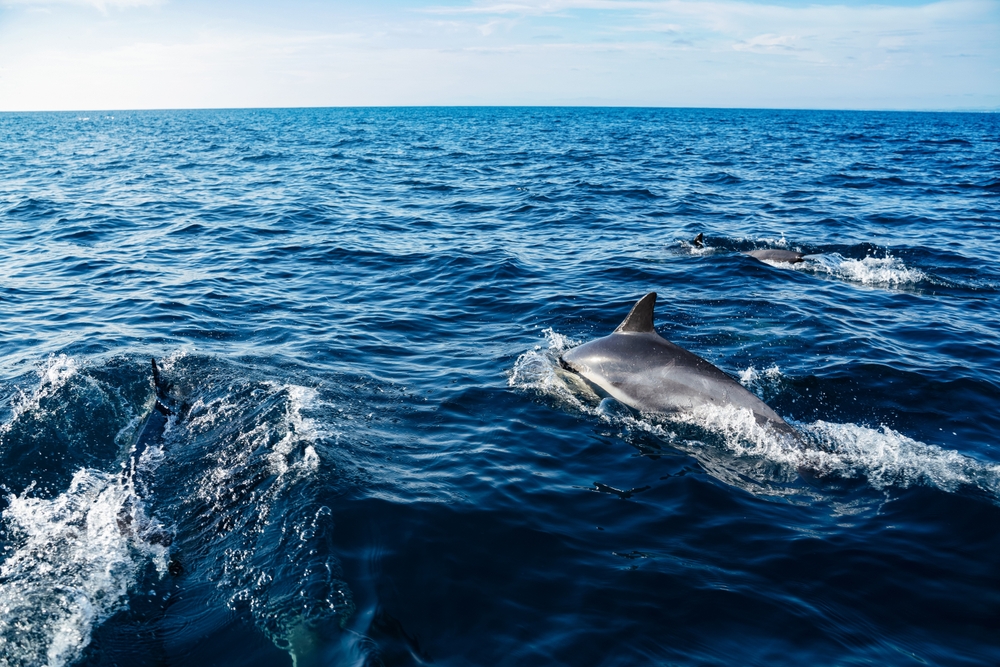
The Day Compassion Interrupted Survival
Off the southwest coast of Western Australia, in Flinders Bay, a mother humpback whale named Spirit was swimming with her calf. This stretch of ocean is part of a well documented migratory route for humpback whales, where mothers often travel with newborn calves toward safer, warmer waters after giving birth. According to the National Oceanic and Atmospheric Administration, these early stages of a calf’s life are among the most vulnerable, as young whales rely heavily on their mothers for protection and nourishment while they build the strength to survive long migrations.
That context matters, because what unfolded was not just a random encounter, it was a collision between two powerful biological drives. On one side was maternal investment, a mother sustaining and defending her offspring through one of the most fragile stages of life. On the other was reproductive competition, where adult males seek to maximize mating opportunities, sometimes at extreme cost to existing calves. Scientists have documented that such aggression, while difficult to witness, is part of mating strategies observed in several mammal species, including whales, where eliminating a calf can bring a female back into estrus sooner.
In that moment, Spirit’s response was not hesitation but resistance. She placed her body between the incoming males and her calf, using positioning and movement to absorb pressure and redirect attention away from the young whale. This was not about winning a fight in the traditional sense, it was about buying time, creating space, and sustaining just enough control to keep her calf alive in a situation where the odds were not in her favor. And just when it seemed like strength alone would be stretched to its limit, the situation was on the edge of shifting in a way no one present could have predicted.
When Strangers Became Guardians
From a distance, a pod of dolphins moved in with unusual speed and direction, not wandering or foraging but converging on a developing conflict. Observers from Whale Watch WA described how the animals closed the gap and immediately began positioning themselves between the adult males and the mother with her calf, forming what appeared to be a deliberate defensive front. This type of spatial organization has been documented in dolphin behavior, where individuals align and adjust their spacing in response to perceived threats, creating a moving barrier that limits access and disrupts momentum. Research on dolphin group dynamics has shown that such coordinated positioning is not random but relies on real time awareness of both companions and external actors.
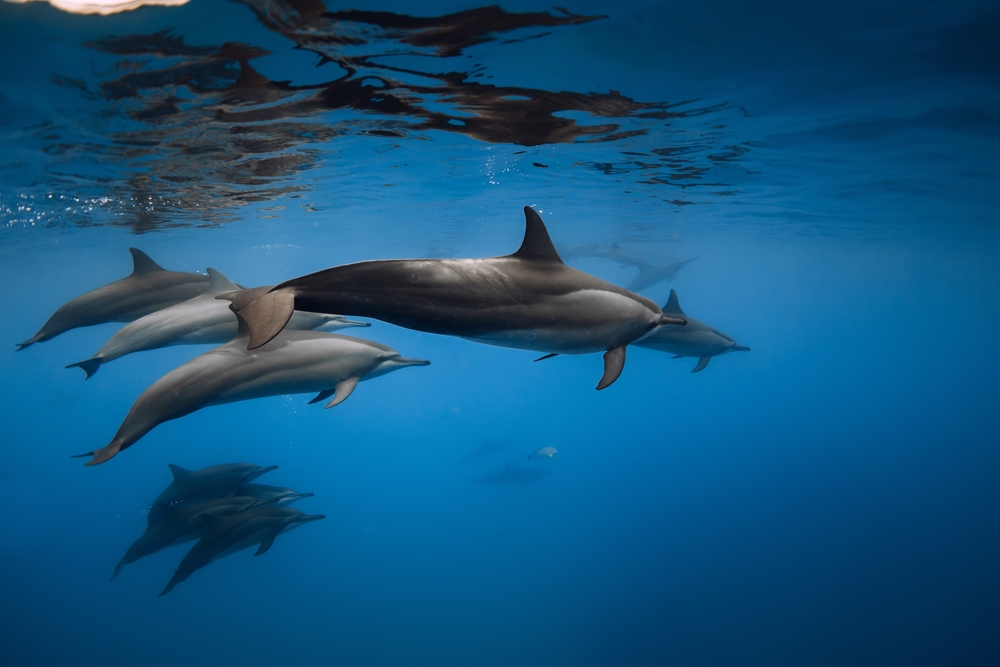
What stands out in this encounter is not only the presence of the dolphins but the precision of their movement. They did not scatter or react individually. Instead, they held formation, adjusted their orientation as the whales shifted, and maintained proximity to the vulnerable pair without escalating the situation into direct physical conflict. Some displayed open mouth gestures, a known signal in dolphin communication that can function as a warning or assertion in tense interactions. The effect was not immediate domination but disruption, creating enough instability in the advancing group to slow the encounter and alter its trajectory.
The sequence unfolded under direct human observation, captured on video and later described as highly unusual for interspecies interaction at this scale. As the dynamic changed and the pursuing whales lost cohesion, the dolphins maintained their positions until the pressure eased, then gradually withdrew without lingering. There was no prolonged engagement and no sign of opportunistic behavior. Their intervention was contained, targeted, and time bound, suggesting a response calibrated to the situation rather than an ongoing involvement, and leaving behind a moment that continues to challenge how we interpret intention in the natural world.
The Line Between “Us” and “Them” Is Thinner Than We Think
We have long organized the world into clean divisions that make it easier to understand but harder to question. Human and animal. Thought and instinct. Choice and reaction. These categories create a sense of distance that allows us to believe that what we feel and decide is fundamentally different from what exists elsewhere in nature. Yet moments like this do not simply challenge that belief, they expose how fragile it is when placed against observable behavior. When animals repeatedly respond to situations in ways that appear structured, situationally aware, and directed toward another being’s safety, the line we draw begins to look less like a boundary and more like an assumption.
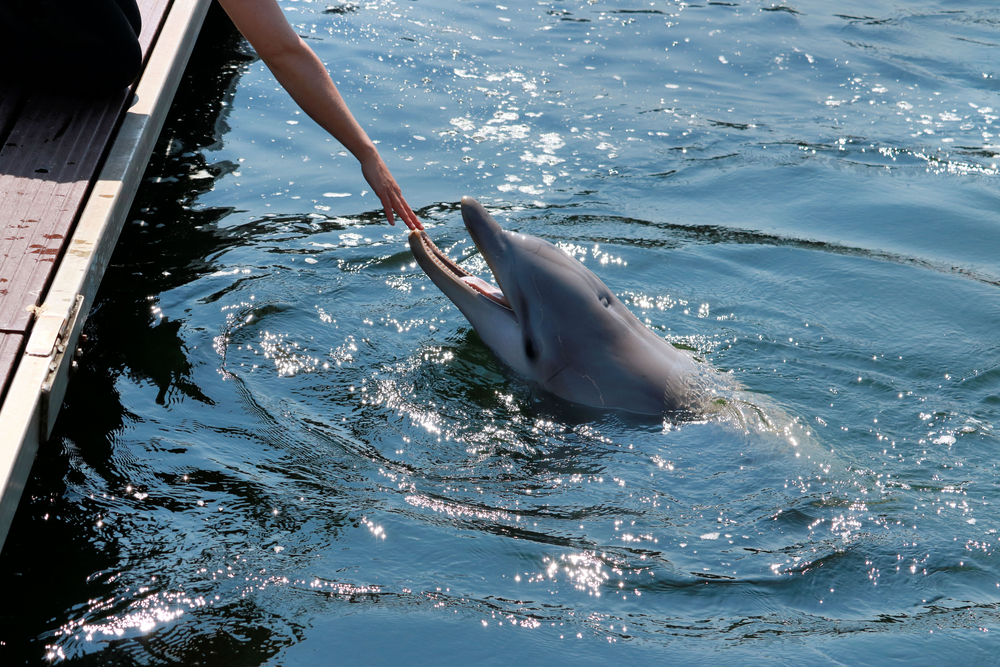
This is not based on a single story. In New Zealand, swimmers once reported being surrounded by dolphins that formed a tight, rotating circle around them as a great white shark moved nearby. The dolphins maintained that formation, keeping the swimmers close together until the threat passed, only then dispersing. The event was widely reported and investigated, adding to a growing number of documented cases where dolphins intervene in ways that cannot be easily explained as coincidence or simple curiosity. Encounters like this do not rely on speculation alone. They are observed, recorded, and revisited, forming a pattern that forces a more careful interpretation.
What makes these moments difficult to dismiss is not just what happens, but how consistently similar the responses appear across different situations. The behavior reflects recognition of risk, adjustment to that risk, and sustained engagement until the situation changes. That sequence suggests more than reflex. It points toward a level of perception that challenges the idea that meaningful response belongs only to humans. When we look closely, the difference between us and them does not disappear, but it becomes far less absolute than we once believed.
What Science Can Explain… and What It Can’t
Science offers frameworks that help us interpret behavior without assigning human emotion too quickly. Researchers studying dolphins point to neurobiology and cognition, noting that dolphins possess large, highly developed brains with regions associated with social processing, memory, and decision making. This allows them to interpret complex situations, track multiple moving agents, and adjust their behavior in real time. Rather than reacting blindly, dolphins can evaluate context, which may explain how they identify moments of imbalance or vulnerability and respond in ways that appear structured and intentional. Their sensory world also differs from ours, as echolocation provides a detailed perception of movement and internal states, giving them access to information that shapes how they interpret risk in ways we are only beginning to understand.
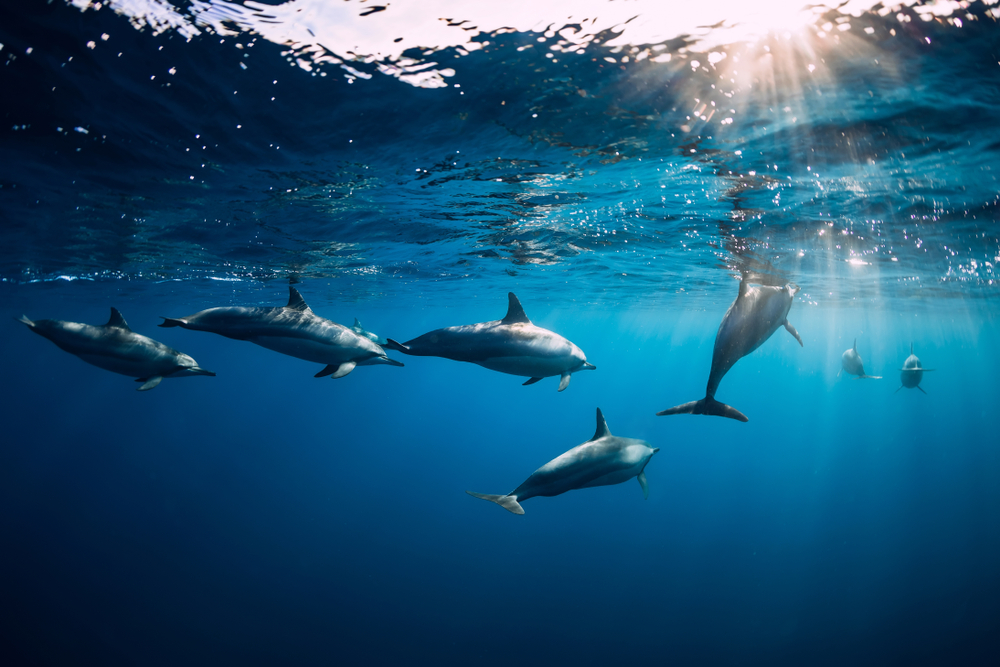
At the same time, science remains cautious about assigning motives such as empathy or morality in the human sense. What it can confirm is pattern and consistency. Across documented observations, dolphins demonstrate flexible responses that adapt to changing conditions, sustain focus until a situation resolves, and involve coordinated participation rather than isolated action. These features suggest a level of behavioral complexity that sits somewhere between instinct and deliberate choice, a space where interpretation becomes less certain. What remains unresolved is not whether dolphins can act in ways that resemble care, but how we define that care without projecting ourselves onto it. The uncertainty does not weaken the observation. It sharpens it, reminding us that understanding does not always arrive with clear boundaries, and that some of the most important questions remain open not because they lack evidence, but because they challenge the limits of how we explain behavior itself.
Rethinking What It Means to Be “Advanced”
We have been taught to measure advancement through output. What we build, how fast we innovate, how efficiently we solve problems. Progress becomes visible in infrastructure, in data, in systems that scale. But this way of measuring intelligence leaves out something quieter and far more difficult to quantify: how a being responds when there is nothing to gain. Across disciplines, from cognitive science to behavioral ecology, there is growing recognition that intelligence is not only about problem solving but about flexibility, awareness, and the ability to navigate complex social environments. Studies on animal cognition increasingly show that many species are capable of cooperation, role differentiation, and context dependent responses that cannot be reduced to simple stimulus and reaction.
What this suggests is not that humans are less advanced, but that our definition may be incomplete. If intelligence includes the ability to perceive vulnerability, adjust behavior accordingly, and sustain that response without immediate reward, then it expands beyond tools and technology into something relational. The challenge is not to romanticize animal behavior or project human values onto it, but to recognize that the capacity for meaningful response exists on a broader spectrum than we once assumed. When we shift our definition in this way, advancement is no longer just about what we create, but about how we choose to engage with the world around us.
A Mirror We Can’t Ignore
This is where the story turns toward us. Not as observers, but as participants in the same moral landscape. The contrast is quiet but difficult to ignore. While dolphins respond without hesitation, we often pause even when the cost of helping is small. We learn to distance ourselves from what does not directly affect us, to assume that someone else will act, to treat compassion as optional rather than essential. Yet at its core, compassion is not about convenience. It is about recognition. It is the moment you see vulnerability and decide it matters, even when there is no obligation, no shared identity, and no immediate reward. The dolphins did not share species, language, or stakes with the whale, but they recognized something and chose to respond. The question that remains is not what they did, but what we choose to do when faced with our own moments of awareness.
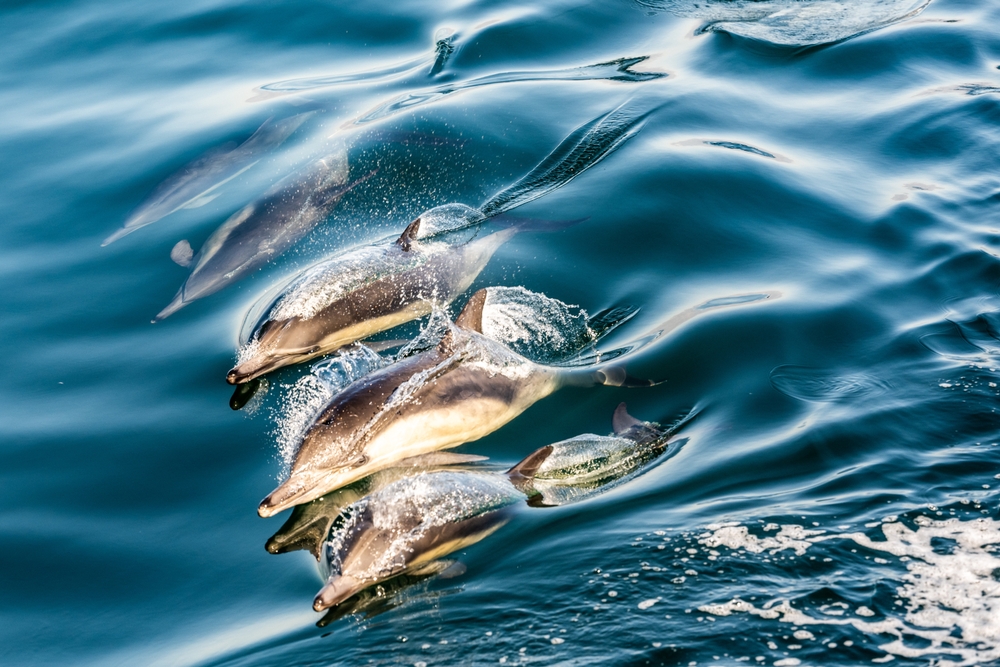
At the same time, the story extends beyond a single act into a broader responsibility. The same species capable of protecting others now faces growing threats shaped by human activity. Ocean ecosystems are being altered by overfishing, plastic pollution, chemical runoff, and persistent industrial noise that disrupts the very sensory systems dolphins rely on to navigate and communicate. These pressures do not exist in isolation. They reshape the conditions that make balance and survival possible, affecting not only dolphins but entire marine networks connected to them. To protect dolphins is to protect the integrity of those systems and the future of the interactions they sustain. It is a reminder that responsibility is not abstract. It is expressed through choices that either preserve or erode the environments where life, in all its complexity, continues to unfold.
The Moment You Decide Not to Look Away
Somewhere in the ocean, a mother and her calf are alive because a group of dolphins chose to act without hesitation, without reward, and without being asked. That is not just a story to admire, it is a standard to confront. We often wait for the perfect moment, the right conditions, or a clear benefit before we step in, but the truth is far simpler and far more demanding. Change does not begin with certainty, it begins with a decision. A decision to recognize what is in front of you, to refuse indifference, and to act even when no one is watching. In a world that constantly pulls our attention away from what matters, the real question is not whether compassion exists, but whether we are willing to practice it. Because in the end, the difference between the world we have and the world we want may come down to a single choice we face again and again: to look away, or to step forward.
Featured Image from Shutterstock