
Woman Responds After Being Shamed for Using Disabled Parking With Her Ill Son
It was meant to be just another hospital visit. For Emma Doherty, these visits were not unusual. They were part of a routine shaped by necessity rather than choice, filled with early mornings, long waits, and the quiet emotional endurance that comes with caring for a seriously ill child. Over time, she had learned how to move through these days with strength, even when things felt overwhelming.
But on this particular day, something unexpected was waiting for her in the parking lot. Something small in size, yet powerful enough to shake her completely.
When Emma returned to her car after taking her young son to Alder Hey Children’s Hospital in Liverpool, she noticed a handwritten note placed on her windshield. At first glance, it may have seemed like any other note someone might leave behind. But as she read the words, it quickly became clear that this was something else entirely.
It was not a polite question. It was not even a misunderstanding expressed with hesitation. It was a direct accusation, written with anger and certainty by someone who believed they knew exactly what had happened.
In that moment, after everything she had already been carrying, the weight of those words hit harder than expected.
A Harsh Judgment From a Stranger
The note accused Emma of misusing a disabled parking space. It claimed that she did not have a disabled person with her and suggested that she was taking advantage of a system meant to support others.
The language was aggressive and personal. It reflected a strong sense of frustration, but also a complete lack of understanding about the situation. The person who wrote it had made a decision about Emma based solely on what they saw in a brief moment.
This kind of reaction is not rare. In busy parking lots, especially near hospitals or shopping areas, accessible spaces are often limited. People can feel protective of them, particularly if they or someone they know relies on those spaces. Seeing someone park there without obvious signs of disability can trigger immediate judgment.
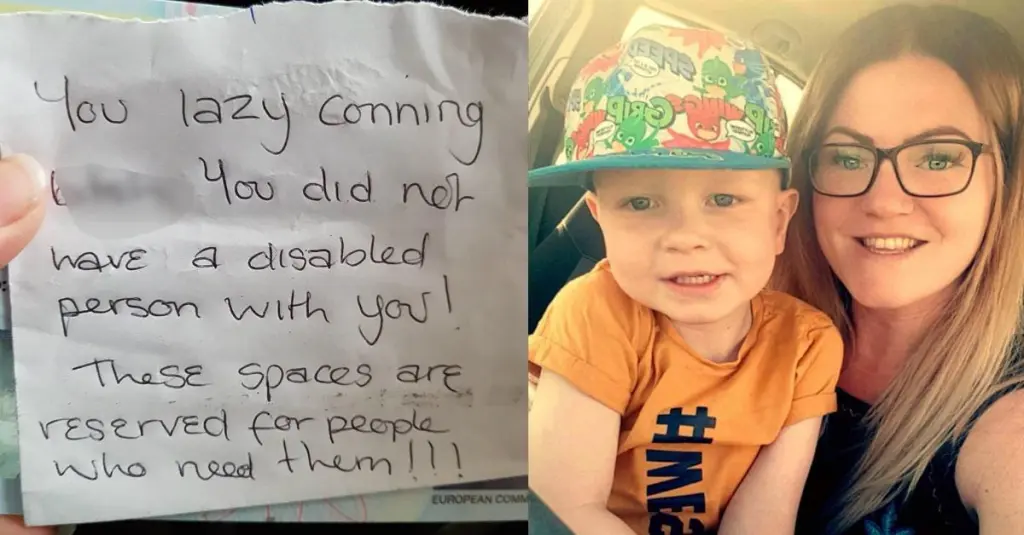
Image Credits: Facebook @emmadoherty
It is a reaction that many people recognize. There is a common belief that disability should be visible. If it is not, doubt can quickly take its place. That doubt can turn into frustration, and in some cases, into confrontation.
But what Emma experienced shows how quickly that instinct can go wrong.
The Reality Behind the Moment

What the person who left the note did not know was that Emma’s three year old son, Bobby, was seriously ill. His condition was not simple or temporary. It was complex, ongoing, and life changing for both him and his mother.
In his short life, Bobby had already undergone more than fifteen operations. These included three open heart surgeries, procedures involving his stomach, lungs, and diaphragm, and numerous interventions to support his arteries and circulation. He had suffered strokes that left him temporarily paralyzed and had experienced complications affecting his brain and physical development.
Much of his life had been spent in hospital settings. Intensive care units had become familiar environments. Machines, monitors, and medical teams were part of his everyday reality. For Emma, this meant constant vigilance, emotional resilience, and the responsibility of making difficult decisions about her child’s care.
Despite all of this, Bobby did not always appear visibly disabled. On some days, he could walk short distances. He could smile, play, and show glimpses of a childhood that looked, from the outside, relatively typical. To a stranger passing by, there might be no immediate sign that anything was wrong.
That contrast between appearance and reality is what made the situation so painful. The note was not just incorrect. It dismissed an entire lived experience that the writer had not taken the time to consider.
When Disability is Not Visible

Emma addressed this misunderstanding directly in her response. She explained that not all disabilities are visible and that not everyone who qualifies for a disabled badge needs to use a wheelchair at all times.
This is a point that often goes overlooked. Disability is not a single, fixed experience. It exists on a spectrum, with different conditions affecting people in different ways. Some individuals rely on mobility aids constantly, while others may only need them occasionally. Some conditions are external and obvious, while others are internal and invisible.
In Bobby’s case, his heart condition and overall health meant that even short distances could be exhausting or risky. While he might be able to walk for a brief period, that did not mean he could safely manage longer distances without strain.
On the day the note was left, Emma had chosen to carry him instead of using his wheelchair. They were running late after a series of medical tests, including scans that had already taken a toll on both of them. It was a decision made in a moment of urgency, not a reflection of his needs.
This detail is important because it highlights how easily situations can be misinterpreted. A single snapshot of someone’s life does not reveal the full picture. Without context, even well intentioned assumptions can become harmful.
The Emotional Weight of the Experience

Emma later shared that the note affected her more deeply than she expected. She described feeling upset rather than angry, pointing to the ignorance behind the message as the most painful aspect.
Caring for a child with a serious illness comes with an emotional burden that is difficult to describe. There are moments of fear, uncertainty, and exhaustion that accumulate over time. Parents in these situations often learn to push forward, focusing on what needs to be done while setting aside their own feelings.
But the note brought those feelings to the surface. It was a reminder that, on top of everything else, she was also being judged by people who had no understanding of her situation.
Emma also revealed that this was not the first time she had experienced this kind of reaction. She had noticed people staring or whispering as she and Bobby walked from their car. There was often an unspoken question in the air, a sense that others were trying to figure out whether she truly belonged in that space.
Over time, these small moments can add up. Each look, each whisper, and each assumption contributes to a feeling of being watched and evaluated. For someone already dealing with significant challenges, that added pressure can be overwhelming.
Turning Pain Into a Message

Instead of keeping the experience to herself, Emma chose to speak out. She shared a photo of the note on Facebook along with a detailed explanation of her situation. Her post was honest, emotional, and direct.
She described Bobby’s medical history, outlining the surgeries and complications he had faced. She also addressed the assumptions behind the note, making it clear that not all disabilities are visible and that people should think carefully before judging others.
Importantly, she acknowledged that she did not owe anyone an explanation. Her decision to share her story was not about justifying herself. It was about raising awareness and challenging a mindset that affects many people.
Her words resonated because they were grounded in real experience. They were not abstract or theoretical. They came from a place of lived reality, shaped by years of navigating a difficult situation.
A Story That Resonated Widely

After being shared online, Emma’s post quickly gained attention. Thousands of people reacted to it, with many expressing support and empathy. The story spread across social media platforms, reaching audiences far beyond her immediate network.
Many individuals shared their own experiences of being judged because their disabilities were not visible. Parents spoke about similar situations involving their children. Others reflected on how they had previously made assumptions and how this story had changed their perspective.
The response highlighted how widespread this issue is. It is not limited to one person or one situation. It is part of a broader pattern in how society understands and reacts to disability.
At the same time, the story created an opportunity for learning. It encouraged people to reconsider their instincts and to approach situations with more caution and empathy.
The Importance of Empathy in Everyday Moments
One of the key lessons from this story is the importance of empathy. The person who left the note may have believed they were acting in the interest of fairness. They may have thought they were protecting a space meant for those in need.
However, their actions were based on incomplete information. Instead of helping, they caused harm to someone already dealing with a difficult situation.
Emma’s response encourages a different approach. It suggests taking a moment to consider that there may be more to a situation than what is immediately visible. In many cases, choosing not to judge can be a more compassionate and responsible choice.
Empathy does not require full understanding. It simply requires a willingness to accept that we do not always have all the answers.

The Ripple Effect of a Single Moment
What started as a brief encounter in a parking lot quickly turned into something much larger. Emma’s story reached thousands of people, sparking conversations and encouraging reflection.
For some, it served as a reminder to be more mindful in their interactions. For others, it provided validation and recognition of experiences they had faced themselves. In both cases, it contributed to a greater awareness of an issue that often goes unnoticed.
This ripple effect shows how even small moments can have a significant impact when they are shared. It also highlights the role of personal stories in shaping public understanding.
A Reality Worth Understanding
At its core, this story is about more than a note or a parking space. It is about the assumptions people make and the consequences those assumptions can have. It is about the gap between what we see and what is actually there.
Emma Doherty’s response did not just address one individual. It spoke to a wider audience, encouraging people to think differently about how they interpret the world around them.
Her message is simple but powerful. Not all disabilities are visible. Recognizing that fact can change how we treat others in everyday situations.
In a world where quick judgments are easy to make, her story offers a reminder to slow down, to consider the possibility of unseen challenges, and to choose empathy over assumption.
It is a lesson that extends far beyond a single moment in a parking lot. It is something that can shape how we interact with others every day, often in ways that matter more than we realize.