

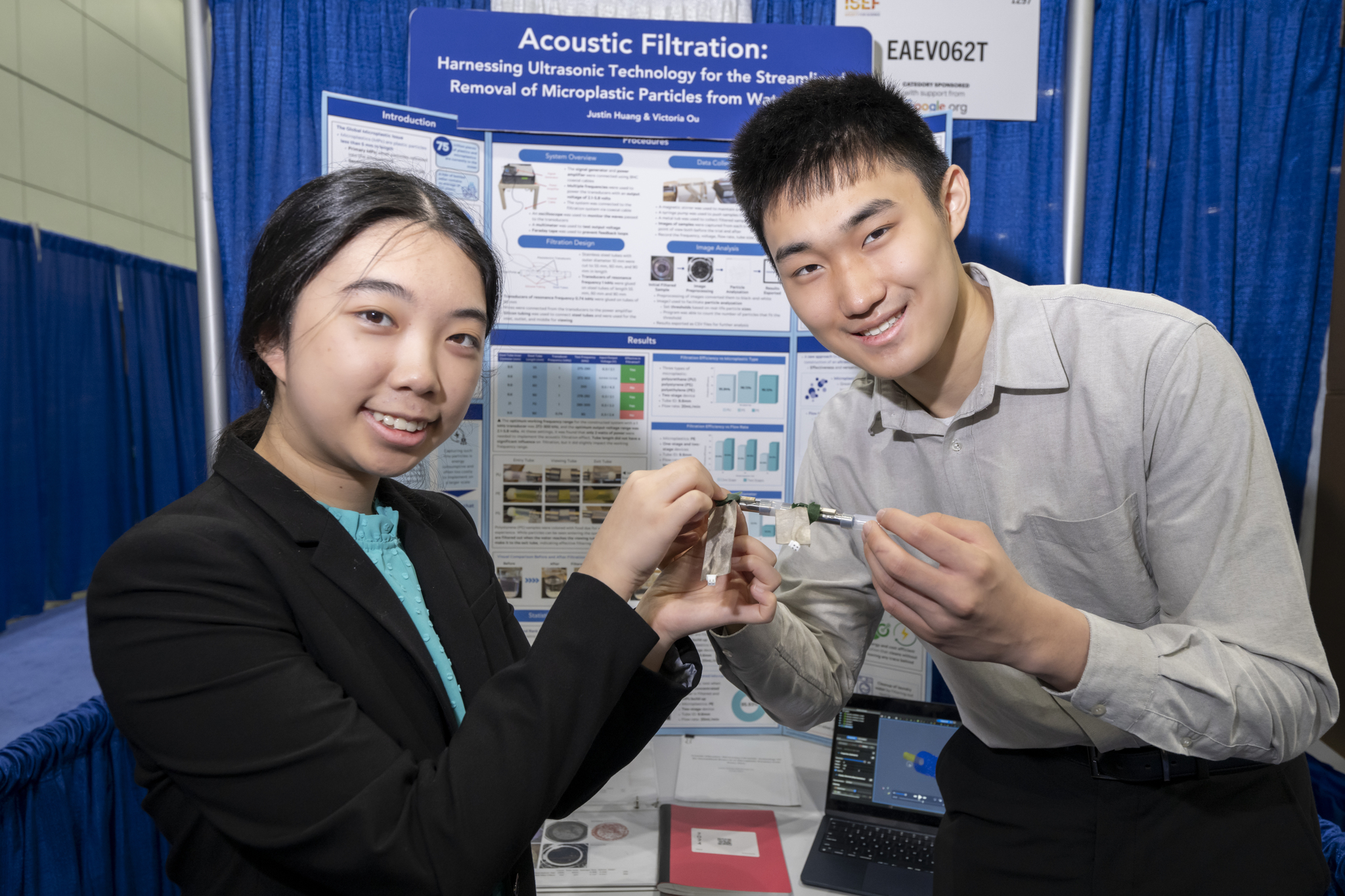
A Pen-Sized Device Built by Two Teenagers Removes 94% of Microplastics From Water in a Single Pass
Somewhere in Los Angeles, in a room full of the brightest young scientific minds on the planet, two 17-year-olds from Texas stood on a stage and collected a $50,000 check for solving a problem that governments haven’t regulated, water treatment plants haven’t fixed, and industries haven’t prioritized.
They built their prototype at home. It’s the size of a pen. And it works better than anything currently in use. Before getting to what they built, it helps to understand what they were up against.
Microplastics Are Already Inside You
Plastic doesn’t disappear. It breaks down into smaller and smaller pieces until those pieces become invisible to the naked eye, and then they go everywhere. Microplastics have turned up at the summit of Mount Everest and in the deepest trenches of the ocean. Researchers have found them in human blood, breast milk, and lung tissue. By some estimates, each person inhales and ingests roughly a credit card’s worth of plastic every single week.
Health researchers have linked many common plastic chemicals to increased cancer risk, fertility problems, developmental issues in children, and hormone disruption. Nobody fully understands the long-term consequences yet because we’ve never lived through a long-term experiment like this one before. What’s clear is that the plastic is already inside us, and more arrives every day.
What’s also clear, and this is the part that should bother everyone, is that almost nothing is being done to stop it at the water level.
A Field Trip That Changed the Direction of Everything

Victoria Ou and Justin Huang have been friends since elementary school. Both 17, both students at College Park High School in The Woodlands, Texas, both drawn to environmental problems in a way that most teenagers aren’t. Last fall, while looking for an idea to develop for a science fair project, they decided to visit a local water treatment plant. They went looking for solutions. What they found instead was a gap.
Water treatment plant employees told them plainly that the EPA doesn’t regulate microplastics. Because there’s no regulation, treatment plants have no mandate to remove them. Microplastic-laden water goes in, microplastic-laden water comes out, and nobody in the regulatory system has called that a problem worth fixing. “We knew, from then, to focus on this issue,” Huang told Business Insider.
That visit didn’t discourage them. It focused them. They had found a real problem with no adequate solution attached to it, which is exactly the kind of problem two teenagers with a science fair deadline and an environmental conscience will walk straight toward.
Why Everything Already Tried Keeps Failing
Before building anything, Ou and Huang needed to understand why existing approaches hadn’t worked. What they found was a field full of partial solutions and significant trade-offs.
Chemical coagulants like aluminum hydroxide can clump microplastics into larger chunks that are easier to filter out. The catch is that those same chemicals can alter the pH of treated water and introduce new pollutants into the environment. Solving one contamination problem by adding another isn’t much of a solution.
Physical filters do exist, but they clog. Microplastics are small enough and numerous enough that physical filtration at any meaningful scale becomes a maintenance problem faster than it becomes a treatment solution. Biological approaches using enzymes to break plastic down are still too slow and too limited to handle the volume of water that treatment plants process daily.
Even if the EPA announced regulations tomorrow, there isn’t a ready, scalable, chemical-free method waiting to be deployed. Ou and Huang understood this clearly before they built a single component. They weren’t trying to improve an existing system. They were starting from a different question entirely.
The Pen-Sized Device That Outperforms Everything

What they built looks improbable for what it does. A long steel tube, roughly the size of a pen, containing two stations of piezoelectric transducer components that generate ultrasonic sound waves when electricity passes through them. Water enters one end. Clean water exits the other.
Here’s what happens in between. As water flows through the tube, the ultrasonic waves generate pressure. That pressure acts as an invisible barrier, pushing microplastic particles backward while allowing water molecules to continue moving forward. Nothing chemical. Nothing that clogs. No biological process is waiting to catch up with the volume. Just sound waves, pressure, and physics.
Ou and Huang tested their device against three of the most common types of microplastics found in water: polyethylene, polystyrene, and polyurethane. In a single pass through the device, it removed between 84% and 94% of microplastics present in the water samples. No second pass required. No additional treatment step. One tube, one pass, up to 94% gone.
For context, that’s a filtration rate that existing methods haven’t matched without introducing the kinds of trade-offs that make them impractical at scale.
A Room Full of the World’s Best Young Scientists
Ou and Huang presented their work at the Regeneron International Science and Engineering Fair in Los Angeles, where nearly 2,000 competitors from 9th through 12th grade gathered to compete for more than $9 million in prizes. Students from science fairs around the world bring their best work to ISEF each year. Getting there at all is an achievement. Winning anything is extraordinary.
Ou and Huang won two things. First place in the Google-sponsored Earth and Environmental Sciences category. And the Gordon E. Moore Award for Positive Outcomes for Future Generations, which came with a $50,000 prize. Neither of them saw it coming. “This is something that I’ve been dreaming of my whole life, so I’m still pinching myself trying to figure out if this is real or not,” Huang said.
They had gone to Los Angeles hoping to share their work and come home with the experience. What they came home with instead was first place, a top prize, and $50,000 to put toward the next stage of development.
Where This Goes Next
Ou and Huang have a clear picture of where their technology could eventually operate. At the large end: municipal wastewater treatment plants, industrial textile facilities that release significant amounts of microplastic fiber into water systems, sewage treatment plants, and rural water sources that have no current treatment infrastructure at all. At the small end: laundry machines, which are a major source of microplastic pollution with every wash cycle, and even home drinking water filtration.
Getting from a pen-sized prototype built at home to any of those applications requires significant work. The device needs professional-grade equipment, laboratory-level testing environments, and engineering refinement before it’s ready for anything beyond proof-of-concept demonstrations. Huang has said as much directly, pointing to better equipment and lab conditions as the immediate next steps before large-scale manufacturing becomes a realistic conversation.
The $50,000 prize gives them a real shot at those next steps. Two teenagers with a functioning prototype, a competition win, and fifty thousand dollars in research funding are in a better position than most early-stage environmental technology projects, regardless of who built them.
What Two 17-Year-Olds Just Demonstrated
Pull back from the invention for a moment and look at what this story actually shows. Microplastic contamination in water is a documented, measurable, growing problem. Researchers have been tracking it for years. Governments have been slow to regulate it. Treatment infrastructure hasn’t adapted to address it. Industries that produce plastic haven’t been compelled to solve it.
Two teenagers with a shared interest in the environment, a school science fair deadline, and a visit to a water treatment plant built a working filtration device in their first year of trying. It outperforms existing chemical and physical methods on the primary metric that matters: how much plastic it removes. It does so without chemicals, without clogging, and without introducing new problems while solving the original one.
Sound waves push the plastic back. Clean water passes through. A credit card’s worth of plastic a week doesn’t have to keep ending up inside human bodies. The question this story leaves sitting in the room isn’t whether the problem can be solved. Ou and Huang answered that. The question is why it took a high school science fair project to get here, and what that says about how seriously the adults in the room have been taking the problem all along.
Image Source: Society Communications Team https://societyforscienceandthepublic.app.box.com/s/8oi5wbdi1yr4ovhfizlj9d5a5mylrsm0/file/1533783971262