

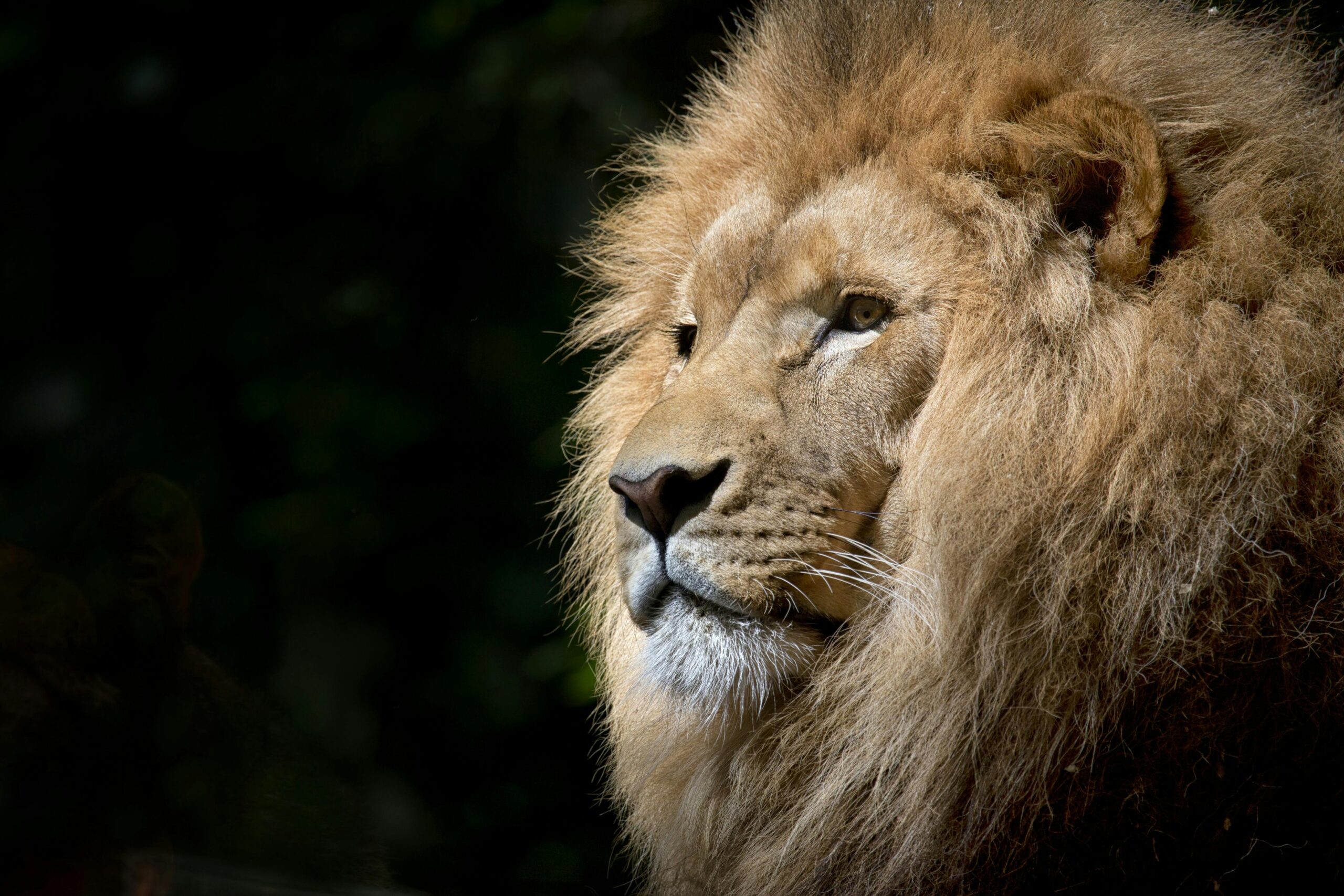
In the wild heart of Uganda’s Queen Elizabeth National Park, where tall grasses ripple beneath the equatorial sun and crocodiles patrol dark waterways, survival is rarely forgiving. Strength, speed, and dominance decide who eats and who starves. For lions, apex predators built for explosive chases that can reach nearly 50 miles per hour, physical perfection is often the difference between life and death.
Yet in this unforgiving landscape, one lion has rewritten the rules.
Jacob, now eleven years old, moves differently from the others. He walks with a limp. One of his hind legs is gone. One of his eyes no longer sees. By every conventional measure, he should not have survived. And yet, not only has he endured, he has adapted in a way that has left conservationists and scientists astonished.
Recent thermal drone footage has finally revealed the secret behind his survival. Instead of relying on the high speed pursuits typical of his species, Jacob has developed an entirely different strategy. He hunts like a leopard.
A Life Marked by Trauma
Jacob’s story is not simply one of injury. It is a chronicle of repeated human and environmental pressures that would have ended most predators’ lives.
As a young lion, Jacob first encountered a wire snare set by poachers. Wildlife veterinarians managed to save him that time, but his luck did not hold. In 2020, he was caught in a steel trap. The device severed his hind leg above the foot. The amputation left him permanently disabled in an ecosystem where physical dominance determines hierarchy.
Not long after, tragedy struck again. A Cape buffalo gored him during a violent encounter, damaging one of his eyes. The injury left him partially blind.
Then came another blow. His pride was poisoned, a tactic used in parts of Africa to retaliate against lions or to harvest body parts for illegal trade. Jacob survived. Many around him did not.
By the time he reached adulthood, he had endured more trauma than most wild animals experience in a lifetime. Experts often observe that so called tripod lions, those missing a limb, rarely survive without heavy reliance on a pride. Big carnivores that cannot sprint or overpower prey are typically forced into scavenging roles or perish from starvation.
Jacob defied that pattern.
The Science Behind a Predator’s Limitation
To understand why Jacob’s survival is so extraordinary, it helps to understand how lions typically hunt.
Lions are pursuit predators. Unlike leopards, which rely heavily on stealth and solitary ambush tactics, lions often coordinate in groups. They stalk, then sprint in short explosive bursts. Their muscular hind legs provide the thrust required to close distance rapidly and tackle large prey such as antelopes, buffalo, or zebra.
A missing hind leg drastically reduces acceleration and balance. A partially blind lion loses depth perception, critical during the split second timing of a chase. For Jacob, both disadvantages exist simultaneously.
Alexander Braczkowski of the Kyambura Lion Monitoring Project has followed Jacob since 2017. For years, researchers were puzzled. How could a lion unable to compete in high speed chases maintain body condition? How could he continue patrolling territory and even seeking mating opportunities?
The answer remained elusive until filmmakers and researchers deployed drones equipped with high definition heat detection cameras. The thermal footage provided a rare nighttime view into Jacob’s behavior.
What they saw changed assumptions about behavioral flexibility in large carnivores.
Reinventing the Hunt
The footage revealed something unexpected. Jacob was not attempting traditional lion hunts at all.
Instead of sprinting across open savannah, he positioned himself within dense brush. He minimized movement. He waited. When prey approached within close range, he lunged in short, calculated bursts. On some occasions, he was even observed digging animals out of burrows.
These behaviors are more commonly associated with leopards.
Leopards rely on precision rather than power. They use cover extensively. They ambush from short distances. They often target prey that can be subdued quickly without prolonged chases. Jacob appears to have shifted from a power based strategy to a precision based one.
One of his preferred targets is the warthog. Adult warthogs can weigh over 400 pounds, but they often retreat into burrows when threatened. Jacob has been filmed ambushing them at night, sometimes alone and sometimes alongside his brother Tibu.
Braczkowski has explained that Jacob simply does not stand a chance in a long pursuit. By selecting specific prey and altering his technique, he has effectively rewritten his dietary blueprint.
Andrew Loveridge of Panthera, a global wild cat conservation organization, has noted that many lions across Africa lose limbs to traps. Yet very few display such pronounced shifts in strategy. Most depend on pride support. Jacob’s semi independent success is rare.
Craig Packer of the University of Minnesota has suggested that adaptive behaviors, if advantageous, could potentially spread within localized populations over time. However, current observations indicate that most lions in Queen Elizabeth National Park continue to hunt in traditional ways, targeting large, fleet footed herbivores.
Jacob stands apart.
Crossing the Kazinga Channel
If reinventing his hunting method were not remarkable enough, Jacob has also participated in one of the most daring documented swims by a lion.
The Kazinga Channel connects Lake Edward and Lake George and is known for hosting one of the largest concentrations of hippos and Nile crocodiles in the world. Lions are not natural long distance swimmers. Most recorded attempts to cross this channel end within a few hundred meters, sometimes fatally.
Yet Jacob and his brother Tibu swam approximately 1.5 kilometers, nearly a mile, across the predator infested waterway at night. Thermal cameras captured their hesitation at the shoreline. Movement in the water, likely crocodiles, caused them to retreat multiple times. On their fourth attempt, they entered the channel and swam steadily until reaching the opposite bank.
Researchers believe this may be the first recorded instance of a lion completing such a distance in these conditions. For Jacob, navigating strong currents and potential attacks with one hind leg missing heightened the risk dramatically.
Why take such a gamble?
Competition for lionesses in the park is intense. The lion population in this region has nearly halved in recent years, according to researchers. Fragmented habitat and human presence near bridges may have deterred safer crossing options. The swim likely represented a calculated risk in pursuit of mating opportunities.
Braczkowski described Jacob as a lion with nine lives. The swim, he said, is a testament not only to resilience but to necessity. In a human dominated world, wildlife is increasingly forced into difficult decisions simply to reproduce and secure territory.
A Species Under Pressure
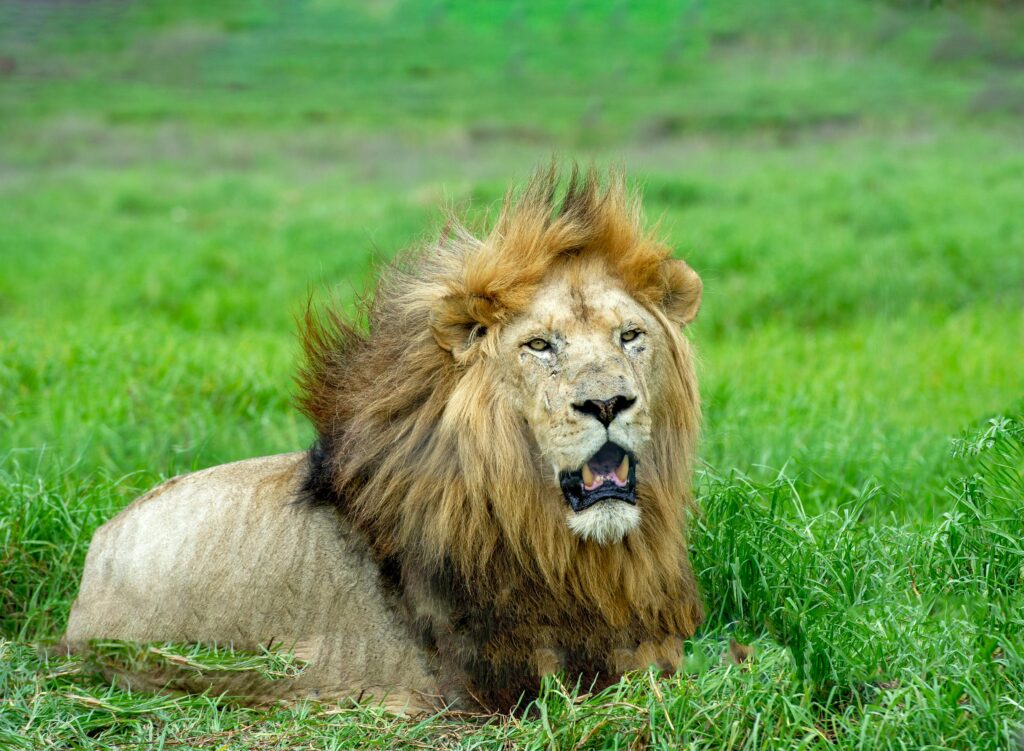
Jacob’s individual story unfolds against a broader conservation crisis.
According to the International Union for Conservation of Nature, lions are classified as vulnerable, with populations declining across much of their range. Over the past three decades, numbers have dropped by nearly half. In West Africa, some populations are so diminished that they approach endangered status.
Habitat fragmentation plays a central role. Expanding agriculture, infrastructure, and settlements divide territories that once allowed wide roaming. Human wildlife conflict, often triggered by livestock predation, results in retaliatory poisoning. Snares set for bushmeat inadvertently maim apex predators.
Climate change compounds these pressures by altering prey distribution and water availability.
Within this context, Jacob’s behavioral flexibility may represent more than an anomaly. It could signal how certain individuals respond to mounting stressors.
George Schaller, a renowned field biologist, has long described lions as fighters. Their social structure, cooperative hunting, and territorial persistence reflect resilience as a species trait. Yet adaptation at the individual level, particularly after severe injury, remains less understood.
Jacob demonstrates that survival is not purely a matter of physical strength. Cognitive flexibility and risk tolerance also shape outcomes.
Innovation in the Wild
Scientists often debate the extent to which large predators can innovate.
Behavioral plasticity refers to an animal’s ability to modify actions in response to environmental change. In primates and some bird species, such flexibility is well documented. In apex carnivores, it is less frequently observed or harder to capture.
Jacob’s case offers rare visual evidence.
Thermal drone technology allowed researchers to observe nocturnal behavior without disturbing the lions. The footage captured not only the mechanics of ambush but the patience involved. Jacob selects terrain carefully. He reduces reliance on sprinting. He targets prey that minimizes the risk of prolonged struggle.
This shift suggests a capacity for learning and recalibration. It raises important scientific considerations. If environmental pressures intensify, will more lions experiment with alternative prey or methods? Could such shifts alter ecosystem dynamics?
For now, Jacob remains an outlier. Most tree climbing lions in Queen Elizabeth National Park continue traditional hunting strategies. But his example broadens the understanding of what is possible.
The Human Dimension
It is impossible to separate Jacob’s injuries from human activity.
Poacher’s snares and steel traps are not random hazards. They are direct products of economic hardship, illegal wildlife trade, and conflict between communities and predators. Poisonings often follow livestock losses.
Conservation efforts in Uganda include anti poaching patrols, community outreach programs, and collaring initiatives that allow real time monitoring of lion movements. These measures aim to reduce conflict while safeguarding both wildlife and local livelihoods.
Jacob’s survival underscores why such efforts matter. Each individual lion contributes genetically and socially to a fragile population. Braczkowski has described Jacob as symbolically and genetically invaluable.
His continued movement across the Kazinga Channel, up to twenty crossings in recent years, suggests that despite his injuries, he remains reproductively active and territorially engaged.
That fact alone challenges assumptions about disability in the wild.
Redefining Strength
In popular imagination, strength is often equated with physical dominance. Jacob complicates that narrative.
He cannot outrun antelope. He cannot rely on symmetrical power. Yet he persists. He adjusts. He calculates risk differently.
There is something profoundly instructive in that.
Nature is frequently described as ruthless. But it is also adaptive. Evolution does not reward perfection. It rewards survival within constraints. Jacob’s story illustrates that even severe limitation does not automatically eliminate agency.
For researchers, he provides data. For conservationists, he provides urgency. For observers around the world, he provides perspective.
His survival does not romanticize suffering. The injuries he sustained reflect real and ongoing threats. But his response to those injuries reveals a capacity for innovation that deepens respect for the species.
What Jacob’s Story Means for the Future
As environmental pressures intensify across Africa, the long term viability of lion populations will depend on habitat protection, conflict mitigation, and adaptive capacity.
Jacob alone cannot alter continental trends. Yet his case contributes to scientific understanding in meaningful ways.
First, it demonstrates that severe injury does not always preclude reproductive or territorial success.
Second, it highlights the value of technology in documenting rare behaviors that might otherwise go unnoticed.
Third, it reinforces the importance of conserving not just populations but individuals. Each animal carries behavioral variations that may prove critical under shifting ecological conditions.
Jacob continues to patrol more than a kilometer a day. He continues to hunt. He continues to swim when necessary. In a landscape shaped by both natural predators and human pressures, he remains present.
There are no guarantees for him or for his species. Lions still face habitat loss, poaching, and declining numbers across much of their historical range. But Jacob’s story introduces a note of cautious possibility.
Survival in the wild is not static. It is dynamic, shaped by trial, error, and adaptation. In the tall grasses of Queen Elizabeth National Park, one lion has shown that even when speed is lost and vision narrowed, ingenuity can endure.
Jacob’s gait may be uneven, but his impact is not.
Featured Image Source: Pexels