

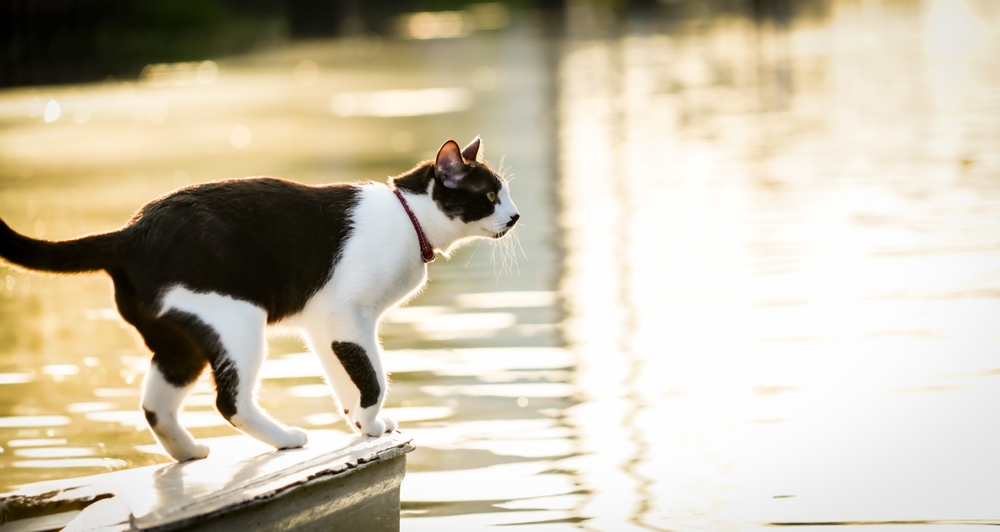
Amsterdam Is Adding Tiny Staircases to Save Stray Cats Trapped in Its Canals
Amsterdam’s canals are among the most recognizable urban features in the world, instantly associated with the city’s identity and history. They curve gently through neighborhoods, reflecting rows of centuries old buildings, houseboats, and narrow streets that feel carefully preserved against time. For residents, the canals are part of everyday routines, something passed on bike rides, walks, and commutes without much thought. For visitors, they represent romance, charm, and the idea of a city that has learned to live in harmony with water rather than fight against it. As a UNESCO World Heritage Site, the canal network is celebrated as a triumph of urban planning and engineering, admired for how it balances function, beauty, and resilience.
Yet beneath that admired surface lies a problem that has quietly persisted for years, mostly invisible to those enjoying the view. In the past six months alone, that problem has taken a tragic toll. According to animal welfare organization Dierenambulance Amsterdam, 19 cats have drowned in the city’s canals, with six of those deaths occurring in the city center. These incidents are not freak accidents or unavoidable acts of nature. They are the predictable result of infrastructure designed centuries ago, long before anyone considered how animals move through modern cities. High stone walls, cold water, and the absence of escape routes mean that when a cat falls in, survival often depends on luck rather than strength or instinct. Faced with mounting evidence and growing pressure from animal welfare advocates, Amsterdam has now approved a plan to install small wooden staircases along its canals, offering cats and other animals a realistic chance to escape.
A Deadly Problem Hidden in Plain Sight
The canals that define Amsterdam were constructed with human priorities at the forefront. Trade routes, transportation corridors, and flood management shaped their design, resulting in vertical stone walls that rise directly from the water. For people, this poses little risk. Boats, ladders, docks, and quays provide access points, and humans understand how to navigate these spaces safely. For animals, however, the canals can become deadly traps the moment they fall in.
Cats are especially vulnerable because of how they interact with urban environments. They walk along narrow ledges, jump between surfaces, and often explore close to the water’s edge. Animal welfare workers say that many falls happen in an instant. A loud noise, a sudden movement, a barking dog, a passing cyclist, or even a slick stone surface after rain can cause a cat to lose its footing without warning.
Once in the canal, panic sets in quickly. Cats may swim along the wall searching for an exit that does not exist, burning energy with every second. Dierenambulance Amsterdam has responded to countless calls involving animals struggling in the water, and rescuers often arrive to find there is simply nowhere nearby for the animal to climb out. They warn that the true scale of the problem is likely higher than reported, since not every drowning is witnessed or recovered.
The Numbers That Forced the City to Act
Statistics often fail to convey emotional weight, but in this case they were impossible to dismiss. Nineteen cats drowned in just six months, a figure that shocked animal welfare organizations and city officials alike. The fact that six of those deaths occurred in the city center only heightened concerns, showing that this was not limited to neglected or remote areas but happening in some of the busiest parts of Amsterdam.
For Judith Krom from the Party for the Animals, the numbers represented more than data points. They highlighted a known and preventable risk that had been allowed to continue for too long. Her party exists specifically to represent the interests, rights, and welfare of animals in political decision making, and she argued that ignoring the issue amounted to accepting unnecessary suffering.
Rather than calling for complex infrastructure overhauls or long term studies, Krom focused on a practical solution that could save lives quickly. Her motion asked the city to formally acknowledge the problem and commit to an intervention that was simple, affordable, and effective.
Small Staircases Designed to Save Lives
The approved plan involves installing small wooden staircases along canal walls at carefully selected locations. These staircases sit low in the water, with evenly spaced slats that provide grip for wet paws and tired limbs. The gentle angle allows animals to climb out without needing significant strength, even if they are exhausted or panicked.
The design is intentionally subtle. City planners have emphasized that the staircases should blend into the historic environment rather than draw attention. They are not meant to change how the canals look or feel to residents and visitors, but to exist quietly as a safety feature that only becomes noticeable in moments of need.
Maggie Ruitenberg from the Katten Kenniscentrum explained the importance of accessibility when speaking to Dutch daily Volkskrant. “A ladder can really save their life, as long as there are enough of them,” she said. Her comment reflects a key principle behind the initiative, that escape routes must be frequent enough that an animal does not have to swim long distances to find one.
Funding the Initiative Without Trade Offs
Amsterdam has allocated €100,000 to the project, equivalent to roughly $116,400 USD. Crucially, the funding comes from a biodiversity budget that had not previously been used, meaning the initiative does not divert money from essential services for residents.
Supporters argue that this funding choice makes the decision both compassionate and responsible. It acknowledges animal welfare as part of environmental stewardship while avoiding the perception that human needs are being neglected.
Judith Krom summarized the thinking behind the project by stating, “A simple measure can prevent enormous animal suffering.” The quote has resonated widely, capturing why many see the staircases as a small but meaningful investment rather than an extravagant gesture.
Backed by a Clear Political Mandate
On July 10, the Amsterdam City Council voted in favor of Krom’s motion, signaling broad political support for the initiative. The approval showed that concern for animal welfare can cut across party lines when the solution is clear and reasonable.
Krom stressed that the vote carried symbolic importance in addition to its practical impact. “The adopted motion demonstrates that as a city, we take responsibility for protecting the lives of animals,” she said after the decision.
For animal advocates, the council’s approval represented validation after years of raising concerns about canal drownings and calling for preventative measures.
Working Closely With Animal Welfare Experts
To ensure the staircases are placed where they are most needed, the city is working closely with Dierenambulance Amsterdam. Rescue call data and incident reports are being analyzed to identify canal sections with the highest risk of animal falls.
By prioritizing these high risk areas, officials hope to reduce drownings as quickly as possible. The approach allows the city to focus resources where they will have the greatest immediate impact.
Authorities have confirmed that the first staircases will be installed later this year, marking the beginning of what could become a permanent safety feature throughout the canal network.
Why Cats Are Especially Vulnerable
Despite their reputation for agility and balance, cats are not immune to the dangers of urban infrastructure. Narrow ledges, smooth stone surfaces, and constant human activity create an environment where even a small misstep can have serious consequences.
Once in the water, cats face both physical and psychological challenges. Cold temperatures drain energy quickly, while panic can prevent calm, efficient swimming toward distant exits.
Experts warn that without nearby escape routes, even strong swimmers can become exhausted long before finding a way out.
A City With a Long History of Loving Cats
Amsterdam is widely known as a city that embraces animals as part of everyday life. Cats are common sights in homes, shops, bookstores, and cafes, often treated as familiar companions rather than background wildlife.
The Netherlands also maintains one of the lowest stray animal populations in Europe, thanks to extensive spaying and neutering programs and strong public awareness.
Against that backdrop, the recent drownings feel especially troubling, highlighting a disconnect between good intentions and the realities of urban design.
Learning From Amersfoort’s Example
Amsterdam’s decision was influenced by similar efforts in nearby Amersfoort. That city has announced plans to install around 300 comparable staircases along its canals and quays as part of its 2024 animal welfare program.
Local councils there collaborated with residents to identify locations where animals frequently fell into the water, demonstrating the value of community involvement.
The example helped reinforce the idea that such measures are both achievable and effective.