

Archaeologists Reveal 18,000 Year Old Mammoth Bone Shelters That Changed How We Understand Survival
There are moments when history whispers instead of shouts. When the past does not arrive as a monument or a written record, but as a question that asks us to look at our own lives a little differently. This is one of those moments.
Eighteen thousand years ago, during one of the harshest periods our planet has ever known, human beings stood on frozen ground in what is now Ukraine and made a choice. They did not wait for the climate to soften. They did not complain about the cold. And they did not retreat into hopelessness. They looked at what remained after survival, the bones of mammoths, and they built shelter.

Not metaphorical shelter. Real homes. Places to sleep, to work, to gather, and to endure.
Archaeologists have reexamined Ice Age dwellings constructed largely from mammoth bones, revealing new insights into how ancient communities survived extreme environments. The discovery does not just tell us where people lived. It tells us how humans respond when conditions are unforgiving, and what that response can teach us today.
Life at the Edge of Survival
Around 18,000 years ago, Earth was emerging from the Last Glacial Maximum, the coldest phase of the last Ice Age. Vast ice sheets covered much of the Northern Hemisphere. Temperatures were brutal. Food was scarce. Survival was not guaranteed.
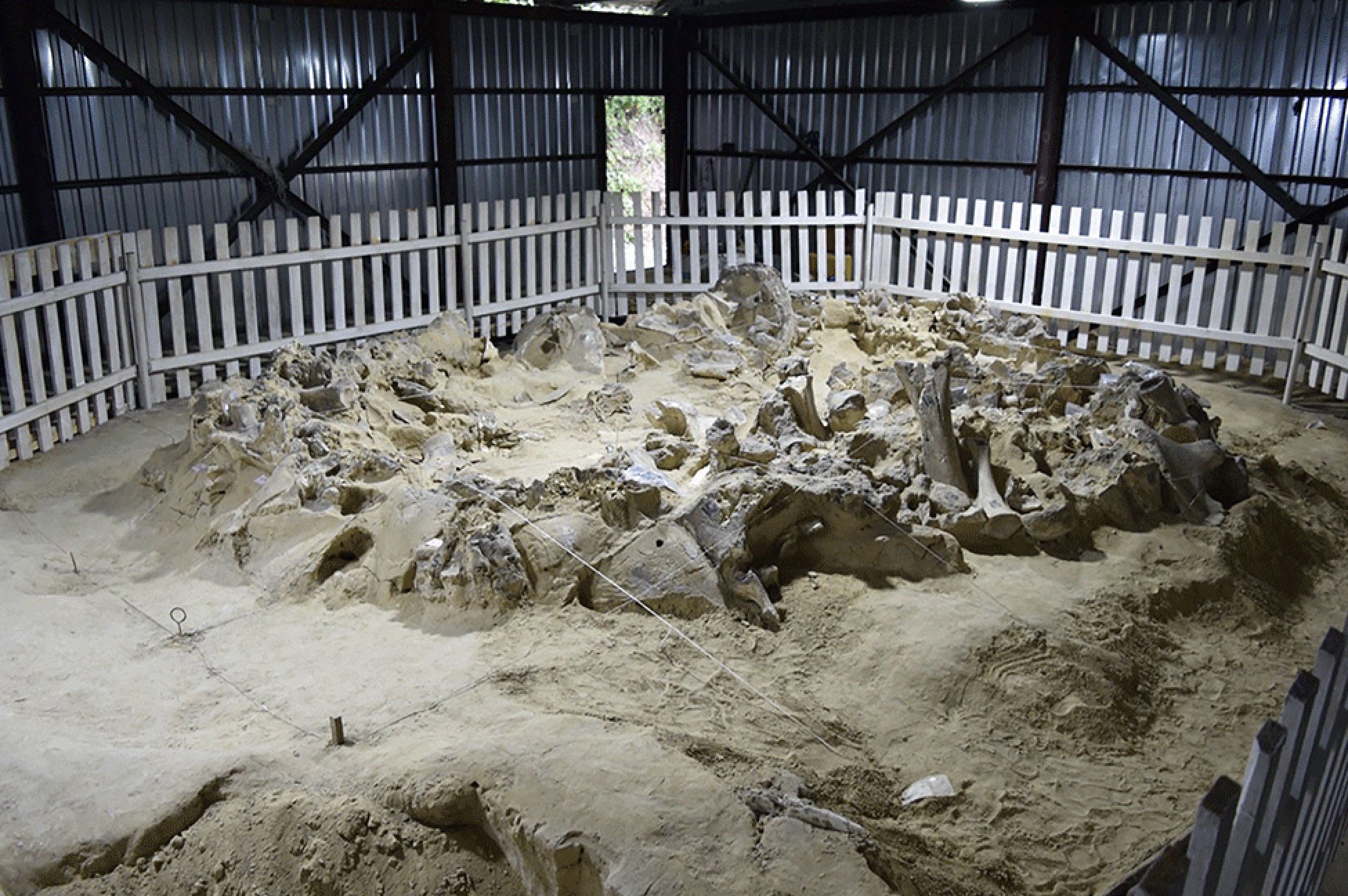
Yet in this environment, small groups of humans settled near what is now the village of Mezhyrich, roughly 70 miles southeast of present day Kyiv. Archaeologists first excavated the site between 1966 and 1974, uncovering enormous mammoth bones arranged in circular formations. Even then, researchers suspected these were not random remains, but deliberate structures, homes built from the bodies of animals that once roamed the frozen plains.
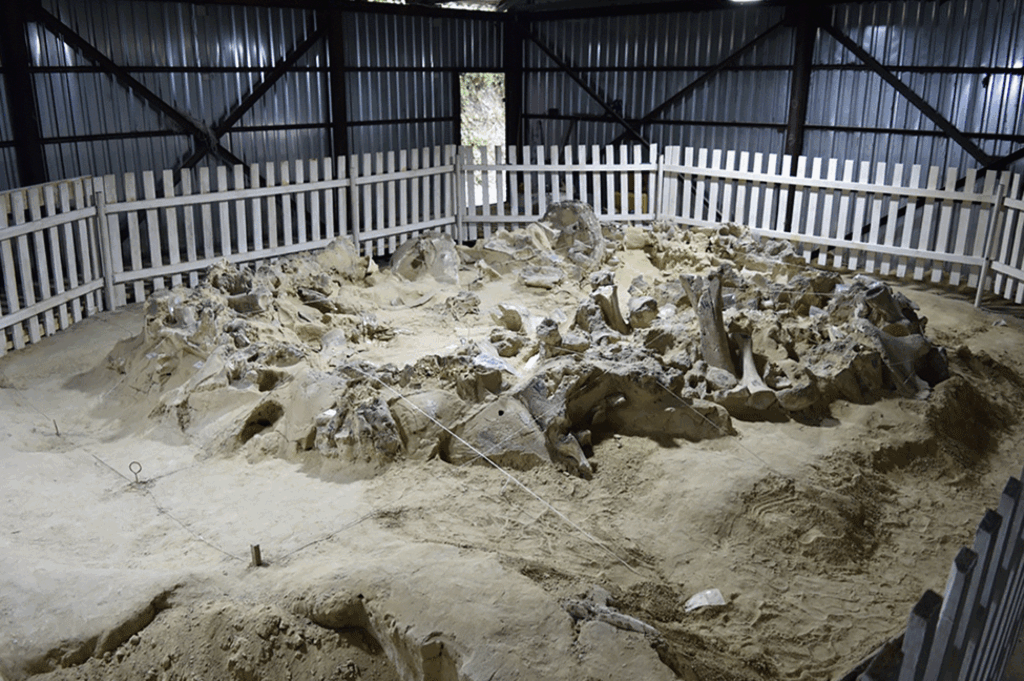
For decades, scholars debated exactly when these dwellings were used and for how long. Earlier estimates placed their construction anywhere between 19,000 and 12,000 years ago, a wide window that left many questions unanswered. To refine the timeline, researchers recently returned to the site, applying modern radiocarbon dating techniques to animal remains found alongside the mammoth bones.
Their findings narrowed the story. The largest structure at Mezhyrich dates to between 18,323 and 17,839 years ago, just after the peak of the Ice Age. Based on the dating evidence, the dwelling may have been used intermittently for up to 429 years. As the researchers explained in a statement, this suggests that the shelters were “practical solutions for survival rather than permanent settlements.”
These were not cities. They were lifelines.
Architecture Born From Necessity
What makes these dwellings remarkable is not just their age, but their ingenuity. Mammoths were not small animals. Their skulls, tusks, and long bones were massive, difficult to move, let alone assemble into functional structures. Yet Ice Age humans found a way.
Pavlo Shydlovskyi, an archaeology professor at Taras Shevchenko National University of Kyiv and co author of the study, described how the shelters were built in an email to Live Science. He explained that the foundations may have included “mammoth skulls and large long bones, set vertically into the ground [which] formed a kind of plinth or ‘foundation.’”
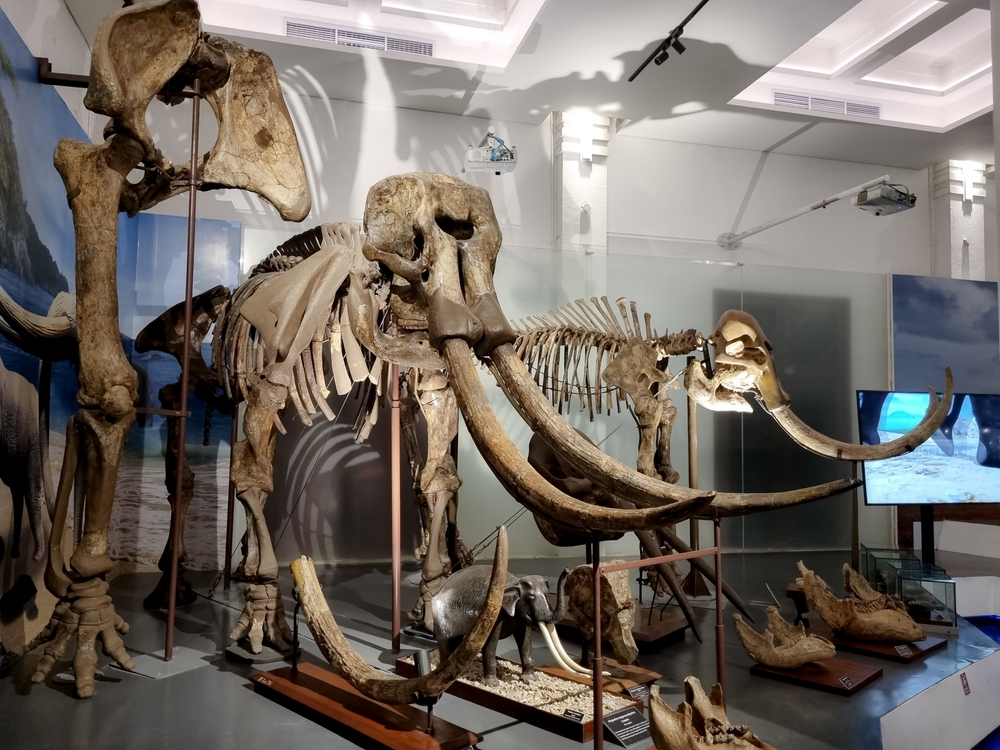
On top of this skeletal framework, additional materials were layered to create protection from wind and cold. Shydlovskyi noted that “tusks and large flat bones were placed on the upper part of the structure [the roof] functioning as weights and wind protection.” Researchers believe a wooden framework may have supported parts of the shelter, covered with hides from smaller animals or possibly birch bark.
This was architecture without textbooks. Engineering without formal training. Design shaped entirely by need.
Each shelter likely housed five to seven people. Inside, daily life continued even as temperatures outside plunged. Archaeologists believe residents carried out activities such as flint knapping, animal skin processing, and small animal butchering within these bone built walls.
In other words, these were not emergency hideouts. They were living spaces, places where life went on.
Community as a Survival Strategy
Survival at Mezhyrich was not an individual effort. It depended on people functioning as a unit, coordinating daily tasks and sharing responsibility in an environment where mistakes carried real consequences. The size of each shelter suggests an intimate social structure where every role mattered and where cooperation was not optional, but essential.
The range of activities believed to have taken place inside these dwellings points to shared routines rather than isolated labor. Work had to be timed, resources had to be managed, and knowledge had to circulate within the group. Over time, this kind of coordination creates more than efficiency. It creates stability.

The fact that at least one dwelling may have been used intermittently for centuries suggests continuity across generations. These were places people could return to, rebuild, and rely on. In unpredictable conditions, that continuity becomes its own form of resilience. The researchers wrote that the mammoth dwellings “show how communities thrived in extreme environments, turning the remnants of giant animals into protective architecture.” Thriving here does not mean comfort. It means maintaining function, care, and cohesion despite uncertainty.
What These Dwellings Reveal About Us
It is easy to look at discoveries like this as artifacts of a distant past, interesting but disconnected from modern life. But what these dwellings reveal is not a set of ancient techniques. It is a pattern of human response. When faced with conditions they could not control, people focused on what they could influence. They assessed their reality clearly, without illusion, and acted within its limits.
What stands out is not strength or dominance over nature, but acceptance paired with intention. These communities did not try to recreate comfort as they imagined it elsewhere. They reshaped their expectations to match their circumstances. That ability to adjust one’s definition of progress, safety, and success is a form of intelligence that often goes unrecognized.
At its core, this story reflects a mindset. Survival was not driven by optimism alone, nor by despair, but by practical clarity. The people who built these dwellings understood that resilience is not about waiting for conditions to improve. It is about deciding how to live meaningfully inside conditions that may not change anytime soon.
When Shelter Was Temporary by Design
One detail that often goes unnoticed is that these dwellings were not meant to last forever. The evidence suggests they were used intermittently, revisited when conditions allowed, then left behind when circumstances shifted. That impermanence was not a flaw. It was intentional. In a volatile world, flexibility mattered more than permanence.
This tells us something distinct about how these people understood security. Safety was not tied to ownership or permanence, but to readiness. They did not anchor their identity to a single place or structure. Instead, they built what they needed, used it fully, and moved on when required. Adaptation meant staying light enough to respond, rather than rigid enough to break.
There is a quiet wisdom here. Stability does not always come from holding on. Sometimes it comes from knowing when to rebuild, when to return, and when to let go without seeing it as failure. These dwellings reflect a relationship with time that was fluid rather than fixed, where survival depended not on permanence, but on the ability to adjust without losing direction.
A Quiet Lesson From Deep Time
There is something deeply humbling about realizing that 18,000 years ago, humans were already grappling with questions that still define our lives today. How do we create safety when certainty is gone. How do we support one another when resources are limited. How do we endure long stretches of uncertainty without losing a sense of purpose or direction. These are not modern dilemmas. They are human ones.
The mammoth bone dwellings do not suggest that life was simple or gentle. They point to hardship as a constant feature of existence. What changes across time is not the presence of difficulty, but the way people choose to meet it. The evidence left behind does not speak of comfort. It speaks of response. Of decisions made under pressure. Of people refusing to surrender agency even when circumstances offered very little room to maneuver.
Seen this way, these ancient shelters become more than archaeological structures. They become mirrors. They reflect a long standing human capacity to build meaning inside limitation, to organize life around what is possible rather than what is ideal. The warmth they provided was not only physical. It came from intention, cooperation, and the decision to keep going together.

If people could do this with mammoth bones and frozen earth, then adaptation is not a question of ability. It is a question of willingness. The challenge passed down to us is not whether change can happen, but whether we are prepared to engage with our own conditions as directly, as honestly, and as deliberately as they once did.
Featured Image from Wei Chu Orcid, Pavlo Shydlovskyi Orcid, and Andreas Maier Orcid under CC BY 4.0