

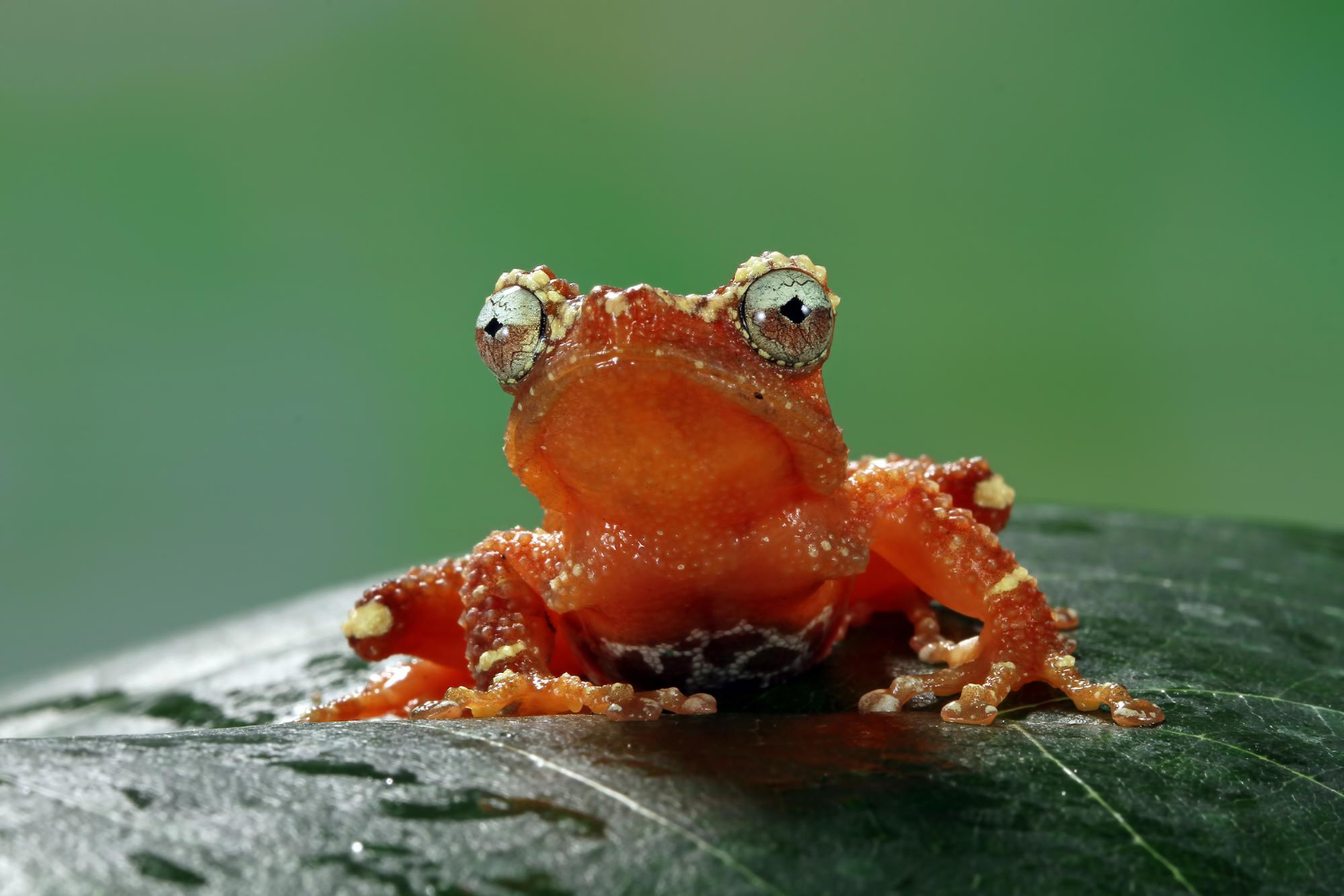
Bright Orange Frog Smaller Than a Pencil Eraser Just Showed Up in Brazil’s Misty Mountains
Something incredible is hiding in the misty mountains of southern Brazil. It wears the color of a traffic cone, yet it managed to stay invisible to science until now. Picture a creature so small it could comfortably sit on the tip of your pencil, so bright you would think it would be impossible to miss. And yet, for years, it hopped through the leaf litter of ancient cloud forests, completely unknown to the outside world.
What finally gave it away? Not its eye-catching appearance. Something far more surprising.
Scientists have just announced they found a new species of pumpkin toadlet, and the story of how they discovered it will change how you think about what it means to truly see the world around you.
Heard Before Seen
Imagine walking through a forest so thick with mist that everything appears dream-like. You scan the ground, searching for movement among fallen leaves. Nothing. Yet all around you, a chorus of tiny voices calls out. High-pitched. Persistent. Coming from everywhere and nowhere at once.
Researchers tracking these sounds in the Serra do Quiriri mountain range kept hearing something different. A call that didn’t match any known species. Two notes, each containing up to four pulses, rising from the damp forest floor. Males were advertising themselves to potential mates, completely unaware they were also announcing their existence to curious scientists.
Finding the callers proved far harder than hearing them. Despite wearing what amounts to nature’s high-visibility jacket, these toadlets are masters of concealment. Bright orange bodies pressed flat against rotting leaves, they stayed hidden while their voices echoed through the trees.
Eventually, the team collected 32 individuals and brought them to the lab. Genetic sequencing confirmed what their ears had told them. Physical examination revealed subtle differences from known relatives. Acoustic analysis proved the calls were distinct. A new species had entered the scientific record.
They named it Brachycephalus lulai, after Brazilian President Luiz Inácio Lula da Silva. Why name a tiny frog after a political leader? “Through this tribute, we seek to encourage the expansion of conservation initiatives focused on the Atlantic Forest as a whole, and on Brazil’s highly endemic miniaturized frogs in particular,” the research team explained.
Tiny Bodies, Big Personalities
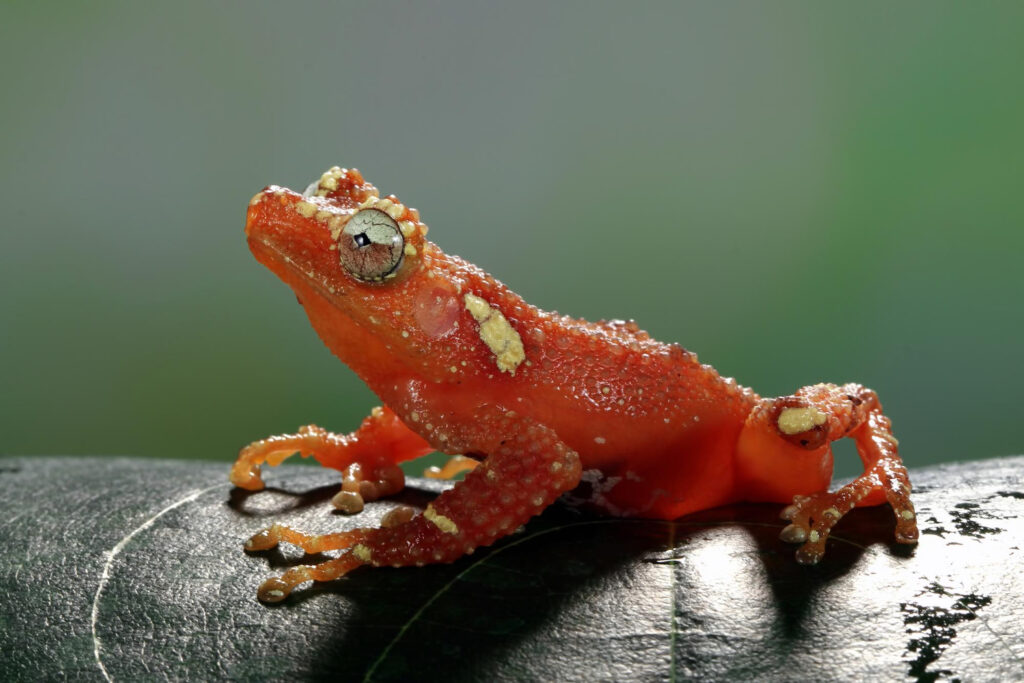
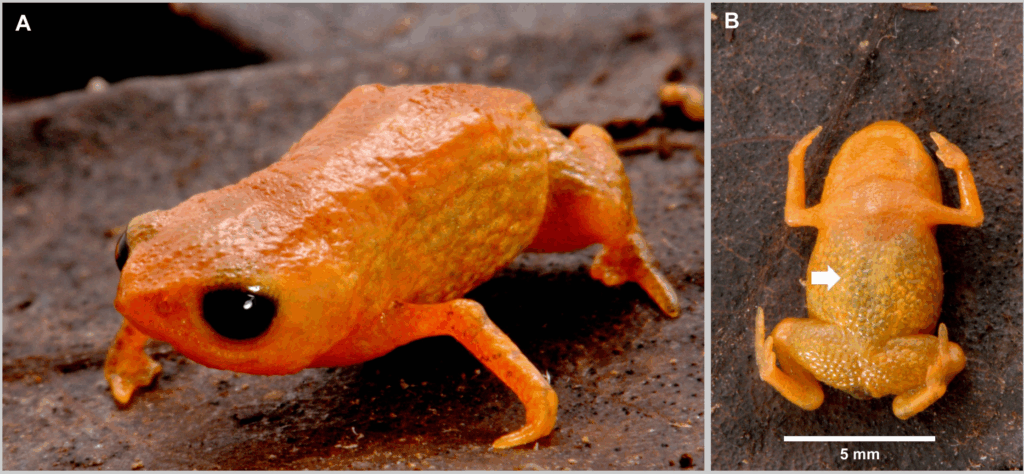
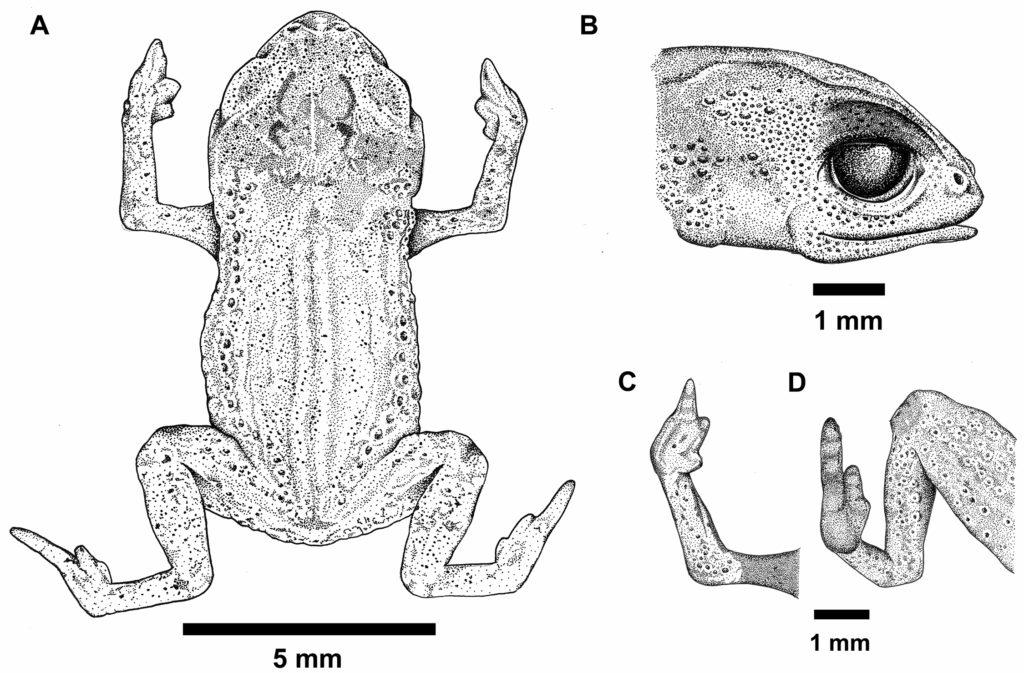
Let’s talk about just how small we’re dealing with here. Males measure between 8.9 and 11.3 millimeters long. Females run slightly larger at 11.7 to 13.4 millimeters. For perspective, a standard pencil eraser is about six millimeters across. We’re talking about a fully formed, living, breathing amphibian that barely stretches past two erasers placed end to end.
Yet within that impossibly small package exists everything needed for life. A rounded snout. Jet-black eyes. Smooth orange skin punctuated by irregular green and brown patches along the sides. Four visible fingers on each hand, with the fourth reduced to a vestigial trace in some individuals. And here’s something that still baffles researchers. No visible fifth toe. Evolution apparently decided these frogs didn’t need it.
Sexual dimorphism runs strong in the species, with females consistently outgrowing males. Both sexes share that unmistakable pumpkin-orange glow, a color scientists believe advertises potent skin toxins to any predator foolish enough to consider a meal.
Unlike most frogs, pumpkin toadlets skip the tadpole stage entirely. Eggs laid on land hatch directly into miniature froglets, ready to hop away and start their secretive lives in the leaf litter. No ponds needed. No swimming lessons required. Just instant, tiny frogs.
Bones That Tell Stories
When researchers put one specimen under a high-resolution CT scanner, they discovered a skeleton unlike almost anything else on the planet. Extreme miniaturization has done strange things to these animals over evolutionary time.
Vertebrae near the hips have fused. A mineralized layer sits just beneath the skin of the back, possibly stiffening the body or influencing color. Toe bones have disappeared. Skulls have shrunk and compacted. What remains is a highly specialized frame built for one purpose. Surviving as one of the smallest four-limbed animals on Earth.
Even stranger, some of their close relatives have bones that glow under ultraviolet light. Others appear completely deaf to their own mating calls. Scientists suspect these seemingly handicapped species might rely more on bright colors and body movements to communicate than on sound. How B. lulai fits into this puzzle remains an open question.
Life on Sky Islands
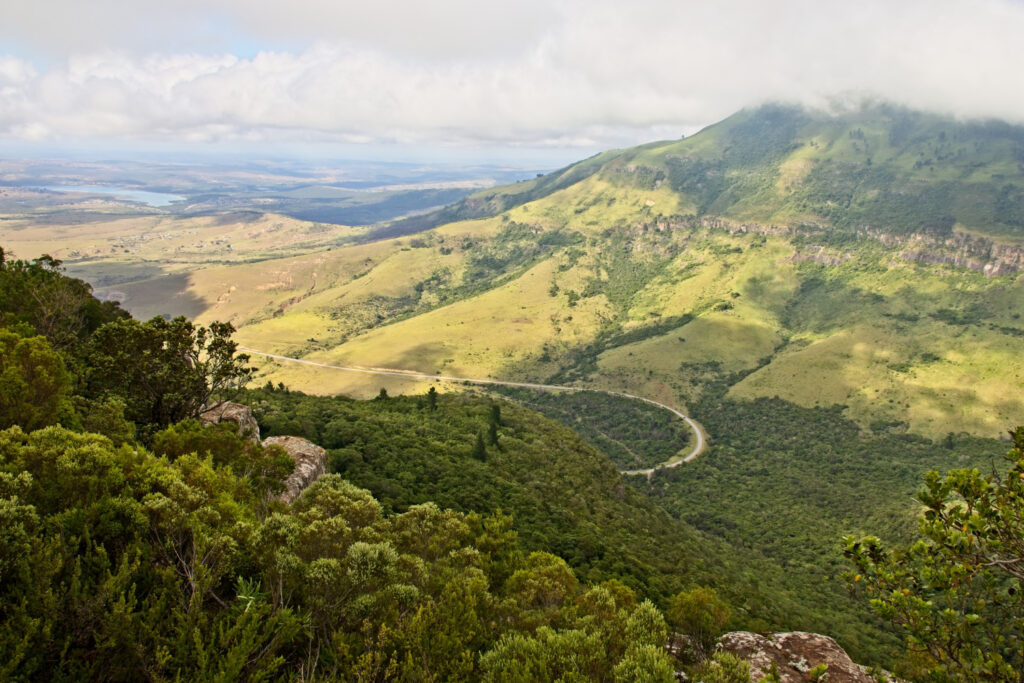
To understand how such a specific creature came to exist, you need to understand the landscape it calls home. Serra do Quiriri sits on the border between the Brazilian states of Paraná and Santa Catarina. Rugged peaks rise above 1,500 meters, their summits cloaked in grasslands and wrapped in cloud forests that stay misty and humid year-round.
Biologists call places like this “sky islands.” Isolated high-elevation habitats are separated by warmer lowlands that act as barriers for ground-dwelling creatures. A frog adapted to cool, damp mountain forests cannot simply walk across hot, dry valleys to reach the next peak. Each mountaintop becomes its own world.
During past dry periods in the region, forests retreated downslope, huddling in valleys while grasslands dominated the heights. When wetter conditions returned, trees marched back upward, reclaiming territory in isolated patches surrounded by open ground. These forest fragments became microrefugia, tiny stable patches where populations found themselves cut off from their relatives.
Stuck in separate pockets of suitable habitat, those isolated populations began to drift apart. Different calls. Different colors. Different genetics. Given enough time, they became different species entirely.
B. lulai shares Serra do Quiriri with two close cousins, B. auroguttatus and B. quiririensis. All three likely descended from a common ancestor whose population fractured as forests expanded and contracted across thousands of years. What looks like one mountain range to us was actually three separate worlds to these miniature frogs.
A Family Reunion 43 Species Strong
https://journals.plos.org/plosone/article?id=10.1371/journal.pone.0334746
Brachycephalus lulai becomes the 43rd member of its genus, and the discovery continues an extraordinary run of new finds. Before the year 2000, scientists knew of only seven species in this group. Since then, 35 more have emerged from the mountains of southeastern and southern Brazil.
DNA sequencing has revolutionized how quickly researchers can identify and describe new species. A few decades ago, a find like B. lulai might have taken years to confirm. Now, genetic analysis can settle questions in months. Combined with acoustic recording equipment and high-resolution imaging, modern science has opened a window into a hidden world of miniature amphibians that our ancestors never knew existed.
Many of these species are microendemic, restricted to a single mountaintop or a cluster of adjacent peaks. Some occupy ranges measured in single-digit square kilometers. For creatures so limited in distribution, every new threat carries outsized weight.
Safe For Now, But Watching Closely
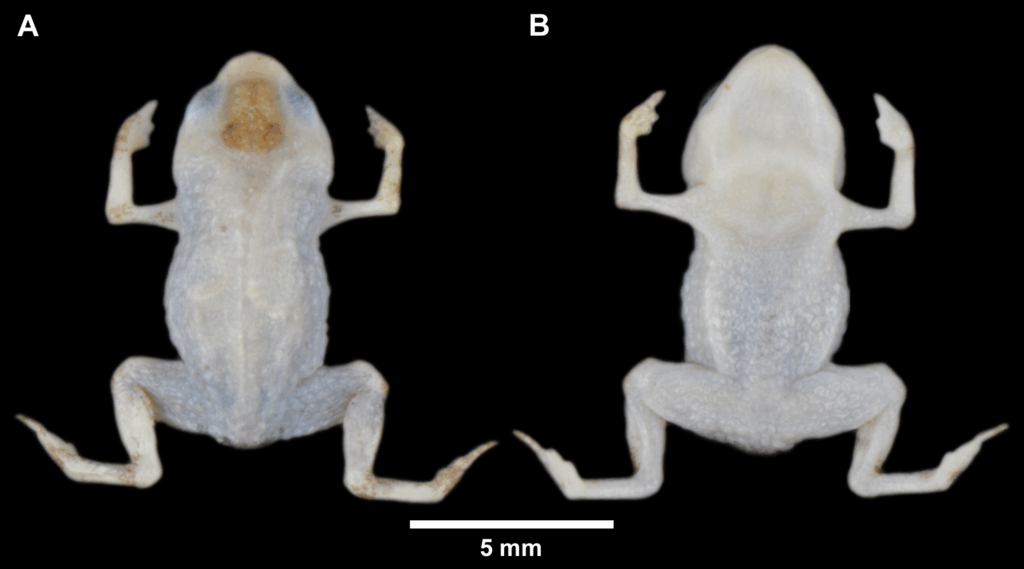
(Image Credit: Luiz Fernando Ribeiro, CC-BY 4.0)
Here’s where the story takes a complicated turn. Despite occupying roughly 8 square kilometers of suitable habitat, B. lulai currently faces no obvious threats severe enough to warrant alarm. Researchers recommend classifying it as “Least Concern” on conservation assessments.
But that classification comes with important caveats. “Although Brachycephalus lulai sp. nov. is currently classified as Least Concern, this status is based on the absence of observed ongoing decline and the apparent lack of plausible future threats. Nevertheless, it is essential to continue systematically monitoring this scenario,” the study authors wrote.
Surrounding mountains already face grassland fires, cattle grazing, invasive pine trees, expanding roads, and tourist trails that could damage forests if they spread upslope. Across the Atlantic Forest biome, remaining fragments often sit small and isolated, leaving species with tiny ranges exposed to any local disturbance.
A single bad fire season. An unchecked spread of invasive plants. A new road was carved through the critical habitat. For a frog that exists nowhere else on Earth, any of these could spell disaster.
A Refuge Worth Fighting For
Conservation doesn’t always require dramatic interventions. Sometimes, it means drawing a line on a map and saying “here, at least, we will protect what remains.”
Researchers propose creating the Refúgio de Vida Silvestre Serra do Quiriri, a wildlife refuge covering about 6,600 hectares. Under Brazilian law, this type of protected area allows land to remain mostly in private hands while still establishing legal safeguards against destructive activities.
“The new species is found close to other endemic and threatened anurans, justifying a proposition for the Refúgio de Vida Silvestre Serra do Quiriri, a specific type of Integral Protection Conservation Unit that would not necessitate expropriation of land by the government. This unit would help ensure both the maintenance and potential improvement of the conservation status of these species,” the research team concluded.
One refuge could protect three Brachycephalus species plus the endangered Melanophryniscus biancae frog. Practical management could include controlled burns to prevent catastrophic wildfires, sustainable cattle stocking rates, removal of invasive pines, and regulated tourism that brings economic benefits without trampling sensitive habitats.
What One Small Frog Can Teach Us
We live in an age of mass extinction. Species vanish faster than scientists can count them. Habitats fall to chainsaws and bulldozers. Climate shifts reshape ecosystems in real time.
Against that backdrop, discovering a new species feels like finding a love letter from the universe. A reminder that life still holds secrets. That wonder still hides in misty mountain forests, waiting to be heard if we only learn to listen.
B. lulai teaches us something important about paying attention. Researchers walked past these frogs for years before they recognized the calls as something new. How much else do we overlook because we haven’t learned to notice it yet?
Naming a species after a political figure draws headlines, but headlines fade. Real protection requires sustained action, local support, and the willingness to value what cannot be measured in economic terms. A frog the size of a pencil tip contributes nothing to GDP. It won’t cure diseases or feed hungry populations.
Yet it represents millions of years of evolutionary history, a lineage that survived ice ages and droughts, and shifting continents. It carries a message from the past to the future, written in DNA and voiced in high-pitched calls that echo through cloud forests.
Protecting tiny habitats preserves long evolutionary histories. Sometimes, the smallest things carry the biggest messages. And sometimes, you have to close your eyes and simply listen to discover what’s been there all along.