

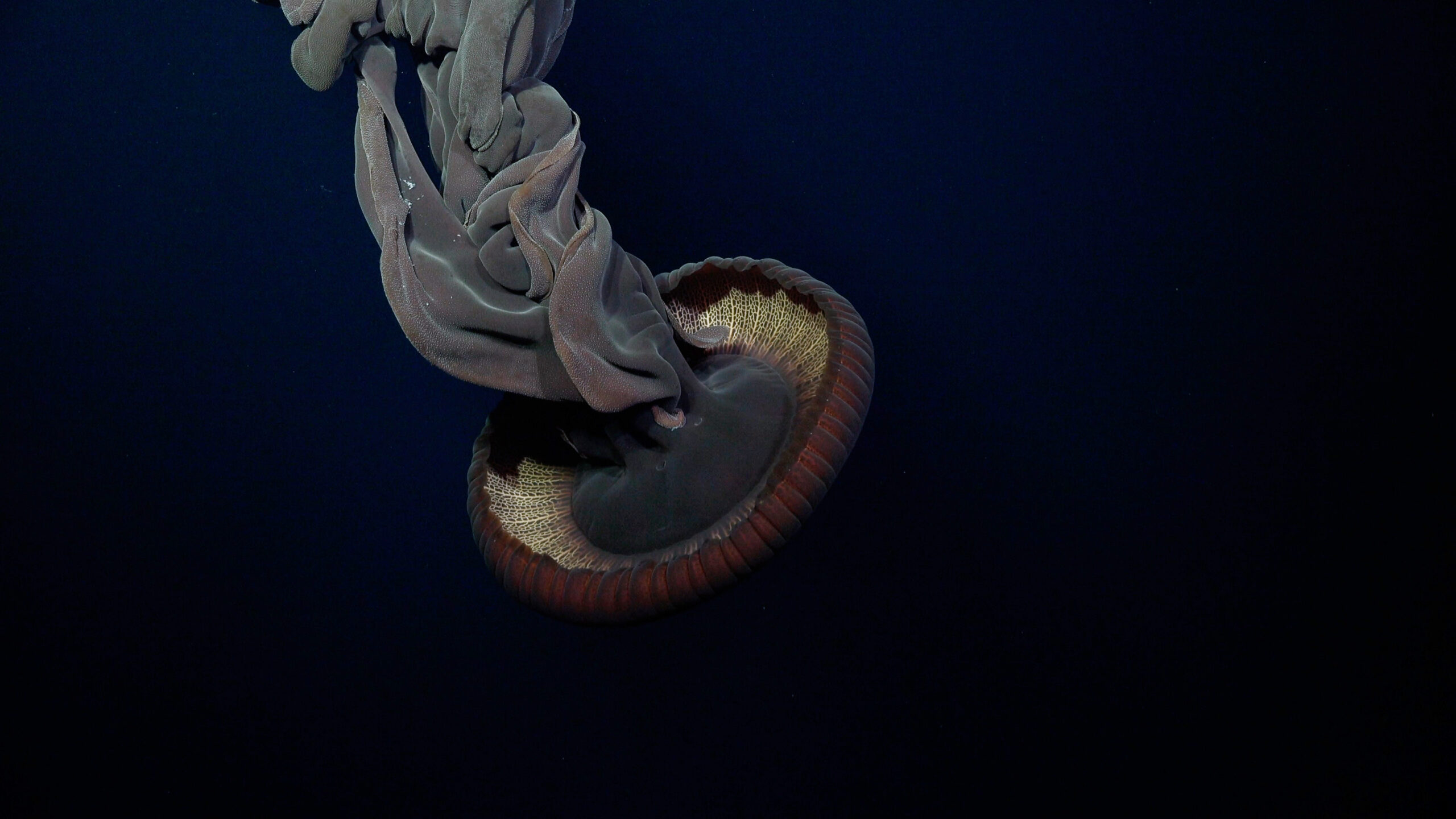
School-Bus-Sized Jellyfish Discovered Off the Coast of Argentina
What if the biggest things on this planet are the ones we never actually see? We live in a time where it feels like every piece of information is just a click away, yet the deepest parts of our world are still as mysterious as outer space. A recent encounter in the Atlantic Ocean has reminded us that while we go about our daily lives, massive giants are drifting through the dark, just waiting to be discovered.
Meet the Phantom of the Abyss
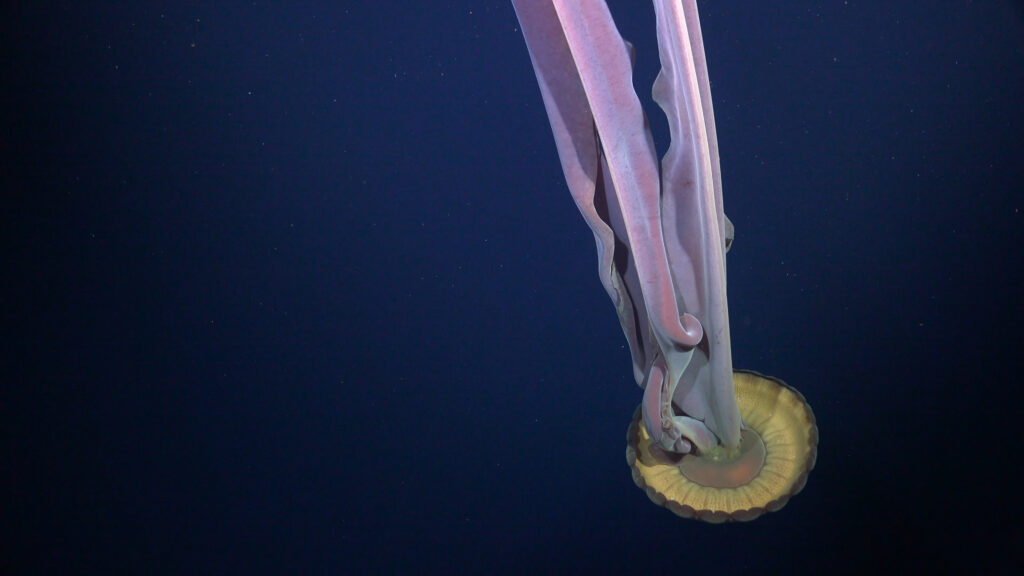
In late December, a team of researchers lowered a robotic vehicle into the cold waters off the coast of Argentina. They were scanning the ocean floor when, at a depth of 800 feet, the control room suddenly went quiet. On their screens floated a creature so large and rare that it felt like seeing a ghost.
It was a Stygiomedusa gigantea, or giant phantom jelly. This is not the type of small jellyfish you might see washed up on a beach. It is a massive animal with a bell over three feet wide and four thick, ribbon-like arms that can stretch thirty feet long. To put that in perspective, this creature is the length of a standard school bus drifting through the deep.
For over a century, scientists knew these giants existed, but they almost never saw them alive. Since 1899, they have only been recorded roughly 100 times, usually found damaged in fishing nets. Seeing one moving freely in its natural habitat is incredibly rare. As Steve Haddock, a marine biologist, noted, people often think the unexplained parts of our ocean are filled with tiny, hidden things. The reality is different. We are sharing this planet with massive living things that have simply gone unnoticed.
María Emilia Bravo, the biologist who led the dive, described the moment as a “mixture of excitement and disbelief.” It serves as a powerful reminder that even in the modern age, where we think we have mapped the entire world, there are still giants drifting in the dark, waiting to be seen.
Surviving the Darkness Together
In the “midnight zone” of the ocean, a layer of water that extends down to 13,000 feet, total darkness surrounds everything. Food is scarce, and there are very few places to hide. Survival here seems like a lonely, brutal game. Yet, the giant phantom jelly does not navigate this darkness alone.
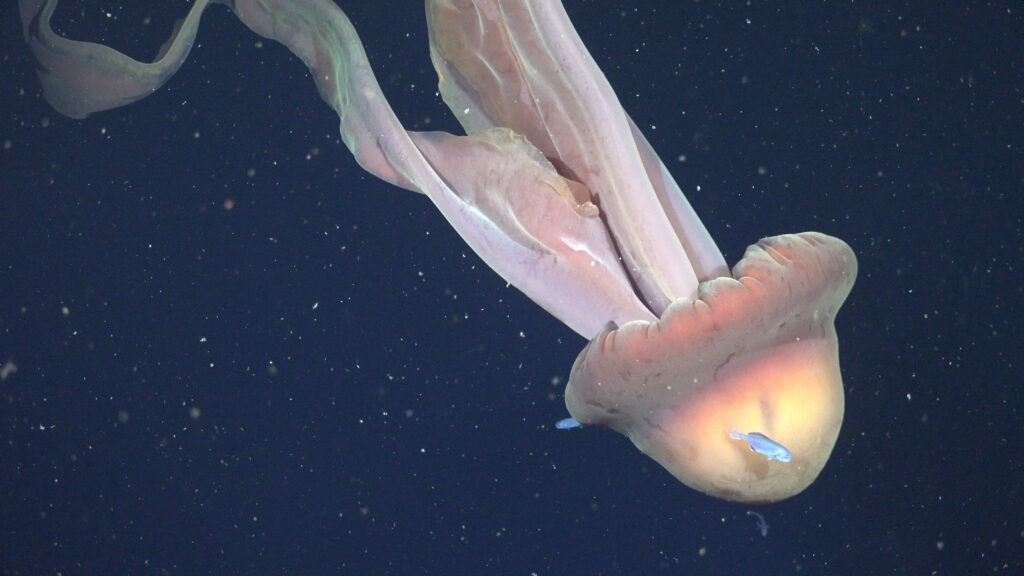
Unlike other jellyfish that use venomous stingers to stun their prey, this giant uses its thirty-foot, curtain-like arms to scoop up plankton and small fish. But if you look closely at the footage captured in Argentina, you see something strange. Small fish are swimming calmly right next to the jelly’s massive bell, hovering in and out of its dangerous arms.
These fish, identified as Centrolophus, are not being eaten. They are partners. It is a perfect trade-off. The jellyfish provides a moving fortress, protecting the small fish from other predators in the open water. In return, the fish act as a cleaning crew, eating parasites that would otherwise harm the jelly.
Steve Haddock, a marine biologist, describes this relationship as an “Odd Couple” type story. Despite the vast emptiness of the ocean, these two very different species find each other and stick together for protection. It is a powerful lesson from the bottom of the world: nothing survives entirely on its own. Even in the deepest, coldest dark, life finds a way to cooperate.
A Universe Beneath the Waves
It turns out that the deep ocean is not a barren wasteland but a bustling metropolis of life that we are only starting to understand. During the same expedition, scientists documented twenty-eight new species, ranging from deep-sea urchins to ancient corals.
They stumbled upon a “whale fall,” which is the carcass of a whale that has sunk to the ocean floor. This might sound grim, but in the deep sea, it becomes a vital oasis of food that supports life for decades. Nearby, they found “cold seeps,” areas where methane bubbles up from the Earth’s crust. These spots act like underwater gas stations, fueling microbes that sustain clams, mussels, and tube worms in a place where sunlight never reaches.
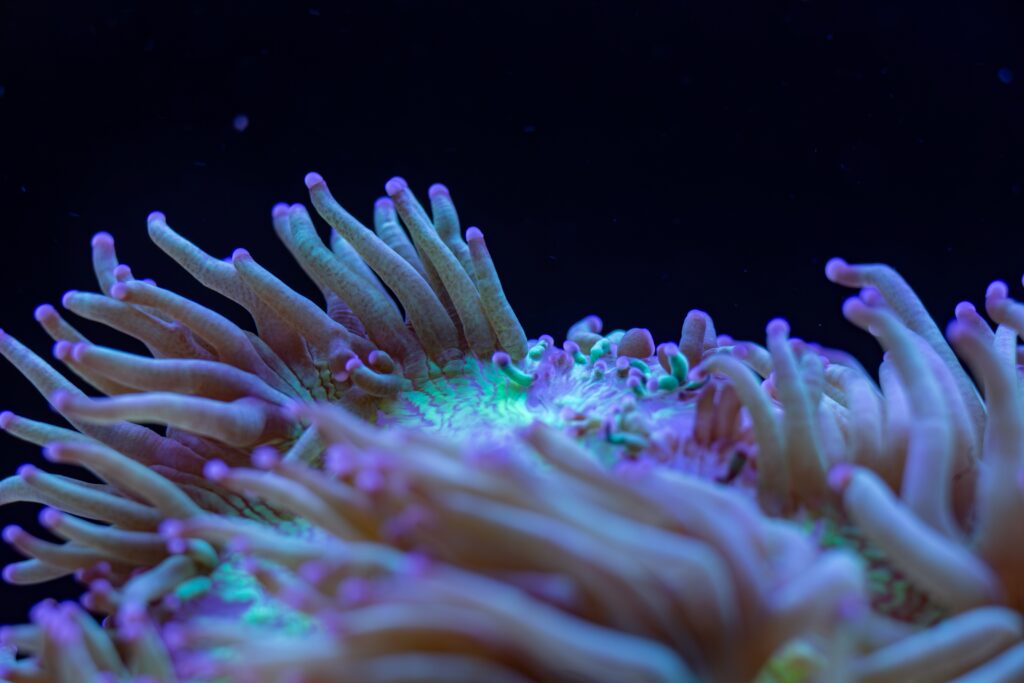
The team even discovered vast gardens of “bubblegum coral,” named for their bulbous, pink tips. It is a colorful, thriving world hidden in total darkness. As María Emilia Bravo, the expedition’s chief scientist, noted, “We opened a window into our country’s biodiversity only to find there are so many more windows left to be opened.”
It challenges the idea that we have seen it all. Just when we think we have mapped our world, the ocean reminds us that there are still entire landscapes and ecosystems waiting right beneath our feet.
Life on the Edge: Thriving in the Void
We often treat the deep ocean like it is invincible—a dark, cold void that nothing can hurt. But the data tells a different story. The expedition didn’t just find new animals; they found that the boundaries of life are far wider, yet more fragile, than we imagined.
Take the Bathelia candida coral. Scientists found a massive reef thriving nearly 400 miles further south than anyone thought possible. This isn’t just a pile of rocks on the sea floor. It is a nursery for fish, octopuses, and crustaceans, serving as a critical piece of the ocean’s puzzle in a place previously thought to be empty.
Melisa Fernández Severini, a researcher on the team, emphasized that while these ecosystems are extraordinary, they are also incredibly vulnerable. The ocean holds 98% of the living space on our planet, yet we know so little about how it functions. When we don’t know something exists, we cannot protect it.
Discovering these deep-water highways is not just about curiosity. It is about realizing that even at 3,000 meters down, life is delicate. A change in one area ripples through the entire web. We are realizing that the deep sea is not disconnected from us; it is the foundation that supports the rest of the planet.
The Power of Staying Curious
It is easy to believe that there is nothing left to find. People have mapped the mountains and looked at the stars, often assuming every corner of this planet is already understood. But then, a creature the size of a school bus drifts out of the darkness. It is a giant that has lived alongside humanity for ages, yet remained almost completely invisible until now.
This discovery brings a needed dose of humility. If a thirty foot animal can go unnoticed for over a hundred years, it is clear that the world is much bigger than many people imagine. As the researchers noted, opening one window into the deep only shows how many other windows are still closed.
The ocean is not just a blank space on a map or a resource to be used. It is a living frontier that holds the history of the Earth. If such a massive being can stay hidden in the shadows, imagine the other secrets waiting in the silence of the deep. It is a call to look past the surface of everyday life.
Real growth starts by admitting that the full picture is not yet clear. This jellyfish is a sign that wonder is still alive. Stay curious. Keep an open mind. The world is still full of magic for those who are willing to search for it.
FEATURED IMAGE CREDIT: ROV SuBastian / Schmidt Ocean Institute