

Hospice Nurse Explains The One Sign That Appears In The Final Weeks Of Life
Death is a subject most people instinctively avoid until it becomes impossible to ignore. It carries fear, uncertainty, and a sense of helplessness, especially in cultures that prioritize youth, productivity, and constant forward motion. When someone we love begins to decline, the lack of honest conversation around dying often makes the experience even more frightening. Many families enter the final weeks of life feeling unprepared, unsure of what is normal, and terrified of what every new change might mean.
For hospice nurse Julie McFadden, this silence around death is exactly what causes unnecessary fear. As a Los Angeles based registered nurse specializing in end of life care, Julie has spent years sitting beside patients in their final weeks and guiding families through the process. Known online as Hospice Nurse Julie, she uses social media to share what she witnesses every day with the goal of alleviating what she calls “the fear and stigma around death and dying.” In a recent video that has deeply resonated with viewers, Julie revealed what she considers one of the clearest signs that someone is likely to die within a few weeks. Rather than framing it as something dark or terrifying, she described it as a natural and often peaceful part of the dying process.
Who Hospice Nurse Julie is and why her voice matters
Julie McFadden has witnessed hundreds of deaths during her career, not from a distance, but up close in patients’ homes and hospice facilities. Her work places her in intimate moments where people are at their most vulnerable, surrounded by family, memories, and emotion. Through these experiences, she has noticed consistent patterns that repeat themselves regardless of age, background, or belief system.
On platforms like TikTok and YouTube, Julie has built an audience of millions by speaking openly about what happens at the end of life. Her calm and compassionate explanations have made her a trusted voice for people caring for dying loved ones and for those simply trying to understand mortality. She also authored the bestselling book “Nothing to Fear,” expanding on the same themes she shares online.
Julie is careful to clarify that she does not predict death or offer guarantees. Instead, she educates families about signs that hospice workers commonly see so that people are not caught off guard. Her goal is not to remove grief, but to replace panic with understanding and presence.
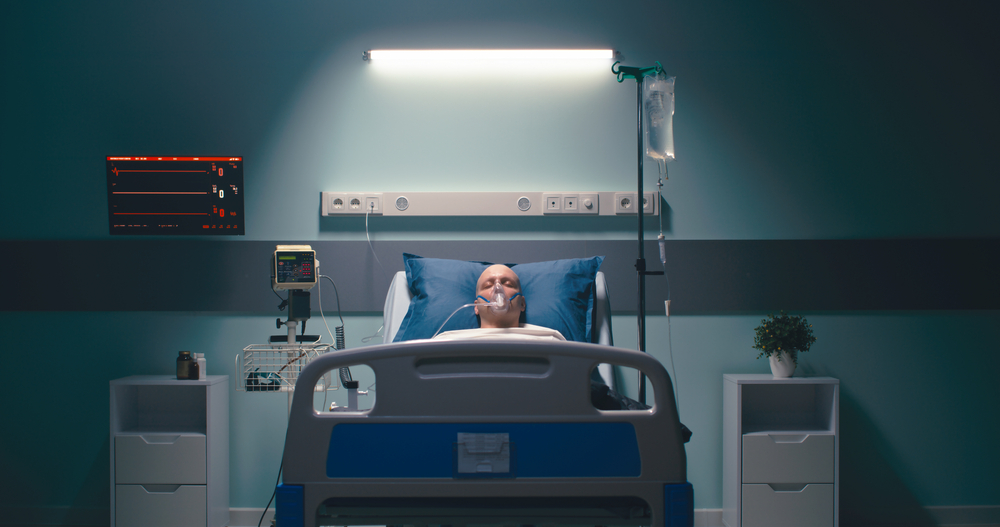
Image Credit: Shutterstock
The ‘death stare’ Julie says often appears weeks before death
In her video, Julie explains that there are several end of life phenomena that happen to most people. One of the earliest signs she notices, usually a few weeks to about a month before death, is something she refers to as the “death stare.” Despite the unsettling name, she stresses that it is not a scary experience for the person going through it.
“If you’re not familiar with the end-of-life phenomena, there’s a few things that happen at the end of life to most people,” Julie explained. “One of the things is called a death stare, which is when someone gets really fixated on a certain part of the room, and no matter what you do.”
She continued by describing how intense the fixation can be. “You can snap your finger right in front of their face – an they will not move their gaze.” According to Julie, people experiencing this often appear calm or even joyful rather than confused or distressed.

Image Credit: Shutterstock
What the death stare actually looks like in real life
Julie noted that the death stare does not always look the same. “Sometimes they just stare. Sometimes they will talk to someone who you don’t see,” she said. “Sometimes they’ll have a big smile on their face, like they’re seeing something that’s obviously making them very happy.”
These moments often happen repeatedly throughout the day, with patients shifting their focus away from conversations and locking onto something unseen. Family members may initially think their loved one is daydreaming or confused, especially if they are not familiar with end of life changes.
Julie emphasized that this behavior is not something to correct or interrupt. From her experience, it is simply part of the transition that happens as someone nears the end of their life, and it often brings a sense of calm rather than distress.
A patient story that stayed with Julie
Julie shared a story about an elderly man she was caring for that clearly left a lasting impression on her. The man and his wife were both in their mid to late 90s and had been married for 70 years. “I instantly loved these two. They were so, so, so sweet,” Julie recalled. “They still seemed to be pretty madly in love.”
She described the patient as “pleasantly confused.” He recognized his wife and was happy to see Julie, but he struggled to keep up with conversations. As Julie was checking him over, she noticed that “he would be looking at me and smiling, then suddenly turn his head and be fixated on another part of the room.”
Julie said he would then break into “a huge smile, like he was seeing something over there.” Throughout the visit, she tried to regain his attention but could not. “Even though I am a hospice worker, it still always floors me hearing the stories in real time and seeing them,” she said.

Image Credit: Shutterstock
Why hospice workers see this as a timeline marker
Julie explained that she wanted the man’s wife to notice what was happening because these signs can sometimes give families a sense of timing. “A lot of times these end-of-life phenomena can kind of give you a timeline of when this person may be dying,” she told viewers.
She added, “I usually starts happening a few weeks to a month before someone dies.” In this case, the wife revealed that her husband had been staring off into space and smiling for about a week, multiple times a day.
When the wife asked him what he was looking at, he gave an answer that surprised them both. “He said ‘Jesus,’” the wife told Julie. Julie explained that “many people say they see many different things and it usually depends on what religion they are.”

Image Credit: Shutterstock
End of life visioning and seeing loved ones who have died
Another sign Julie often witnesses in people nearing death is what she calls end of life visioning. “It’s one of the main phenomena’s that we see as healthcare workers at the end of life,” she explained.
“This is when someone sees someone who has died already that they usually love and know,” Julie said. This can include parents, siblings, friends, or even pets. She added that patients may “have conversations right in front of us with these people that we don’t see.”
According to Julie, this experience is so common that hospice teams include it in educational packets for families so they are not alarmed when it happens.

Image Credit: Shutterstock
A moment that gave everyone chills
As Julie continued speaking with the elderly man’s wife, another detail emerged. The wife’s sister had recently passed away, but she had not told her husband because she did not want to upset him while he was vulnerable.
After a week, she decided to tell him anyway. His response stunned her. He calmly told her, “She came to me last week and told me she had died.”
Julie said, “I’m getting chills telling you this story.” The wife shared that her husband was smiling as he said it, “like he was OK with it.”
Why experts say these visions should not be feared
Some people assume that visioning is caused by a lack of oxygen or confusion, but Julie pushed back on that idea. “Because when it does happen, most people are alert and oriented and are at least a month from death, so they don’t have low oxygen,” she explained.
Researcher and hospice expert Christopher Kerr has also studied these experiences extensively. He has observed that the people who appear in these visions are often those who once protected and comforted the dying person, rather than figures associated with fear.
Kerr has said that trying to explain the cause of these experiences can sometimes miss what matters most. The meaning and comfort they bring to the patient is what deserves reverence.
What families can do when they witness it
Julie advises families not to argue with or dismiss what their loved one is seeing. As long as the experience is not causing distress, it does not need to be treated or corrected.
Many patients describe these visions as reassuring. They may feel guided, comforted, or told that everything will be okay. For families, understanding that this is normal can reduce fear and allow them to focus on being present.
Julie believes that education is one of the greatest gifts hospice care can offer, because it replaces panic with understanding during an already emotional time.
A quiet takeaway about death and living
Julie McFadden’s message is not about predicting death or removing grief. It is about honesty. By talking openly about what happens at the end of life, she hopes people will feel less alone and less afraid.
While death will always be painful for those left behind, the process itself is often gentler than many expect. For many patients, the final weeks are marked by peace, connection, and moments of deep meaning.
If there is a lesson to take away, it may be this. Talking about death does not make it come sooner. But understanding it can make the journey feel less frightening, and remind us to focus on what matters most while we are still here.
Featured Image Credit: Shutterstock