


Woman Goes Viral After Sharing Sketches of What She Saw During a Near-Death Experience
Most people spend their entire lives afraid of the end, imagining death as a cold, dark switch where the lights simply go out. We assume that when the heart stops, the story is over. But a viral drawing from a woman who survived the unthinkable, along with new discoveries from neuroscientists, suggests that we might have it all wrong. The boundary between life and death isn’t a silence; it might just be the loudest, most vivid moment of them all.
The Stadium of Souls
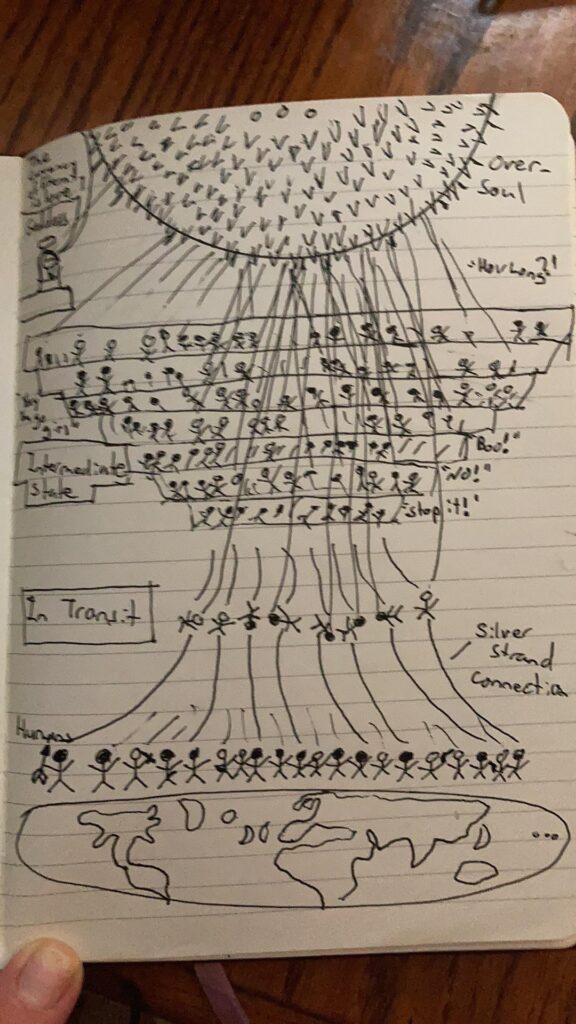
Two years after surviving a near-death experience, a woman picked up a pen to sketch a memory that refused to fade. It was not a chaotic void she witnessed, but a structured, vibrant reality. In her drawing, the Earth appeared at the bottom, resembling a theater in the round. As she ascended, she saw a stadium shaped like a spiral climbing toward a blindingly bright heaven.
This spiral was not empty. It was lined with souls watching the Earth below. They reacted in real time, offering cheers and encouragement to the living. They saw everything. At the height of this ascent, a radiant figure appeared on a balcony, causing a reverent silence to fall over the stadium. Her face shone like white light, and she offered a single, powerful command: “Do not be afraid.”
Perhaps the most striking detail was the presence of slender silver cords. These thin lines connected every soul in heaven and every person on Earth to the light at the top of the spiral. It revealed a universal truth: everyone is connected to one source, and that source is love. The woman returned with a specific instruction that defines the human experience: “The currency of eternity is love.”
A Fireworks Finale
For generations, humanity viewed death as a sudden switch to darkness, a fading signal that simply cuts out. However, modern science suggests the exit is not a shutdown, but a crescendo. The legendary Apple founder Steve Jobs hinted at this mystery with his final words: “Oh wow, oh wow, oh wow.” Now, researchers are beginning to understand the biological mechanics behind that awe.
Dr. Jimo Borjigin and her team at the University of Michigan have analyzed the brains of patients in their final moments. Contrary to the belief that the brain immediately goes dormant when the heart stops, their findings reveal a state of “hyper-activation.” In the seconds after life support is removed, the brain does not whimper; it roars to life.
EEG recordings have captured significant bursts of gamma waves—the highest frequency of brain waves typically associated with intense focus, memory recall, and consciousness. This phenomenon occurs in the “posterior cortical hot zone,” an area essential for sensory perception. Dr. Ajmal Zemmar, a neurosurgeon, describes this surge as the “neuronal equivalent of a fireworks finale.”
When the brain ceases to receive oxygen, a state known as hypoxia, it triggers a massive release of neurotransmitters. It is a highly coordinated biological event, not a chaotic malfunction. The brain appears to be working overtime, potentially replaying memories or synthesizing a final, profound reality. Science is providing the physiological evidence for what spiritual traditions have claimed for eons: the end of life is a moment of intense, vivid clarity.
Does Your Life Really Flash Before Your Eyes?
The old cliché says your life flashes before your eyes. Science is now validating this cinematic finality. As the brain loses oxygen, it does not simply fade to black; it unlocks the library of the past. Dr. Jimo Borjigin notes that even with closed eyes, the dying brain triggers a cascade of memory recall, accessing the temporoparietal junction. This is the same area active during dream states and reported out-of-body experiences.
Dr. Charlotte Martial, a neuroscientist at the University of Liège, proposes that this is not magic, but a complex chemical cocktail. A sudden drop in energy causes a flood of neurotransmitters. Serotonin spikes, potentially creating vivid visual imagery. Endorphins rush in, masking pain with an overwhelming sense of peace. Noradrenaline helps etch these final moments into a conscious experience.
Some researchers believe this is an evolutionary echo of “thanatosis,” the biological instinct to play dead in the face of a predator. It is a defense mechanism designed to detach the mind from the terror of the physical body. In these critical moments, the brain transforms a frightening reality into a safe haven. It seems biology is hardwired to ensure that when the end comes, it arrives not with fear, but with a chemical embrace of comfort.
What Happens in the Mind After the Heart Stops
Hollywood has taught us that death is a specific moment in time. The monitor beeps, the line goes flat, and the doctor looks at the clock to declare the end. But Dr. Ajmal Zemmar argues that this is a fundamental misconception. Death is not a time; death is a process. It is not a sudden switch that flips off, but a gradual transition where the brain continues to function long after the heart has stopped beating.
This gray zone between life and death is redefining medical science. Research led by Dr. Jimo Borjigin found that the brain might actually play a role in shutting down the body. In studies involving rats, blocking signals from the brain to the heart actually prolonged survival. This suggests the brain is not just a passenger in death, but the pilot. It may actively suppress the heart, orchestrating the final shutdown.
Dr. Charlotte Martial notes that Near-Death Experiences often occur when medical staff assume a patient is unconscious. The person on the bed may appear gone, but inside, the mind is still active. The rippling spread of neuronal activity means we cannot pinpoint the exact second a conscious being disappears. The body may be silent, but the internal experience is still unfolding.
Before the Credits Roll

Whether you look at a sketch from a survivor or brain scans from a lab, the message is the same. The end is not a scary dark place. It is a return to connection.
Dr. Ajmal Zemmar asks a question that should make everyone pause: “What was the last emotional conversation you had with a friend or with your partner?”
If the final moments of life are a replay of your memories, then you have a job to do right now. You need to make a movie worth watching. Do not wait for the end to realize what actually matters. That viral drawing showed silver cords connecting every soul to a single source. That source was not money. It was not fame. It was love.
Death is simply a mirror of how you lived. The currency of eternity is love, so spend it wildly while you are here. Make that phone call. Forgive that mistake. Be present with the people around you. When the time comes to look back, make sure you aren’t left holding onto things you cannot take with you. Make sure you leave with a heart full of love.
Featured Image Source: Shutterstock