

The Universe Just Gave Us a Christmas Tree and It Has Something to Teach Us
Every once in a while, the universe interrupts our noise with a whisper. Not a shout. Not a command. Just a quiet reminder that life is bigger, older, and more patient than we are.
Recently, scientists released an image of something extraordinary: a cluster of young stars, 2,500 light-years away, arranged in a way that looks unmistakably like a Christmas tree. It’s beautiful. It’s festive. But more than that, it’s humbling.
Because while we’re rushing to become, the universe is calmly reminding us how becoming actually works.
A Tree Made of Stars, Not Decorations
The image that captured global attention was released by NASA as a composite observation of NGC 2264, a real star forming region within the Milky Way located about 2,500 light years from Earth. Its resemblance to a Christmas tree is not the result of decoration or fantasy, but of how astronomical data from different instruments can be layered to reveal structure that already exists in space.
The image combines observations across multiple wavelengths of light, each contributing distinct information. Blue and white points mark young stars detected in X rays by NASA’s Chandra X ray Observatory, while green wisps trace clouds of gas observed in optical light by the National Science Foundation’s WIYN 0.9 meter telescope. Infrared data from the Two Micron All Sky Survey adds depth by revealing stars otherwise hidden from view. Together, these datasets create a fuller picture of the region without altering its underlying science.
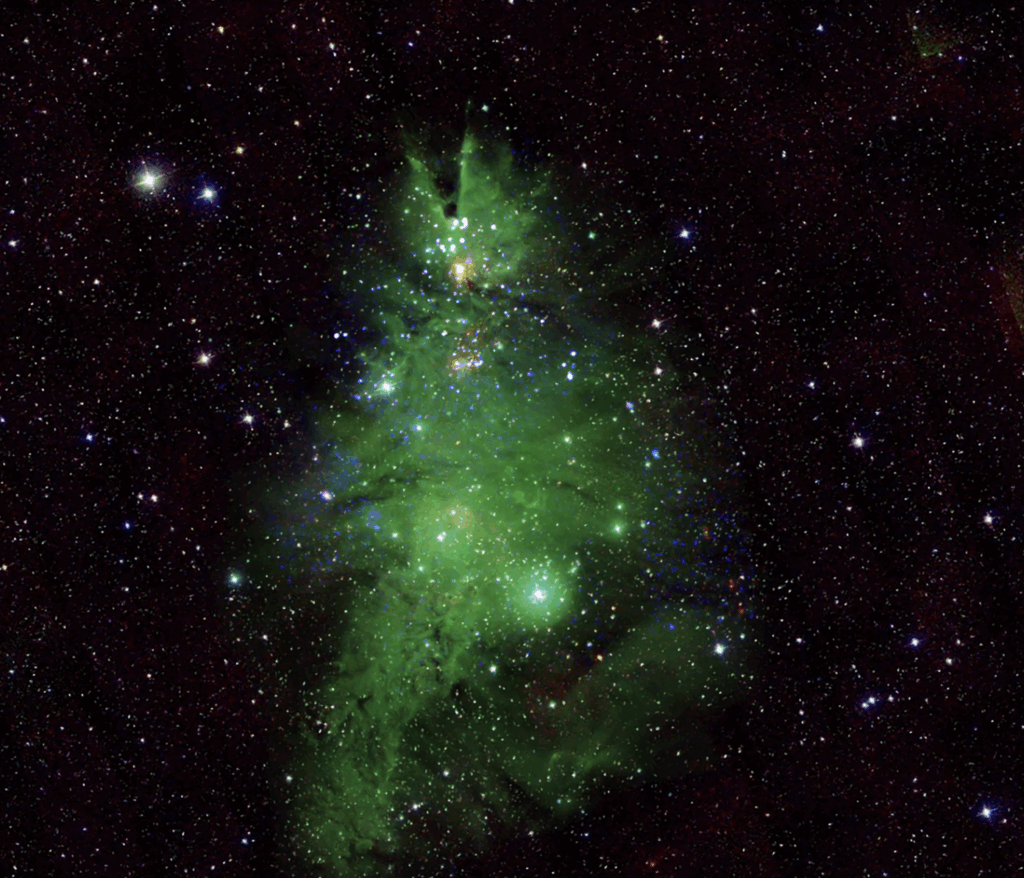
To make the structure easier to recognize, scientists rotated the image so its roughly conical shape points upward. This adjustment does not change what is being observed, only how it is presented. What emerges is a rare moment where rigorous scientific observation aligns with a familiar human pattern, not because meaning was imposed, but because the universe organized itself in a way that invites recognition.
Growth Has Never Been Uniform
We are taught, subtly and repeatedly, to expect progress to arrive on schedule. If you work hard, heal properly, and make the right choices, your life should unfold in a predictable sequence. But nature does not grow that way, and a star cluster makes that plain.
Even when stars are born in the same region, they do not develop in lockstep, largely because mass sets the pace. A higher mass star reaches key stages faster and burns through its fuel at a much greater rate, which means its life unfolds more quickly. Lower mass stars take longer to settle into steady hydrogen fusion, but they can endure for vastly longer spans once they do. So within one shared birthplace, you can have neighbors moving through fundamentally different timelines, not because one is failing, but because their starting conditions are different.
There is another layer to this as well. Star formation is not a factory line where every object receives the same amount of material. In star forming clouds, some embryo stars gain more mass through accretion than others, and interactions with nearby gas and companions can further influence how a young star develops. The outcome is a population that is related, but not identical, where differences are expected rather than exceptional.
If you bring that lesson back to your own life, it challenges a common form of self harm that wears the mask of ambition: comparing your timeline to someone else’s. When you judge your progress only by outward milestones, you ignore the quiet variables that shape growth, including your history, your responsibilities, your health, your environment, and the simple truth that people are built differently. Uniformity is not the standard. It never was.
The Illusion of Constant Light
In the animated version of the image, the stars appear to blink like Christmas lights. NASA is clear that this effect is artificial, designed to highlight where X-rays are detected and to emphasize the visual resemblance to a Christmas tree.
In reality, the stars don’t blink together. That detail matters. Because from a distance, we often assume others have it all figured out. Their light looks steady. Their life looks synchronized. But up close, everyone flickers.
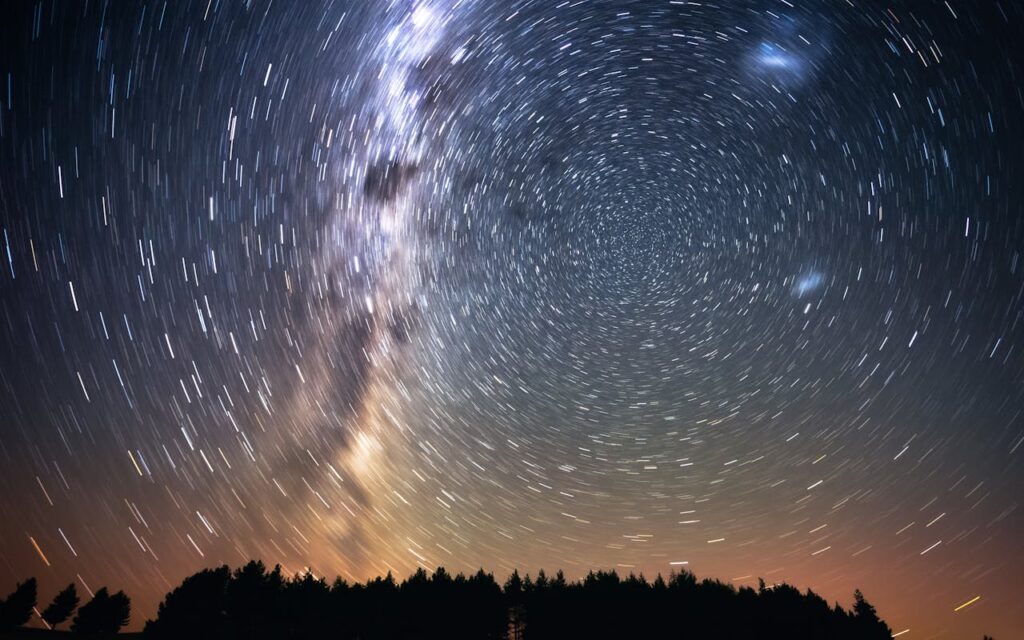
The variations scientists observe in these stars come from magnetic activity, powerful flares, rotation, dark regions on stellar surfaces, and shifting clouds of gas that temporarily obscure their light. Sometimes the brightness changes because material is still falling onto the star as it forms.
Translated into human terms: growth is messy. You don’t shine consistently while you’re still building your core.
We Are All Forming Under Pressure
When we say pressure, we often mean something has gone wrong. But pressure is also what makes change possible. In the cosmos, a star begins when gravity compresses a cloud of gas and dust until the center becomes hot and dense enough for nuclear fusion to ignite. That is not a gentle process. It is sustained compression, heat, and constraint. Formation is not the absence of force. Formation is what force can produce when it is channeled over time.
Human beings are not stars, but we are still biological systems shaped by stress. Your body reads challenge through the nervous system and hormones that prepare you to act. In small doses, that response can sharpen focus and help you meet a demand. In large doses, or when it never turns off, it can exhaust attention, disrupt sleep, and make ordinary problems feel unbearable. The point is not that pressure is good or bad. The point is that pressure is information. It tells you what you are carrying, how long you have been carrying it, and whether you have the support and recovery needed to keep carrying it.

This is where many people get stuck. They judge themselves for reacting to pressure, as if stress is proof of weakness. But a stressed mind is often a mind that has been trying to adapt without enough rest, clarity, or connection. If you want to form something stronger from what you are facing, you do not start by shaming the strain. You start by naming what is demanding energy from you, separating what you can control from what you cannot, and building small recovery habits that signal safety to your body again. That is not motivational talk. That is how regulation works.
Perspective Shapes Power
The image of NGC 2264 does not resemble a tree by default. Its now familiar shape emerges only after the data is rotated and color enhanced, allowing relationships between stars and gas to become easier for the human eye to recognize. In its original astronomical orientation, the structure is still there, but the meaning is harder to see. Nothing about the cluster itself changes. Only the frame does.
This detail matters because it mirrors how understanding often works in our own lives. There are moments when circumstances remain fixed, yet everything feels different once we look again with a wider lens. Growth, identity, and purpose do not always announce themselves clearly at first. They often reveal their coherence only after patience, reflection, or a shift in expectation makes space for it.
The same image also challenges how we interpret youth. The stars in NGC 2264 are young by cosmic standards, yet they are already energetic and active, emitting powerful X rays that far exceed those produced by our mature Sun. Their instability is not a flaw but a characteristic of early formation. They are not weak because they are young. They are intense because they are still learning how to regulate their energy.
When you place these two ideas together, perspective and youth stop looking like limitations. Being early in a journey does not mean lacking influence or significance. It often means your power has not yet settled into its final shape. With time, clarity, and the right frame, what once felt scattered can begin to make sense. What once felt premature can reveal itself as potential in motion.
What This Cosmic Tree Asks of Us
This image is not asking us to marvel and move on. It is asking us to pause and reflect. In a culture that rewards speed and constant output, it invites slowness. In a world that encourages comparison, it calls us back to our own timelines. It reminds us that fluctuation is not failure and that light does not disappear simply because it wavers.
What makes this lesson powerful is how quietly it arrives. Against the vast darkness of space, these stars still gather. They cluster. They form something coherent without urgency or performance. Growth happens not because it is rushed, but because conditions allow it to continue.

You do not need to be light years away to apply this perspective. You can begin by allowing yourself to be unfinished without treating that as a flaw. By recognizing that moments of instability often come before clarity. By releasing the habit of synchronizing your worth to someone else’s rhythm. By remembering that meaningful growth rarely happens in comfort alone.
The universe did not offer this image by accident. It offered it as a reminder that perspective can change everything. A tree made of stars. A message written in light. And a quiet reassurance that you are not late. You are becoming.
Image from Pexels