

A Musician Rescued His Dinner and Taught It Piano Instead
Mattias Krantz stands in front of a fish market tank, watching tentacles curl around glass walls as vendors prepare their daily catch. Most people see dinner swimming in that water. Krantz sees a piano student waiting to be discovered, a creature with eight independent brains that might just learn to make music if given the chance.
Swedish musician and YouTuber Krantz has built a career around eccentric experiments, but his latest project pushes beyond typical creative boundaries into territory most people would consider impossible. What happens when you rescue an octopus from becoming someone’s meal and attempt to teach it an instrument designed for human fingers? Six months of failures, breakthroughs, and unlikely friendship would provide answers nobody expected.
Rescuing Tako From the Fish Market
Walking through a live fish market presents choices most musicians never consider when searching for collaboration partners. Between tanks of lobsters and buckets of clams, Krantz spotted a young octopus whose fate had already been decided by market economics. Instead of letting the creature become takoyaki, the Japanese octopus dish that inspired its eventual name, Krantz purchased Tako and brought him home to begin an experiment that would captivate millions.
Musicians throughout history have worked with unusual instruments, invented new sounds, and pushed artistic boundaries in countless directions. Few have considered whether creatures from completely different evolutionary branches might share our capacity for musical expression. Krantz decided to find out if an animal without ears, bones, or anything resembling human physiology could learn to play piano.
Why an Octopus Makes the Perfect Piano Student
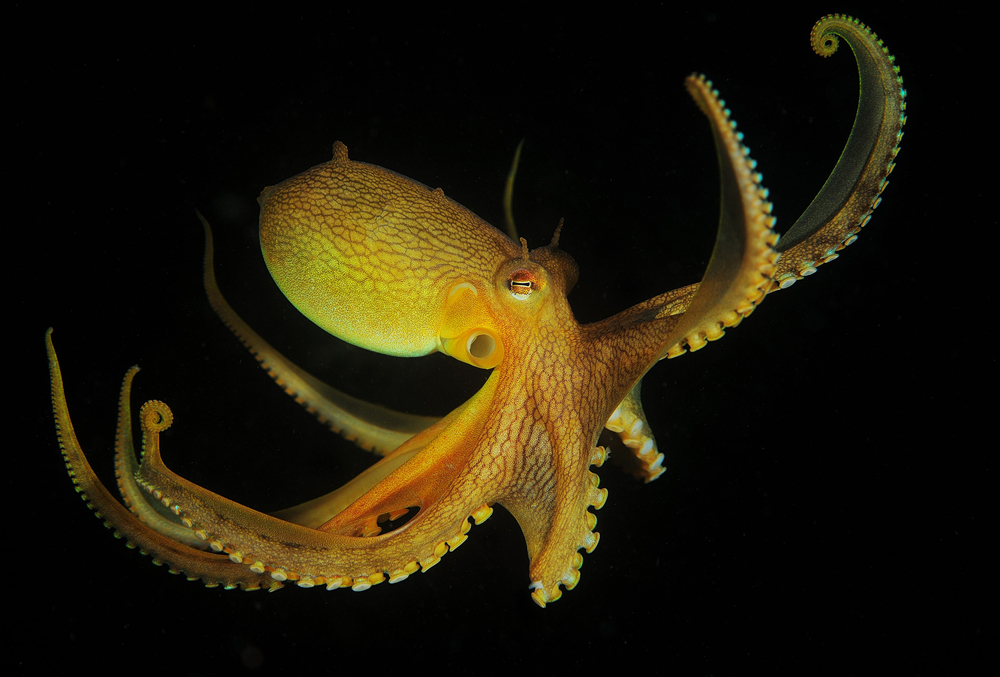
Intelligence tests reveal that octopuses operate at cognitive levels similar to human three-year-olds, solving problems that stump many other animals and demonstrating awareness that suggests complex internal experiences. Each of Tako’s eight arms contains its own cluster of neurons, essentially functioning as independent brains that communicate with the central nervous system while maintaining individual processing power. “I’ve always wanted to teach an animal piano. In theory, octopuses have incredible potential. They’re as smart as a three-year-old, amazing problem-solvers, and each of their eight arms has its own mini brain. It’s like having eight pianists in one body,” Krantz explained, recognizing potential that most people overlook.
Aquarium staff worldwide know octopuses as escape artists who unscrew tank lids, squeeze through impossible gaps, and demonstrate planning abilities that suggest they understand cause and effect relationships. Scientists have documented octopuses using tools, recognizing individual human faces, and even distinguishing between researchers who feed them versus those who merely observe. Opening jars presents no challenge for creatures who can manipulate objects with tentacles containing more nerve endings than entire human bodies.
Research from Brazil suggests octopuses may experience dreams during sleep, their skin rippling through color changes that mirror patterns seen during waking activities. Such findings push scientists to reconsider what consciousness means when it develops in bodies so alien to our own. Studying cephalopod brains offers insights into how intelligence can emerge through completely different evolutionary pathways.
Building a Piano for Someone Without Fingers

Creating an instrument that Tako could play underwater required engineering solutions that no piano manufacturer had ever considered. Traditional keyboards demand downward pressure from fingers, something tentacles struggle to provide with precision. Krantz designed a pull-lever system where Tako could wrap his arms around handles and yank them to activate keys, translating cephalopod strength into musical notes.
Waterproofing electronics presents challenges enough without adding the complexity of making them responsive to tentacle movements rather than finger strikes. Each lever needed precise calibration to respond to Tako’s pulling force while remaining underwater for extended periods. Months of design, testing, and redesign went into creating an aquatic keyboard that could survive both saltwater exposure and the curious prodding of an intelligent octopus determined to understand every component.
Teaching Music to a Student Without Ears
Octopuses lack ears entirely, perceiving their environment through vibration, touch, and visual input rather than processing sound waves the way terrestrial animals do. How do you teach music to a creature that experiences the world through completely different sensory channels? Krantz experimented with creating vibrations in Tako’s tank, hoping the octopus might perceive rhythm through pressure changes in the water surrounding him.
Questions about whether Tako could understand music as humans experience it remained unanswerable, yet Krantz pressed forward anyway. Perhaps music exists as more than organized sound, manifesting instead as patterns that intelligent creatures can recognize regardless of how those patterns reach their brains. Teaching Tako to play became as much philosophical exploration as musical experiment.
First Attempts and Spectacular Failures
Light-up keys seemed like an obvious solution, providing visual cues that would guide Tako toward correct notes and create associations between action and result. Tako hated them, ignoring the flashing lights while using his tentacles to investigate more interesting aspects of his environment. Fake crabs hidden inside the piano failed equally, with Tako quickly determining that plastic shells contained nothing worth pursuing.
Footage from those early weeks shows Tako sitting directly on top of keys, rendering them useless while he examined ceiling corners of his tank with apparent fascination. Other attempts resulted in Tako trying to eat equipment, wrapping tentacles around components that definitely should not enter cephalopod digestive systems. Long stretches passed where Tako simply stared into the void, seemingly questioning why his human companion kept presenting him with this strange underwater contraption.
Moments of doubt crept in as weeks passed without progress, leading Krantz to wonder if the entire project rested on a flawed premise. Maybe octopuses simply cannot play piano, regardless of their intelligence or problem-solving abilities. Maybe some barriers between species cannot be crossed through determination and creative engineering alone.
The Crab Elevator Changed Everything
Breakthrough arrived through a mechanism so simple that Krantz later wondered why he hadn’t thought of it sooner. Instead of hiding rewards or hoping Tako would develop intrinsic motivation to play, Krantz built a crab elevator that lowered real food incrementally as Tako pulled specific levers. Each correct action brought dinner slightly closer, creating immediate feedback loops that Tako’s brain could process and remember.
Watching Tako make the connection between pulling a lever and receiving food transformed the entire experiment from struggle to collaboration. Octopus intelligence excels at understanding cause and effect, and the crab elevator provided crystal-clear causation that Tako could grasp instantly. Pull lever, crab moves, repeat action, crab moves again, complete sequence, receive reward. Simple enough for a creature accustomed to solving puzzles to unlock shellfish in the wild.
From Random Notes to Actual Melodies

Repetition built Tako’s skills as he learned which levers corresponded to which keys and how pulling them in different orders created varied results. Multiple tentacles began hitting notes simultaneously, occasionally producing chords that surprised both octopus and musician. Simple sequences emerged as Tako memorized patterns that consistently delivered rewards, his actions shifting from random exploration to purposeful performance.
Krantz grabbed his guitar and began playing along, creating impromptu jam sessions between human and cephalopod that looked absurd yet somehow worked. Whether Tako understood he was making music remained unclear, but he had definitely learned to play with his aquatic toy in ways that produced sounds Krantz could incorporate into actual musical structures. “I almost forgot sometimes that Tako was destined to become someone’s dinner and now we’re making music together,” Krantz reflected, marveling at how their relationship had evolved from market transaction to artistic partnership.
What Science Tells Us About Octopus Brains
Research into cephalopod neurology reveals that octopuses share intelligence genes with humans despite our evolutionary paths diverging roughly 500 million years ago. Such convergent evolution suggests that certain cognitive capabilities may be inevitable outcomes when nervous systems reach sufficient complexity, regardless of body structure or environmental pressures. Octopus brains solve problems differently than mammalian brains, yet arrive at similar conclusions through alternate neural pathways.
Scientists at Berlin Institute for Medical Systems Biology study octopus nervous systems to gain insights into human neurology, believing that understanding how intelligence manifests in such different organisms will illuminate fundamental principles about consciousness and cognition. Nikolaus Rajewsky, scientific director at the institute, notes that examining how octopus brains function may provide new tools for interfacing with or understanding our own nervous systems better.
Growing awareness of cephalopod intelligence has sparked ethical debates about whether humans should continue eating creatures capable of such sophisticated mental processes. If octopuses can learn, remember individual humans, solve complex problems, and possibly even dream, do they deserve moral consideration beyond what we grant to less cognitively advanced animals? Tako’s piano lessons add another dimension to these conversations.
Twenty-Two Million People Couldn’t Look Away

Video documentation of Tako’s journey exploded across social media platforms, accumulating 22.7 million views on Instagram alone while spreading through YouTube, Facebook, and countless news articles. Comments poured in from viewers amazed by the dedication required, amused by the absurdity of the premise, and moved by the genuine connection developing between Krantz and his aquatic student. “No one would believe me if this wasn’t recorded,” Krantz admitted, acknowledging that the entire experiment sounds like elaborate fiction without video evidence.
Audiences watched Tako’s personality emerge through the fourteen-minute documentary, relating to his stubborn refusal to cooperate and his eventual triumph over seemingly impossible challenges. People love underdog stories, and Tako qualified despite being a cephalopod who started the journey destined for a cooking pot. His transformation from food to friend to internet sensation captured imaginations worldwide.
Choosing Companionship Over Returning to the Ocean
Krantz initially planned to release Tako back into his natural habitat after completing the experiment, believing that freedom represented the best outcome for a creature never meant for domestication. Months of working together changed that calculation as bonds formed between musician and octopus that neither seemed willing to break. Tako had adapted to tank life, learned to trust his human companion, and developed behaviors that might not serve him well in the wild.
Keeping Tako as a permanent pet meant accepting responsibility for a creature with complex needs and relatively short lifespans, yet Krantz decided their partnership deserved continuation beyond the experiment’s official conclusion. Now Tako lives peacefully at home with his teacher, occasionally participating in musical jam sessions when the mood strikes both of them. Their relationship transcends the original goal of teaching an octopus piano, becoming instead a testament to connection across vast evolutionary distances.
What This Wild Experiment Actually Taught Us
Krantz set out to answer a simple question about whether octopuses could learn piano, but his journey with Tako revealed truths about intelligence, communication, and the unexpected places where understanding can flourish. Animals possess capabilities that humans consistently underestimate, limited more by our inability to recognize alien cognition than by any deficit in their mental capacities. Creating conditions where Tako could demonstrate his abilities required Krantz to abandon human-centric assumptions and meet his student on cephalopod terms.
Whether Tako understands music remains debatable, yet he definitely learned to interact with an instrument in ways that produced organized sounds Krantz could incorporate into performances. Such achievement matters less as scientific proof than as inspiration for reconsidering the boundaries we draw between species and the possibilities that emerge when we approach other creatures with creativity rather than preconception. Tako may never perform Chopin, but his tentacles pulling levers to make notes ring out underwater represent something valuable in their own right.
Krantz and Tako continue making music together, an odd couple united by curiosity and sustained by mutual affection. Their story reminds us that connection can bloom in the strangest circumstances when we remain open to possibilities that logic suggests should be impossible. Sometimes the best collaborations emerge from the most unlikely partnerships, even when one partner lacks bones, ears, and any evolutionary reason to care about human musical traditions.