

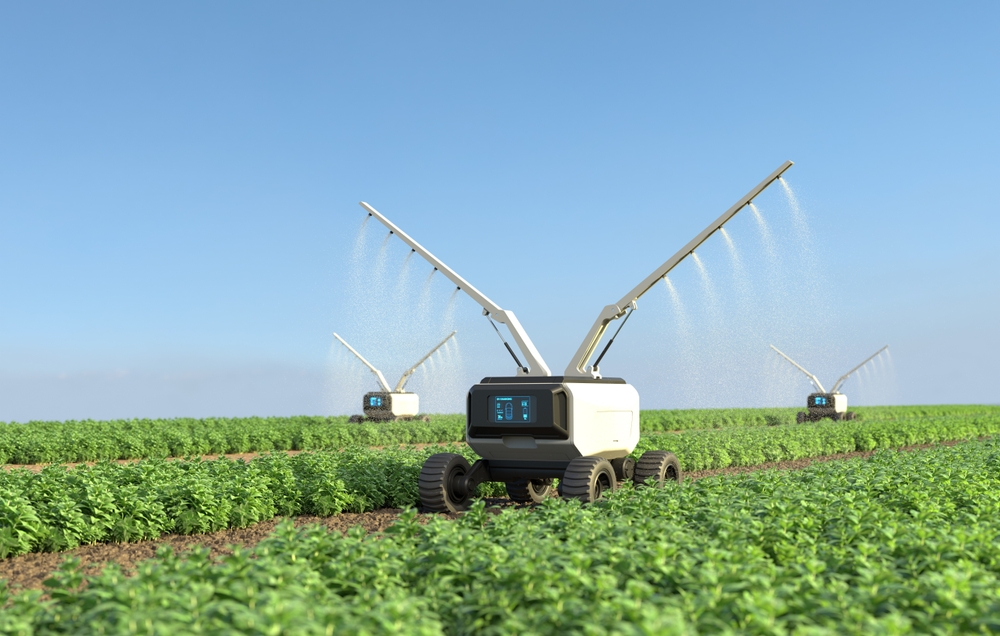
A New Generation Of Farm Robots Is Working While Humans Sleep
Most people imagine farms becoming quiet after sunset. The tractors are parked, workers head home, and the fields disappear into darkness until the next morning. Yet on some farms, the work is only beginning. While entire communities sleep, autonomous machines are moving through rows of crops under the night sky, casting ultraviolet light across leaves and fruit. There is no driver behind the wheel and no crew working overtime. Instead, these machines are carrying out a task that sounds more like science fiction than modern agriculture: fighting disease with light.
The image is striking because it challenges how many of us think about farming. For generations, protecting crops has often meant applying pesticides and fungicides to stop diseases before they spread. Those tools remain essential, but researchers and innovators are now exploring approaches that rely less heavily on chemicals and more on understanding how nature itself works. In fields illuminated by a faint ultraviolet glow, a different vision of agriculture is taking shape. It is quieter, more precise, and driven by a simple idea that could change how crops are protected around the world.
Mientras la industria agrícola global busca alternativas sustentables, un robot autónomo avanza en silencio por los campos en plena noche para eliminar plagas sin utilizar una sola gota de químicos ni pesticidas. pic.twitter.com/GieyrgWnxd
— Ana Caro🌸 (@CaritoMT_33) June 14, 2026
The Night Shift No One Sees
The technology is being developed and deployed through companies such as TRIC Robotics, whose autonomous machines move through fields after dark using UV-C light. Their mission is straightforward: help farmers combat pests and plant diseases while reducing reliance on chemical treatments.
The machines operate when farms are largely inactive. As they travel through crop rows, they shine controlled doses of ultraviolet light onto plants. Some systems can also be equipped with additional tools, including bug vacuums designed to help manage certain pests. The process requires no spray cloud drifting across the field and no operator sitting behind a tractor for hours during the night.
Watching one of these machines at work can feel almost surreal. A quiet robot moves steadily through the darkness while the surrounding landscape remains still. Yet beneath that calm appearance, complex biological processes are unfolding. The ultraviolet light is interacting directly with harmful organisms that threaten crop health.
The approach is already being explored for crops that face persistent disease challenges, particularly strawberries. For growers who spend entire seasons trying to stay ahead of mildew and mold, even a small improvement can make a significant difference.

Why Scientists Turned To Light Instead Of More Chemicals
One of the greatest challenges facing growers is powdery mildew, a fungal disease capable of spreading rapidly through strawberry fields. The infection can damage leaves, reduce yields, and affect fruit quality. For years, fungicides have served as the primary defense against the disease, but pathogens often adapt over time.
Researchers began investigating whether ultraviolet light could provide another tool for managing these outbreaks. What they discovered exceeded expectations. In field trials, UV-C treatments consistently demonstrated an ability to suppress powdery mildew and protect crops from significant damage.
Natalia Peres, a plant pathology professor who helped lead the research, summarized the results clearly. She said, “UV treatments applied once or twice weekly were as effective as the best available fungicides applied on similar schedules for control of strawberry powdery mildew.”
The findings suggested that growers may not always need to rely exclusively on chemical treatments. Instead, they could potentially combine traditional methods with new technologies that target pathogens in entirely different ways. For farmers facing increasing pressure to maintain healthy crops while reducing chemical inputs, that possibility carries considerable appeal.

The Discovery That Changed Everything
One of the most important breakthroughs came when researchers realized that timing mattered just as much as the light itself. Early experiments revealed that ultraviolet treatments became significantly more effective when applied at night rather than during the day.
At first, that result seemed counterintuitive. After all, sunlight naturally contains ultraviolet radiation. If pathogens encounter UV exposure during daylight hours, why would an artificial treatment work better after sunset?
The answer lies in the evolutionary adaptations of the pathogens themselves. Powdery mildew has spent countless generations developing defenses against the natural ultraviolet radiation present in sunlight. Those protective mechanisms help it survive daily exposure. During nighttime hours, however, the pathogen becomes far more vulnerable.
Researchers discovered that applying UV-C light after dark effectively bypasses those natural defenses. Peres explained that the treatment catches the pathogen at a moment when it is less capable of protecting itself from ultraviolet damage. The strategy proved so promising that similar trials expanded beyond strawberries. Reflecting on those broader studies, she said, “While research on these crops is still under way, UV applications seemed effective controlling powdery mildew in all cases.”
A Growing List Of Crops Could Benefit
Although strawberries have become one of the most visible examples, researchers are exploring the technology across a variety of agricultural systems. The goal is to determine where ultraviolet treatments can deliver consistent results while helping farmers reduce fungicide use.
Current research and field trials have included:
- Strawberries
- Grapes
- Hops
- Cucumbers
Each crop presents its own challenges, environmental conditions, and disease pressures. Scientists continue evaluating how UV-C treatments perform across different growing regions and production methods.
The research has attracted international collaboration involving universities, agricultural institutions, and technology developers. Interest continues to grow because the potential benefits extend beyond a single disease or crop. A successful UV treatment system could become part of a larger toolkit that helps farmers manage multiple threats more sustainably.
The economic implications are significant as well. Strawberry production alone represents hundreds of millions of dollars in annual agricultural value. Protecting those harvests with additional disease-management options could provide growers with greater flexibility and resilience.

A Different Vision Of Progress
Technological progress is often associated with bigger machines, more powerful chemicals, or increasingly complex systems. What makes this development fascinating is that its effectiveness comes from understanding biology rather than overpowering it. Scientists did not discover a stronger fungicide. They discovered a moment of vulnerability and found a way to use light to take advantage of it.
The robots moving through fields at night represent more than another agricultural innovation. They reflect a broader shift in how problems are being solved. Instead of forcing nature into submission, researchers are paying closer attention to how natural systems operate and identifying opportunities hidden within those patterns.
There is something quietly remarkable about that image. While the world sleeps, machines move through dark fields carrying a tool that has existed since the beginning of time. They are not spraying more chemicals or introducing a new synthetic compound. They are using light.
As agriculture faces growing demands from a rising global population, some of the most important breakthroughs may come from ideas that appear deceptively simple. In this case, the future of farming may arrive not with more noise or more force, but with a quiet glow moving through the darkness long after the sun has gone down.