


Close your eyes for a moment. Think back to a time when fear blindsided you, not the mild discomfort of a looming deadline, but real, bone-deep fear. Where did you feel it? Before your mind had finished processing what was wrong, something in your body already knew. Your chest tightened. Your stomach dropped. Your arms went rigid.
Now think of a moment of pure joy, a reunion, a victory, a burst of unexpected laughter. Again, before the thought was fully formed, your body responded. It opened. It warmed. It moved toward whatever had caused it.
Most of us have been taught to treat emotions as events that happen in our heads, chemical signals firing between neurons, mental weather passing through a private sky. We talk about feelings as if they belong entirely to thought. But a group of scientists in Finland decided to ask a different question entirely, and what they found may change how you understand every emotion you have ever had.
We’ve Always Known, Haven’t We? Long before any researcher ran a study, human language was already confessing the truth. We say a breakup left us “heartbroken.” We describe stage fright as “butterflies in the stomach.” We talk about bad news giving us “cold feet” and a beautiful piece of music sending “a shiver down our spine.” A betrayed lover feels “sick to their stomach.” A nervous bride gets “cold feet” the night before her wedding.
None of these phrases is an accident. Across centuries and cultures, human beings have reached for the body when trying to describe what happens inside them. Our poets, our storytellers, and our grandmothers all pointed to the same truth that science is now beginning to confirm. Emotions are not abstract. Emotions are physical. For most of human history, we spoke as if we already knew that, even when we lacked the language or the tools to prove it.
What the Scientists Did
In 2013, a research team at Aalto University in Finland, led by psychologist Lauri Nummenmaa, set out to map something that had never been mapped before. Not the brain. Not neural pathways. But the body itself, and more specifically, where people feel emotions inside it.
Over 700 men and women from Finland, Sweden, and Taiwan took part in the study. Researchers showed each participant two blank silhouettes of a human body on a screen, alongside emotional triggers, such as charged words, short stories, film clips, and facial expressions. Rather than asking participants to name or describe what they felt, researchers asked them to paint it. On one silhouette, they colored regions of the body where activity increased. On the other hand, they colored where sensation decreased or went quiet.
Fourteen emotions went through this process: anger, fear, disgust, happiness, sadness, surprise, love, pride, shame, anxiety, contempt, envy, depression, and a neutral state. Researchers made sure none of the stories or film clips directly named an emotion or described a physical reaction, so participants couldn’t simply default to what they expected to feel. What they painted had to come from what they were actually experiencing in that moment. When the team averaged all those individual maps together, something extraordinary appeared.
A Map No One Drew, Yet Everyone Shares
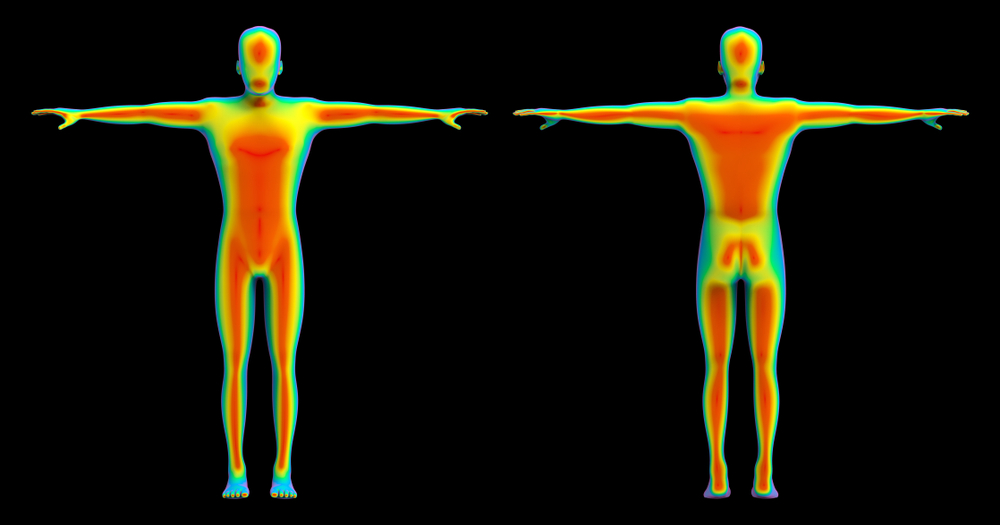
Signature patterns emerged for every single emotion, consistent, statistically distinct, and repeated across all three cultural groups. Finnish, Swedish, and Taiwanese participants, speaking entirely different languages and carrying entirely different cultural histories, produced body maps that matched with striking similarity.
Love and happiness lit up nearly the entire body. Depression did the opposite, dimming activity in the arms, legs, and head, leaving a person feeling contained, muted, and cut off from themselves. Fear and danger flooded the chest with sensation, likely tied to a racing heart and shortened breath. Anger activated the arms and upper body, as if the body were preparing to act. Disgust sent sensations toward the throat and digestive system. Shame and anxiety gathered in the mid-chest.
Most basic emotions produced elevated sensations in the upper chest, probably connected to changes in breathing and heart rate. Every emotion, without exception, is registered in the head, possibly reflecting changes in facial muscle activity, skin temperature, and the felt shift in mental state that emotion brings with it. As Nummenmaa explained, “Our emotional system in the brain sends signals to the body so we can deal with our situation.”
What makes that statement more than a platitude is the consistency with which it showed up across radically different people. West European and East Asian participants, separated by geography, language, and culture, produced body maps that correlated at levels well beyond what researchers consider strong concordance. Culture, it seems, does not write these maps. Biology does.
Your Body Already Knows What You Feel

Neuroscientist Antonio Damasio, a professor at the University of Southern California who had spent years arguing for exactly this kind of mind-body connection, called Nummenmaa’s findings a source of deep satisfaction. He had long believed that each emotion activates a distinct set of body regions, and that the mind reads those physical patterns in order to consciously identify what it is feeling.
“People look at emotions as something in relation to other people,” Damasio said. “But emotions also have to do with how we deal with the environment threats and opportunities.”
What Damasio points to is both ancient and radical. Emotions are not social performances or internal weather events. They are survival mechanisms. When you encounter danger, your nervous system does not wait for your conscious mind to complete a threat assessment. It floods your muscles with oxygen, spikes your heart rate, tightens your chest, and prepares your limbs for action before you have finished forming the thought “I am afraid.” When you fall in love, your body opens and warms across nearly every region because love, biologically, signals safety, connection, and approach. Your body is not translating your emotions after the fact. In many ways, your body is generating them.
The Skeptics Had a Point
No honest account of this research leaves out the criticism. Paul Zak, chairman of the Center for Neuroeconomics Studies at Claremont Graduate University, argued that the study was built on a fragile foundation. He pointed out that people often feel more than one emotion at a time, and that the areas of the brain processing emotion tend to be largely outside conscious awareness. Self-reported body maps, he suggested, might tell us more about cultural stereotypes than about actual physiological change.
It is a fair challenge. When someone hears the word “heartbreak,” have they genuinely felt something shift in their chest, or have they simply recalled that heartbreak is supposed to feel that way? Are we reporting lived experience or narrating expectation?
Nummenmaa and his team took this challenge seriously enough to design controls against it. Participants were led into emotional states through stories and film clips that never named an emotion or described any physical response. A separate group of Swedish speakers, whose language belongs to a different family than Finnish, replicated the original findings exactly, ruling out linguistic contamination. Taiwanese participants, with an entirely different cultural background and mother tongue, produced maps that matched the European results at levels far beyond what chance or stereotype could explain.
Even if conscious body maps don’t perfectly mirror what is happening at a cellular level, the fact that they align so powerfully across culture, language, and individual background points toward something biological and shared. Where do these consistent associations come from, if not from the body itself?
What This Means for Mental Health

Here is where the research stops being merely fascinating and starts being urgent. Mental health disorders do not live only in the mind. Depression alters how a person feels in their body arms heavy, head dull, chest hollow. Anxiety settles into the mid-chest, producing physical constriction that can feel indistinguishable from cardiac distress. People with depression often report chronic pain and a muted relationship with their own physical experience. People with anxiety carry their nervous systems in a state of constant, exhausting activation.
Nummenmaa saw in his findings a potential path toward something medicine has long needed a way to read emotional disorders through the body, not just through self-reported mood or behavioral symptoms. “Many mental disorders are associated with altered functioning of the emotional system, so unraveling how emotions coordinate with the minds and bodies of healthy individuals is important for developing treatments for such disorders,” he said.
If researchers establish a reliable baseline map of how emotions register in a healthy body, then deviations from that map could become a new kind of diagnostic signal. Future research aims to investigate how these body maps shift in people who are anxious or depressed, and whether those maps change as children move through adolescence. Topographical changes in emotional sensation patterns could become a biomarker that clinicians read alongside conventional assessments, adding another layer of information to how we understand a suffering person.
Your Body Is Not a Passenger

If you accept what this research suggests, that emotions do not happen only above the neck, that your limbs, chest, gut, and skin all participate in every feeling you have, then several things about your daily life demand reexamination.
Your posture is not cosmetic. Your breathing is not incidental. Prior research has found that voluntarily changing your body language can alter your subjective emotional state. Reproducing the breathing patterns associated with a specific emotion can induce something of that emotion. Holding a facial expression associated with happiness can shift physiological markers in a measurable direction.
You are not a mind dragging a body around. You are a mind-body system, and signals travel in both directions. Your emotions shape your body, and your body shapes your emotions back.
A Call to Feel on Purpose
Here is the challenge worth sitting with. At some point today, an emotion will move through you: frustration in traffic, warmth during a conversation, or low-grade dread before something difficult. When it does, pause before you rush to name it, manage it, or push it down. Ask instead where you feel it. Scan from your feet to the crown of your head. Notice what has lit up and what has gone quiet.
Pay attention, not just to what you think, but to where you carry it. Your body has been sending you accurate, biologically coded messages about your inner life for as long as you have been alive. Science has now drawn the maps. What remains is for you to learn how to read them.
Source: Nummenmaa, L., Glerean, E., Hari, R., & Hietanen, J. K. (2013). Bodily maps of emotions. Proceedings of the National Academy of Sciences, 111(2), 646–651. https://doi.org/10.1073/pnas.1321664111