


Is Humanity Approaching the Great Filter A New Theory Rekindles the Fermi Paradox
The universe is vast beyond easy comprehension. With hundreds of billions of galaxies and even more stars, many scientists have long believed that intelligent life should be common. And yet, despite decades of searching, we have found no clear evidence of advanced alien civilizations. This unsettling contradiction sits at the heart of one of science’s most famous mysteries known as the Fermi Paradox.
A new wave of research and commentary is now reviving one of the most troubling explanations for this silence. According to recent discussions, the answer may not be that intelligent life is rare, but that it rarely survives long enough to make contact. The idea suggests that humanity may be approaching what is known as the Great Filter.
This perspective is both fascinating and deeply unsettling. It reframes humanity’s technological progress not as a triumph, but as a potential warning sign. If the Great Filter lies ahead of us rather than behind us, the silence of the cosmos could be a message about our own future.

Understanding the Fermi Paradox
The Fermi Paradox originates from a simple question attributed to physicist Enrico Fermi. If intelligent life is common in the universe, then where is everyone. Given the age of the universe and the sheer number of potentially habitable planets, many scientists expected evidence of extraterrestrial civilizations by now.
Over the years, researchers have proposed numerous explanations. Some argue that intelligent life is extremely rare. Others suggest that alien civilizations are deliberately avoiding contact. There are also theories proposing that we are simply not looking in the right way or using the right tools to detect them.
However, the paradox persists because none of these explanations fully resolve the contradiction. Even conservative estimates suggest that at least some civilizations should have arisen millions or even billions of years before humanity. If they had developed advanced technology, traces of their existence should be visible across the galaxy.
As Interesting Engineering explains, the paradox is not just about aliens. It is about probability, evolution, and the future of intelligent life itself. The absence of evidence forces scientists to confront uncomfortable possibilities about survival and self destruction.
What Is the Great Filter
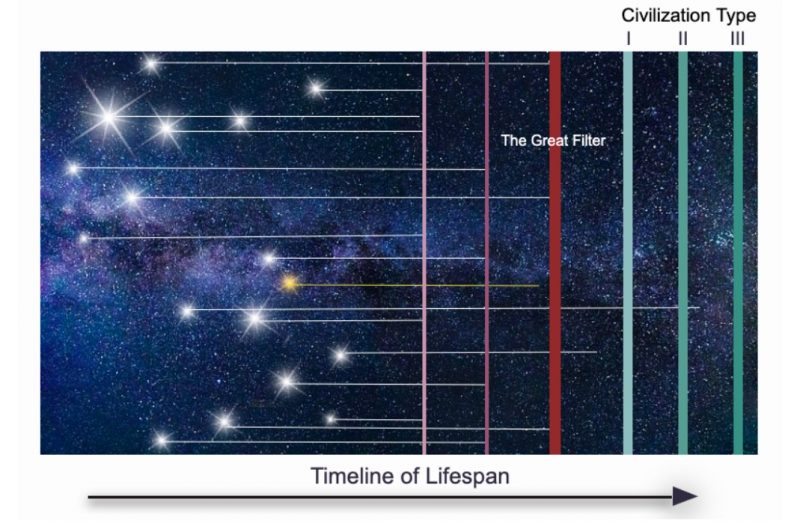
The Great Filter is a theoretical concept introduced to explain why intelligent life appears to be so rare or short lived. It proposes that there is a stage in the evolution of life that is extremely difficult to pass. Most civilizations fail at this stage and never become advanced enough to explore the cosmos.
This filter could exist at any point along the path from simple life to spacefaring intelligence. It might occur before life even begins, such as the formation of complex cells. Alternatively, it could happen much later, after a civilization develops advanced technology.
Psychology Today highlights that the most disturbing version of the Great Filter is the idea that it lies ahead of us. If this is true, then humanity has not yet encountered the most dangerous challenge to its survival. The silence of the universe would then be evidence that most civilizations destroy themselves before spreading beyond their home planet.
In this framing, the Great Filter is not a single event but a collection of existential risks. Nuclear war, climate collapse, artificial intelligence, and uncontrolled technological growth all become potential candidates for this filter.
Why Scientists Think the Filter May Be Ahead
Recent discussions summarized by IFLScience suggest that new models of cosmic development are shifting how scientists think about the Great Filter. One key insight is timing. Earth formed relatively late in the history of the universe, yet intelligent life appeared quickly once conditions allowed.
If intelligent life were easy to sustain, we would expect to see signs of ancient civilizations that had billions of years to expand. The fact that we do not may imply that civilizations tend to burn out soon after reaching a certain level of technological power.
Another factor is energy use. Advanced civilizations require enormous amounts of energy, which often comes with environmental and societal costs. According to researchers discussed by Interesting Engineering, managing this growth without triggering collapse may be far more difficult than previously assumed.
Psychology Today adds a psychological dimension to this argument. As societies gain more power, they also face greater internal stresses. Inequality, misinformation, and conflict can scale alongside technology, potentially accelerating self destructive behaviors.
Technology as a Double Edged Sword
Human history shows that technological progress brings both solutions and new risks. Fire, agriculture, and industrialization each transformed society, but also introduced new dangers. Nuclear weapons represent one of the clearest examples of a technology capable of ending civilization.
Today, emerging technologies raise similar concerns. Artificial intelligence, biotechnology, and autonomous weapons all offer unprecedented capabilities. At the same time, they create scenarios where mistakes or misuse could have irreversible consequences.
IFLScience notes that many Great Filter scenarios involve runaway technologies. Once a civilization develops tools powerful enough to reshape its planet or itself, the margin for error shrinks dramatically. Survival may depend less on innovation and more on restraint.
This idea challenges the assumption that progress naturally leads to longevity. Instead, it suggests that wisdom, cooperation, and ethical governance are just as critical as scientific advancement.

Climate Change and Planetary Limits
One of the most frequently cited candidates for the Great Filter is environmental collapse. Humanity’s impact on Earth has grown rapidly, pushing ecosystems to their limits. Climate change, biodiversity loss, and resource depletion all pose long term threats.
According to Psychology Today, planetary boundaries may act as a natural filter for intelligent life. A civilization that cannot balance growth with sustainability may destabilize the very systems that support it.
This perspective reframes climate change as more than a political or economic issue. It becomes a test of whether intelligent life can adapt its behavior in time to avoid self inflicted extinction.
Interesting Engineering emphasizes that energy transitions are particularly critical. Moving away from destructive energy sources requires global cooperation and long term thinking, traits that may be rare among rapidly advancing species.

The Psychological Burden of Awareness
One unique challenge humanity faces is awareness of its own vulnerability. We are one of the first species, as far as we know, to understand the concept of extinction and cosmic loneliness. This awareness can inspire action, but it can also fuel anxiety and denial.
Psychology Today explores how existential threats affect mental health and decision making. When risks feel overwhelming, people may disengage rather than respond constructively. This psychological response could itself become part of the Great Filter.
Misinformation and polarized narratives further complicate collective action. Even when scientific evidence is clear, social dynamics can prevent effective responses. The ability to coordinate at a planetary scale may be one of the hardest hurdles intelligent life must overcome.
If the Great Filter involves social cohesion and shared responsibility, then survival is not just a technological challenge but a deeply human one.

A Quiet Universe and a Noisy Future
The idea that the Great Filter may be nearly upon us is unsettling, but it is also clarifying. It forces humanity to confront the consequences of its choices in a broader context than ever before. The absence of alien signals becomes a mirror rather than a mystery.
We do not yet know whether the universe is empty, cautious, or filled with civilizations that failed to survive their own success. What we do know is that humanity is at a pivotal moment. Our technologies are powerful, our challenges are global, and our window for meaningful action may be limited.
If the Great Filter lies ahead, then awareness may be our greatest advantage. Unlike hypothetical civilizations before us, we can see the risks and discuss them openly. That alone may give us a chance to choose a different outcome.
In the end, the Fermi Paradox may not be asking where everyone else is. It may be asking who we choose to become.
Featured Image Credit: Photo by PeopleImages | Shutterstock