

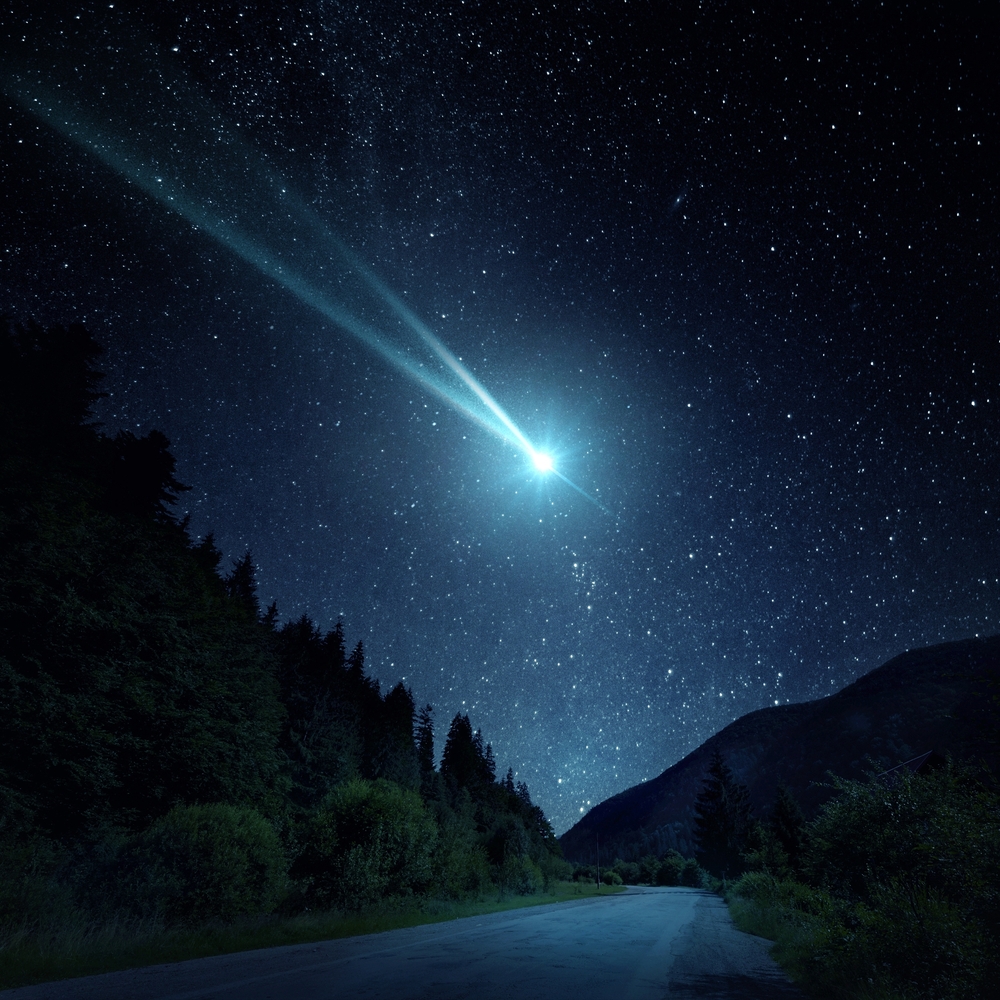
In the quiet, half-lit hours of early morning, when most of the country is either asleep or just beginning to stir, something extraordinary appeared above the UK. A sharp, ghostly beam of white light cut through the sky, startling early risers, dog walkers, runners, drivers, and shift workers alike. For many, it was the kind of sight that instantly stops you in your tracks and makes you question what you are seeing.
Between around 5.00 and 5.30am, reports began to emerge from across England, Wales, Scotland, and parts of Ireland. People looked north east and saw what appeared to be a towering column of light, stretching far higher than clouds and glowing with an eerie clarity. Phones were grabbed. Photos were taken. Messages were sent to family group chats and local Facebook pages. Within minutes, speculation was spreading just as fast as the images themselves.
Was it a UFO? A rare atmospheric phenomenon? A military test? Or something far stranger? As the beam slowly faded from view, it left behind a nation buzzing with questions and competing explanations.
The Moment the Sky Caught Everyone’s Attention
The sightings came in waves. In Robin Hood’s Bay, a coastal village near Whitby, residents reported seeing the light at around 5.30am. In north east Wales, a driver passing through the Ceiriog Valley described glancing up and seeing a perfectly straight white column rising into the darkness. Similar reports followed from Llay in Wales, Newton Stewart in Scotland, Colchester in Essex, and coastal communities stretching north and south.
For many witnesses, the beam appeared brightest at its base and gradually weakened as it rose higher into the sky. Some said it looked almost solid, like a luminous pillar holding the heavens in place. Others noted that it seemed to shift or fade as time passed, as though whatever was creating it was moving away.
Vida Page, who spotted the light from her window in Colchester, told Metro that it was so bright and precise it barely looked real. She said that by the time she ran upstairs to grab her phone, the beam had already begun to lose strength and height, vanishing almost as quickly as it appeared.
What struck many people was just how widespread the sightings were. Reports came from hundreds of miles apart, suggesting this was not a local illusion or isolated event. Whatever it was, it had crossed a significant portion of the UK sky.
Social Media Reacts With Humour, Fear, and Wild Theories
As images and videos flooded social media, reactions ranged from playful to genuinely unsettled. Some users joked that it was finally time for an alien invasion, while others referenced pop culture moments to make sense of the strange sight.
One popular joke compared the beam to the opening sequence of the TV show Mr Bean, where the character famously falls from the sky in a column of light accompanied by choir music. Others suggested it was the Bat-Signal, humorously noting how fitting it would be for a beam of light to appear and summon a caped hero.
Not everyone was laughing, though. For some, the sight triggered genuine anxiety. A few people said they initially feared a missile launch or a military incident, particularly given ongoing global tensions. Others wondered whether it could be connected to space debris, satellites, or experimental technology.
Local weather pages and community groups quickly filled with speculation. Screenshots were analysed. Directions were compared. People asked whether anyone else had seen it, trying to confirm that they were not imagining things.
Early Explanations Point to Light Pillars
As the first wave of excitement settled, meteorologists and weather experts began offering possible explanations. One of the earliest and most widely shared ideas was that the phenomenon could be a light pillar.
Light pillars are an atmospheric optical effect that occurs when light reflects off tiny ice crystals suspended in the air. These crystals are typically flat and hexagonal, and when they float horizontally, they can act like mirrors. When light from a ground source, such as streetlights or the rising or setting sun, hits them at the right angle, it reflects vertically and creates the illusion of a glowing column.
Jim NR Dale, a meteorologist with the British Weather Services, explained to Metro that while surface temperatures were not exceptionally cold, conditions higher up in the atmosphere were likely around or below freezing. Combined with relatively high humidity, this would allow ice crystals to form.
According to Dale, all that is required to create a light pillar is a suitable light source. This could be a setting moon, but it is far more commonly caused by artificial ground based lighting pointing upwards. In this scenario, people across the UK were not seeing one single beam, but many separate light pillars appearing simultaneously.
Light pillars are more commonly observed in colder regions such as Scandinavia, northern Canada, and parts of the northern United States. When they do appear in the UK, they often cause confusion because they are unfamiliar to many people and can look remarkably dramatic.
Doubts Begin to Emerge About the Light Pillar Theory
However, not everyone was convinced by the light pillar explanation. As more footage and photographs surfaced, some observers began to notice details that did not quite fit.
Astrophotographer Tim Burgess, who captured the glowing streak from his home in Kintbury, Berkshire, pointed out that the light appeared to move across the sky. Light pillars, by their nature, are fixed above a light source and do not travel from west to east.
Burgess told Metro that he had seen similar displays before, particularly from SpaceX launches, where rocket stages pass overhead and create visible trails. From reviewing the footage, he said it was clear this could not be a pillar of reflected ground light.
Physicist Les Cowley, who specialises in atmospheric optics, also expressed doubts. He explained that light pillars typically occur on very cold nights when tiny ice crystals float only around 100 feet above the ground. The air temperatures over the UK that morning were not cold enough to support widespread pillar formation.
Cowley added that if light pillars had occurred, people would likely have seen only fragments high in the sky where temperatures were cold enough, not a sharp, narrow beam extending far above cloud level.
The UK Space Agency Offers a Different Answer
As debate continued, the UK Space Agency stepped in with a very different explanation. According to the agency, the mysterious beam was most likely caused by a Chinese rocket passing over the UK.
While the agency stressed that it could not be 100 percent certain, it said that the timing and trajectory strongly supported this conclusion. The object in question was the Zhuque 3 Y1 rocket, a 216 foot tall vehicle launched from a site near the Jiuquan Satellite Launch Center in northwest China at 4.02am UK time.
The rocket was on a test flight, and according to Chinese authorities, its first reusable stage burst into flames while the second stage successfully entered orbit. The UK’s National Space Operations Centre shared an estimated flight path with Metro, showing the rocket soaring west to east over the UK during the time the beam was spotted.
Crucially, the space agency emphasised that the rocket posed no threat to the UK. It was simply passing overhead at high altitude, performing routine manoeuvres associated with spaceflight.
How Rockets Create Glowing Trails in the Sky
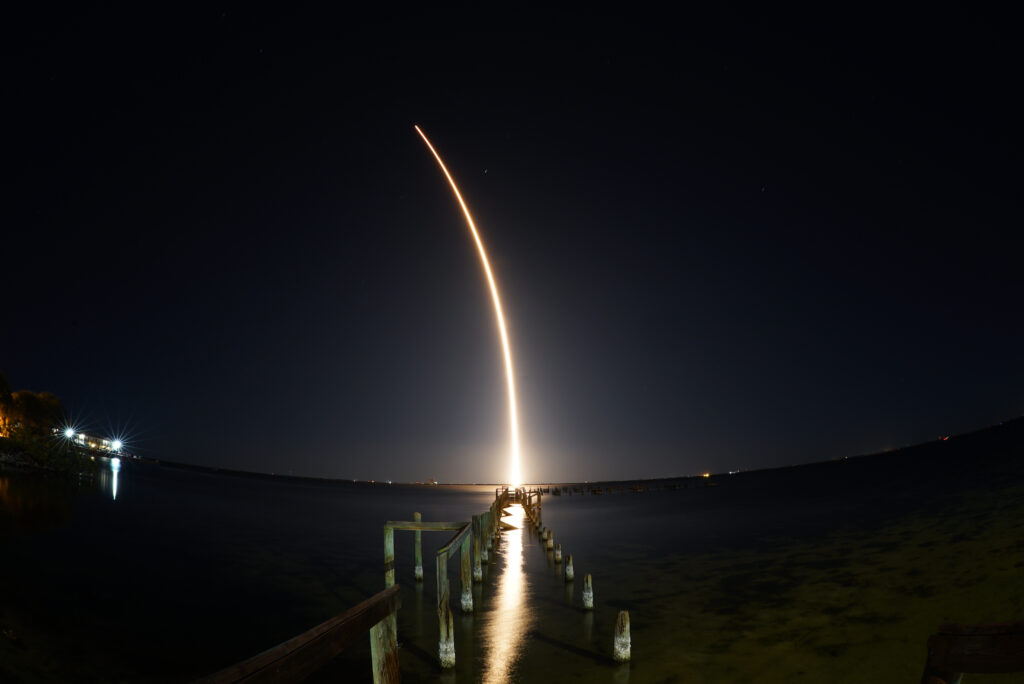
To many people, the idea that a rocket could create such a visible and dramatic effect came as a surprise. However, experts say this type of sight is becoming increasingly common as space activity increases.
As rockets prepare for re entry or adjust their trajectory, they often vent excess fuel. This process, known as a propellant dump, releases gas into the upper atmosphere. Under the right conditions, this gas can become illuminated by sunlight or interact chemically with the ionosphere, producing a glowing trail.
In the case of the Zhuque 3 Y1 rocket, astrophysicists believe the trail became visible because it was flying at dawn. As the sun rose below the horizon, its light caught the vented fuel, causing it to glow brightly against the dark sky.
The result can appear as a straight, narrow beam that slowly changes shape and intensity as the rocket continues on its path. To observers on the ground, it can look otherworldly and completely unfamiliar.
Similar Events Seen in the Us and Elsewhere
This was not the first time rocket activity has caused widespread confusion. In May, stargazers across the United States were baffled by a glowing streak that appeared around midnight and was visible as far south as New Mexico.
At the time, many people believed they were witnessing STEVE, a rare white mauve light phenomenon associated with space weather and geomagnetic storms. The Earth was experiencing a moderate geomagnetic storm that night, adding to the confusion.
However, astronomer Jonathan McDowell later confirmed that the light was caused by a rocket dumping fuel. Just an hour earlier, Chinese startup LandSpace Technology had launched a methane and oxygen fuelled Zhuque 2E Y2 rocket.
McDowell explained that the rocket’s second stage released its Methalox fuel at around 155 miles above the Earth. When the carbon, hydrogen, and oxygen in the fuel entered the charged region of the atmosphere known as the ionosphere, they reacted and produced a long lived glow visible from the ground.
Unlike many SpaceX launches, which often create swirling spiral patterns, this release formed a straight, glowing streak similar to the one seen over the UK.
Why These Sights Trigger UFO Speculation
Whenever something unusual appears in the sky, UFO theories are rarely far behind. Experts say this is partly because humans are wired to seek patterns and explanations, especially when faced with unfamiliar stimuli.
The term UFO simply means unidentified flying object, but it has become strongly associated with extraterrestrial life in popular culture. When people see a strange light or movement they cannot immediately explain, their imagination often fills in the gaps.
Ellie Jarvis, a resident of Clovelly in Devon, described how she initially thought the beam might be a natural trick of the light. Having seen auroras before, she knew this was different. It was too straight, too high, and too precise.
She later said she was surprised to learn it was linked to a Chinese rocket, admitting that her family group chat had been filled with wild theories before the explanation emerged.
The Growing Visibility of Space Activity
One reason these events are becoming more common is the rapid expansion of space launches around the world. Governments and private companies are sending more satellites, test vehicles, and experimental rockets into orbit than ever before.
Companies like SpaceX have already made rocket trails a familiar sight in parts of the world, with their Falcon 9 launches often producing spectacular spirals and glowing plumes. Chinese space companies are now following similar paths, using new fuels and reusable technology.
As more rockets pass over populated areas during dawn or dusk, the chances of people witnessing unusual sky phenomena increase. Without immediate context, it is easy to see why these sights cause alarm or excitement.
When Mystery Meets Science
The beam of light that startled the UK may not have been a UFO or a tear in the fabric of the universe, but it still served as a powerful reminder of how little we often look up.
In a world dominated by screens and schedules, moments like this break routine and force people to pause. They spark conversation between neighbours, strangers online, and experts across different fields. They also highlight the importance of clear communication from scientific and space agencies.
Misinformation can spread quickly, especially when images are striking and explanations are complex. At the same time, these moments present an opportunity to educate and inspire curiosity about the atmosphere, space, and the technology humans are sending beyond Earth.
A Fleeting Spectacle With a Lasting Impact
By the time most people had finished their morning coffee, the beam of light had long since disappeared. What remained were photos, videos, and a shared sense of wonder.
For some, it was a funny story to tell later in the day. For others, it was a brief moment of fear followed by relief. And for many, it was a reminder that even in familiar skies, there are still sights capable of surprising us.
As space launches become more frequent and atmospheric conditions continue to produce rare optical effects, it is likely that similar mysteries will appear again. When they do, the question will not just be what caused them, but how we choose to react.
Looking up, asking questions, and waiting for evidence may not be as thrilling as jumping to extraordinary conclusions, but it brings us closer to understanding the extraordinary world we already live in.