

People Keep Asking Why Space Is Cold If the Sun Is So Hot
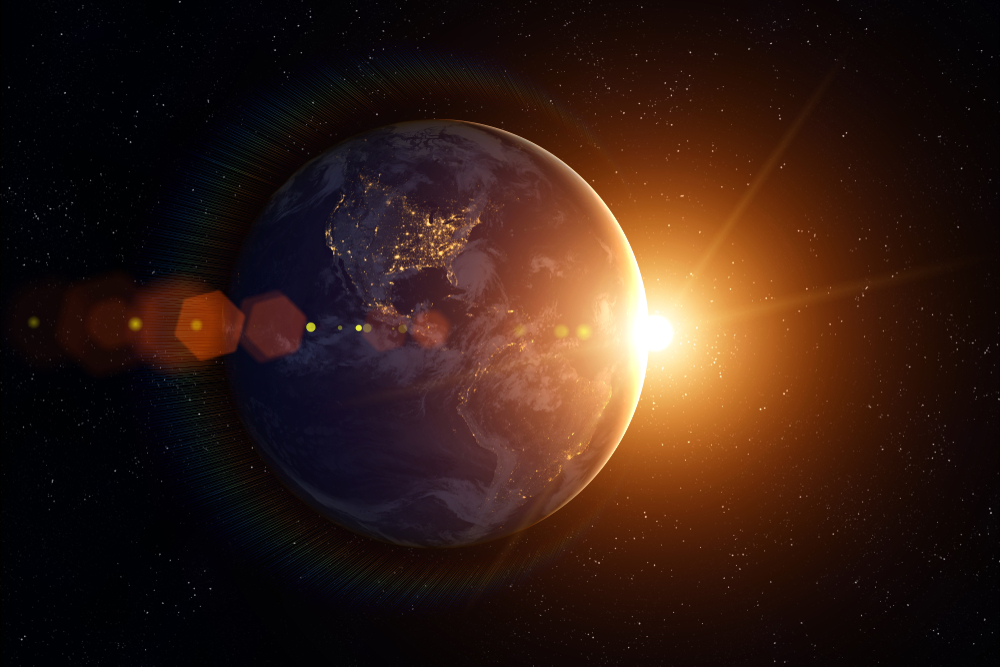
Look up on a clear day and the situation feels deceptively simple. The Sun shines above us, warming our skin, lighting the sky, driving weather systems, and sustaining nearly every ecosystem on the planet. Even when clouds roll in or you step into the shade, the surrounding air often remains warm, and long after sunset the Earth usually holds onto much of the day’s heat. These everyday experiences shape how most people instinctively think about warmth, creating the impression that heat simply spreads outward from the Sun and fills the surrounding sky like warm air filling a room.
That intuition is exactly why a seemingly basic question has captured so much attention online. As one person asked in the Facebook group Physics is Fun, “if the sun is in the sky, why is there heat on earth but not in the sky?” It sounds simple, almost playful, yet it exposes a deep misunderstanding about how heat actually works in the universe. The answer does more than satisfy curiosity. It reveals just how unusual Earth’s warmth really is and why our planet’s climate depends on a delicate set of physical conditions that do not exist almost anywhere else.
Image Credit: Shutterstock
Space Is Colder Than Almost Anything We Can Imagine
Outer space is not just cool in the way a high-altitude mountain or a winter night feels cold. On average, the background temperature of the universe sits at about 2.7 Kelvin, which equals roughly minus 270 degrees Celsius or minus 455 degrees Fahrenheit. This temperature is known as the cosmic microwave background, a faint echo of energy left over from the birth of the universe itself, stretched thin over billions of years as space expanded.
What makes this especially striking is that this temperature exists almost everywhere, even in regions filled with stars, planets, and galaxies. The presence of blazing suns does very little to change the overall chill because space contains so little matter. With almost nothing there to absorb and retain energy, heat never accumulates in a meaningful way. Instead, energy passes through and keeps moving, leaving behind an environment that remains profoundly cold.
This emptiness is the key to solving the puzzle. Space is not cold because it lacks nearby heat sources. It is cold because it lacks the material needed to hold onto heat once energy passes through.
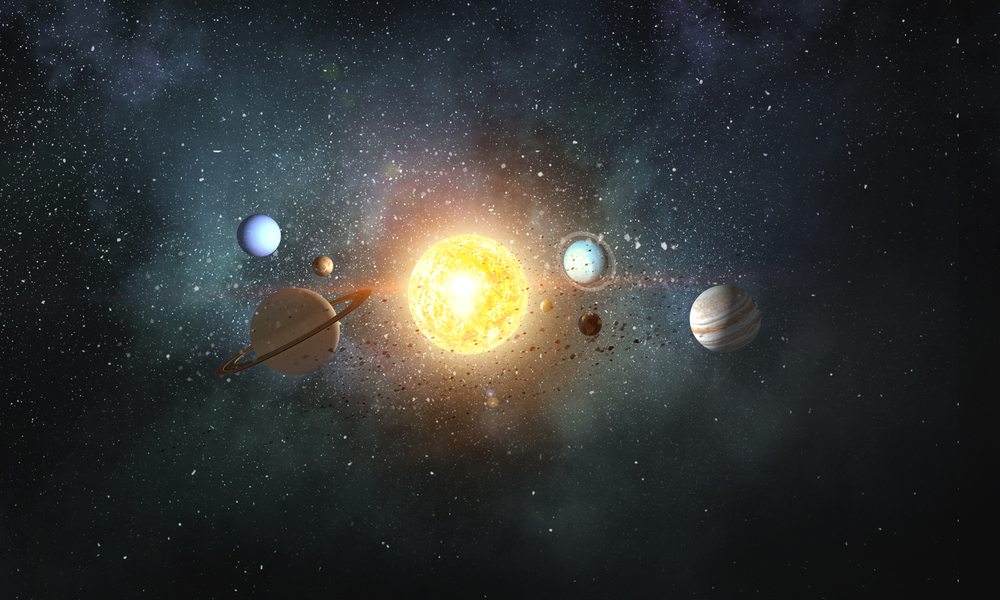
Image Credit: Shutterstock
The Sun Is Hot in Ways That Defy Everyday Logic
The Sun itself is an object of extremes that push far beyond everyday experience. Its core reaches temperatures of more than 15 million degrees Celsius, while its visible surface, known as the photosphere, burns at around 5,500 degrees Celsius. Even more confusing, the Sun’s outer atmosphere, called the corona, becomes hotter again the farther it extends outward, reaching temperatures of several million degrees despite being farther from the core.
These facts alone make it tempting to imagine the Sun as a giant fireball heating everything around it the way a bonfire warms people standing nearby. That mental picture feels natural because it matches how heat behaves in our daily lives on Earth. Unfortunately, it also leads people astray when trying to understand how planets are actually warmed.
The Sun does not heat planets by filling space with hot air. Instead, it releases energy in a form that behaves very differently from the heat we feel from a flame or a radiator.
Image Credit: Shutterstock
Radiation Is the Real Source of Earth’s Warmth
The warmth we feel from the Sun arrives as radiation. This energy travels across the electromagnetic spectrum, including visible light and infrared radiation. These waves move effortlessly through the vacuum of space, but they do not automatically make their surroundings warm simply by passing through.
Radiation only creates heat when it interacts with matter. When solar radiation reaches Earth, it strikes molecules in the atmosphere, oceans, land, and living organisms. Those molecules absorb the energy, begin moving faster, and that increased motion is what we experience as warmth. The more molecules there are to absorb energy, the more heat builds up.
In space, there are simply not enough particles for this process to occur at scale. Radiation streams through, but with almost nothing to absorb it, space itself remains cold even while energy from the Sun passes straight through it.

Image Credit: Shutterstock
Why Earth Holds Heat and Space Cannot
Earth’s atmosphere completely changes how incoming energy behaves. Once solar radiation warms molecules in the air, that energy does not stay confined to the exact spot where sunlight hits. Instead, molecules transfer energy to one another through conduction, while large-scale air movements spread warmth through convection, carrying heat far beyond the Sun’s direct path.
This constant redistribution explains why shaded areas still feel warm and why temperatures usually decline gradually after sunset instead of collapsing instantly. Heat circulates, lingers, and mixes because Earth has both the density of matter and the gravitational conditions needed to support these processes.
Space has none of these advantages. It is nearly empty, so molecules rarely collide. Conduction barely occurs, and convection is impossible without gravity-driven fluids. Without these mechanisms to spread energy, heat cannot accumulate, and cold dominates.

Image Credit: Shutterstock
Getting Close to the Sun Does Not Mean Feeling Warm
The strange nature of heat in space becomes even clearer when looking at spacecraft designed to approach the Sun. Engineers focus on shielding instruments from radiation, not from hot surrounding air, because there is no hot air to worry about. When radiation is blocked, temperatures can plunge dramatically even near the Sun.
As Elisabeth Abel, a thermal engineer working on NASA missions, explained, the purpose of protective shielding is to make sure “none of the solar radiation [will] touch anything on the spacecraft.” When that radiation is kept away, parts of a spacecraft can remain hundreds of degrees below freezing despite flying closer to the Sun than any mission before.
This reality highlights an important truth. Temperature in space depends entirely on exposure to radiation, not on distance to a heat source alone.
Image Credit: Shutterstock
What This Reveals About Earth’s Climate
This cosmic puzzle carries an important lesson for life on Earth. Our planet stays warm because it strikes a delicate balance. It sits at the right distance from the Sun, has an atmosphere capable of absorbing radiation, and can redistribute heat efficiently across its surface.
Climate change does not mean the Sun is suddenly hotter or closer. It means the way Earth handles incoming energy is changing. By altering the composition of the atmosphere, human activity affects how much heat is trapped, how it moves through the system, and how long it remains before escaping back into space.
The same physics that keeps space frozen is what makes Earth sensitive to disruption. Small changes in how energy is absorbed and shared can have enormous consequences for global temperatures and weather patterns.
A Final Reflection on Warmth in a Cold Universe
At first glance, asking why space is cold feels like a fun science question. In reality, it reveals how unusual Earth truly is. Warmth is not the natural state of the universe. Cold emptiness is.
Earth’s ability to capture sunlight, spread its energy, and sustain life relies on systems that are finely tuned and easily disturbed. Understanding how heat really works helps explain why protecting those systems matters so much.
In a universe defined by darkness and cold, Earth’s warmth is not guaranteed. It is a rare outcome of physics, and one that demands care if it is to last.
Featured Image Credit: Shutterstock