


A Scientist Injected Her Own Tumor With Lab-Grown Viruses — The Results Are Astonishing
When conventional medicine offers only punishing options, the instinct for self-preservation can drive us to extraordinary lengths. For virologist Beata Halassy, a third breast cancer diagnosis presented a terrifying choice: endure another grueling round of chemotherapy or try something that had never been officially approved for her condition. Armed with her scientific training and a refusal to accept the status quo, she decided to bypass the waiting room and go straight to the laboratory. What she did next was a calculated risk that challenges the very boundaries of how we approach treatment and the lengths we will go to to save our own lives.
A Doctor’s Own Last Resort

Sometimes, the most radical solutions are born from a refusal to accept the standard options. In 2020, Beata Halassy, a virologist at the University of Zagreb, received news that would break most people. Her breast cancer was back for the third time at the site of a previous mastectomy. The medical recommendation was standard: more chemotherapy. But Halassy knew the toll that treatment takes on the body and mind. She decided she simply could not go through it again.
Instead of accepting this fate, she looked at the problem through the lens of her own expertise. She researched oncolytic virotherapy (OVT), a method that uses viruses to attack cancer cells and wake up the immune system. While this treatment is used for some skin cancers, no government in the world had approved it for breast cancer. Halassy was not a specialist in this specific field, but she knew how to grow and purify viruses. With her back against the wall, she made a choice that blurred the lines between patient and scientist. She decided to cultivate her own treatment in the lab and inject it straight into her own tumor.
A Calculated Gamble
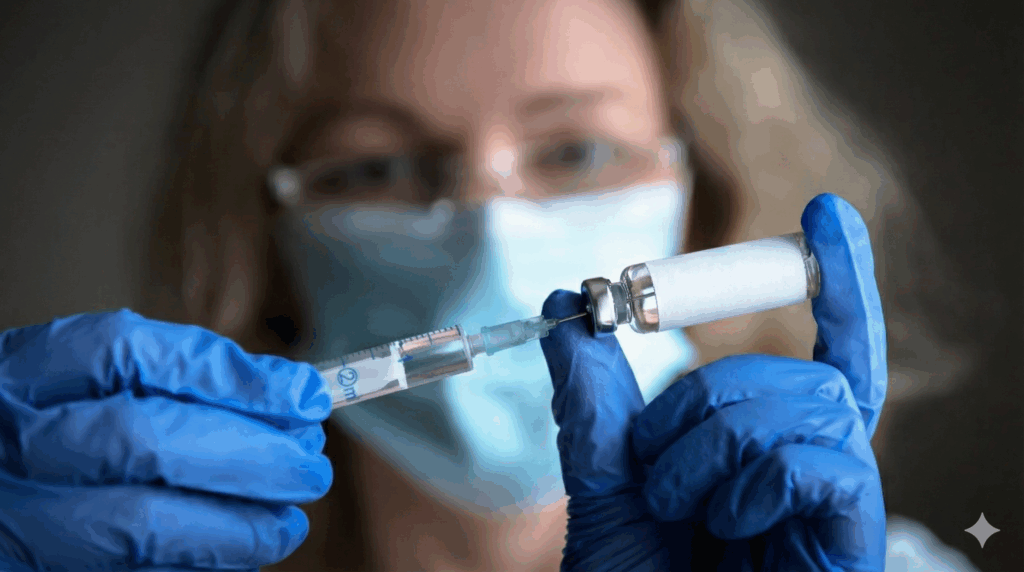
She did not choose her weapons at random. Halassy selected two specific viruses: a measles strain commonly found in childhood vaccines and a vesicular stomatitis virus. She knew both could infect the specific type of cell her tumor originated from. This was not a wild guess. It was a calculated strike using pathogens with established safety records.
Over a two-month period, a colleague administered the injections directly into the tumor. Halassy was brave, but she was not reckless. Her oncologists monitored every step, ready to intervene with standard chemotherapy if the experiment failed.
It worked. The tumor shrank substantially and softened. Crucially, it detached from the muscle and skin it had been invading. This change transformed a difficult surgery into a manageable one. When the tissue was analyzed later, it was full of immune cells. The viral attack had successfully woken up her body’s defenses. Thanks to this gamble, Halassy has remained cancer-free for four years.
Knowledge Too Dangerous to Publish

Success in the lab did not guarantee acceptance in the world. Halassy felt a duty to share what she learned, but the scientific community hesitated. When she tried to publish her findings, she faced rejection after rejection. More than a dozen journals turned her away. The problem was not the data, but the method. Editors worried that publishing her story might encourage others to reject proven treatments and try dangerous self-experiments at home.
Jacob Sherkow, a law and medicine researcher, noted that while her actions likely fell within ethical lines, it was not a simple case. Journals have to walk a fine line between highlighting new knowledge and protecting the public. They feared that desperate patients might see this as a green light to treat themselves without the years of expertise Halassy possessed.
It took a brave editor at the journal Vaccines to finally take the risk. They published her case study in August, recognizing that the knowledge gained was too valuable to hide. This reveals a difficult tension in progress. We want breakthroughs, but we are often terrified of the unconventional paths taken to get there.
A Singular Case, A Broader Mission

Stephen Russell, a specialist in virotherapy, confirms the science holds up. The viral injections caused the tumor to shrink. Yet, he notes that this case does not necessarily break new ground in medicine. Doctors call this an “n of 1” study. A sample size of one person makes it impossible to know if the specific combination of viruses was the key or if it was simply a unique reaction. The true novelty was not the drugs. It was the fact that she grew them in her own lab and used them on herself.
This experiment did not just save a life. It redefined a career. Halassy stated that the focus of her laboratory has completely turned because of this experience. She recently secured funding to investigate using this same therapy to treat cancer in domestic animals. A terrifying diagnosis became the spark for a new professional path. This shows us that our greatest obstacles often point us toward our most important work.
A Necessary Disclaimer

While this story sounds like a movie script, it is absolutely not an instruction manual. Beata Halassy did not just buy a remedy off the internet or mix chemicals in a kitchen. She is a highly trained virologist with decades of experience.
She understood exactly how to cultivate, purify, and administer these specific viruses safely. She possessed a level of technical skill and laboratory access that the average person simply does not have. Trying to replicate this without that deep scientific background could lead to catastrophic results.
Jacob Sherkow, the law and medicine researcher, emphasized a critical distinction. The concern is that this story might encourage vulnerable patients to reject proven medical treatments in favor of unproven, dangerous experiments.
Desperation can drive people to try anything, but self-medication with cancer-fighting viruses should never be the first approach. Halassy herself noted that her experiment required such specific scientific knowledge that it is unlikely anyone could easily copy her.
This was a calculated risk taken by an expert under medical supervision, not a reckless leap of faith. We must admire her bravery without ignoring the reality: this was a rare exception, not a new rule for the general public.
Becoming Your Own Savior

Beata Halassy stopped looking for a savior and realized she had to save herself. That is the real lesson here. It isn’t just about viruses or tumors; it’s about what you do when your back is against the wall.
Too many of us play the victim. We wait for the government, the doctor, the boss, or the partner to come and fix our mess. We freeze when the standard road is blocked. But she didn’t freeze. She looked at a dead end and saw a detour. She took the thing trying to kill her and used it to fuel her life’s work.
You might not have a PhD or a laboratory. You might not be fighting for your life in a hospital bed. But you are fighting something. Maybe it’s fear, maybe it’s debt, maybe it’s a dream that feels impossible.
Stop waiting for permission to fight back. Stop waiting for the perfect conditions. They will never come. You have to take what you have, right now, and use it. Your biggest struggle is not a stop sign; it is a setup for your greatest victory. Don’t just let life happen to you. Grab the wheel.
Source:
- Forčić, D., Mršić, K., Perić-Balja, M., Kurtović, T., Ramić, S., Silovski, T., Pedišić, I., Milas, I., & Halassy, B. (2024). An Unconventional Case Study of Neoadjuvant Oncolytic Virotherapy for Recurrent Breast Cancer. Vaccines, 12(9), 958. https://doi.org/10.3390/vaccines12090958