


Separating Fact From Fear About Vaccines and Autism
For generations, vaccines have played a central role in protecting children from diseases that once caused widespread suffering, disability, and death. They are among the most rigorously studied medical interventions in history, subjected to layers of testing before approval and continuous monitoring long after they are introduced.
Despite this extensive record, a belief has persisted that stands in sharp contrast to the evidence. The idea that vaccines cause autism continues to circulate in public discourse, often reappearing during moments of heightened anxiety, political debate, or social change. This belief has proven resistant to correction, not because the science is unclear, but because it speaks directly to parental fear, uncertainty, and the instinct to search for explanations when something goes wrong in a child’s development.
The endurance of this claim can only be understood by examining the context in which it emerged and the emotional landscape it entered. The story is not one of scientific disagreement, but of how misinformation can take root when timing, authority, and genuine concern intersect. It also highlights how difficult it is to reverse a narrative once it becomes embedded in personal experience, especially when parents are left navigating a condition as complex and still not fully understood as autism.
Image Credit: Shutterstock
The MMR Vaccine Before the Controversy
The measles mumps rubella vaccine was approved in 1971, combining three vaccines that had already been approved individually in 1963, 1967, and 1969. Each of these vaccines had already undergone years of testing and use before they were combined into a single injection. The combined vaccine was introduced to reduce the number of shots children needed while continuing to offer strong protection against three infectious diseases that once spread rapidly and caused severe complications, including hearing loss, brain damage, and death.
In the decades following its approval, the MMR vaccine was administered to millions of children across the United States and around the world. During this time, public health data consistently showed dramatic reductions in measles, mumps, and rubella wherever vaccination rates were high. Surveillance systems designed to detect even rare adverse effects tracked outcomes carefully, and no credible signal emerged linking the vaccine to autism or other developmental conditions.
Before the late 1990s, autism had not been associated with vaccination in the scientific literature. Researchers understood autism as a neurodevelopmental condition with complex origins, but immunization was not considered a plausible cause. That changed abruptly, not because of new biological evidence, but because of the publication of a study that would come to dominate public conversation far beyond its scientific value.

Image Credit: Shutterstock
The 1998 Paper That Sparked the Myth
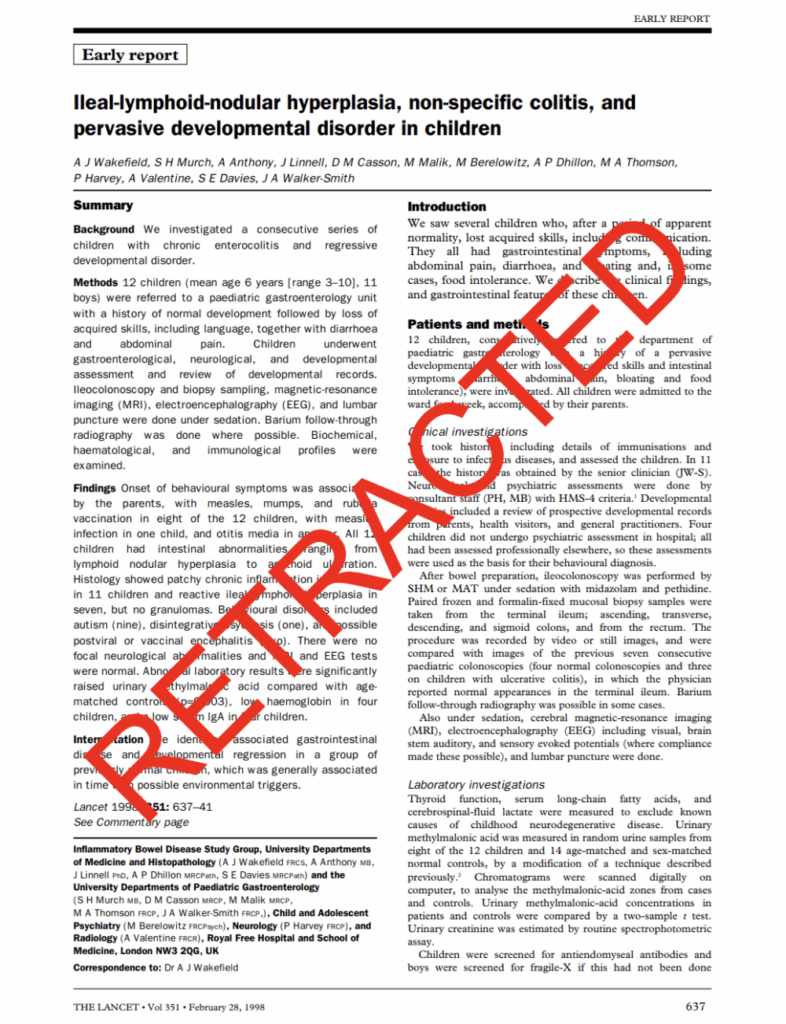
The modern myth linking vaccines to autism began with a 1998 paper published in The Lancet by Andrew Wakefield, a gastrointestinal doctor at the Royal Free Hospital in London. As Johns Hopkins University notes, “The issue was first raised by an article published by Andrew Wakefield in 1998.” The paper examined just 12 children, eight of whose parents reported behavioral changes after the MMR vaccine.
Despite the extremely small sample size, the study drew widespread media attention. It was described as a case series, but it lacked a control group or comparison period. Without that structure, there was no way to determine whether the reported outcomes differed from what might occur in the general population.

Image Credit: Shutterstock
This limitation is fundamental. Even a properly conducted case series cannot establish cause and effect. It can only describe observations. In other words, the study did not contain the basic elements required to support a claim that vaccines cause autism.
Nevertheless, Wakefield publicly framed his findings as evidence of harm. According to Johns Hopkins, “once that paper was published, Wakefield got a lot of press and told people that he had shown vaccines had caused autism.” The authority associated with his medical credentials, institutional affiliation, and publication in a respected journal amplified the claim far beyond what the data justified.
Why the Claim Took Hold
When Wakefield’s paper was published in The Lancet in 1998, it carried the weight of institutional credibility. The journal was respected. The author was a physician. The setting was a well-known London hospital. For many readers, that was enough to treat the findings as legitimate.
The media response amplified the effect. Headlines simplified a small and methodologically weak case series into a sweeping warning about vaccine safety. Nuance disappeared. What began as a limited observation involving 12 children was quickly framed as a major public health concern.
At the time, few members of the public understood how early-stage medical research works. A small case series can generate a hypothesis, but it cannot prove cause and effect. That distinction was lost in public discussion. The study’s limitations were technical. The fear it generated was not.
Wakefield himself contributed to the escalation by speaking publicly about the MMR vaccine as though a causal link had been demonstrated. For parents already trying to make careful decisions about their children’s health, the message landed with force.
In short, the claim gained traction not because the evidence was strong, but because the platform was.

Image Credit: Shutterstock
Retraction, Investigation, and What Followed
Concerns about Wakefield’s 1998 paper began almost immediately. Scientists questioned the tiny sample size, the lack of a control group, and the bold conclusions drawn from just 12 children. As more experts examined the study, deeper problems surfaced.
Investigative journalist Brian Deer uncovered evidence that some of the children’s medical histories had been misrepresented. Parents later confirmed inaccuracies in the paper. It also became clear that the cases were not consecutive, as suggested, but selectively chosen. That kind of cherry-picking undermines the integrity of any scientific claim.
There were also undisclosed financial conflicts of interest. Wakefield had received funding from lawyers preparing lawsuits against vaccine manufacturers, a detail that was not properly revealed at the time.
In 2008, Wakefield and two co-authors were brought before the United Kingdom’s General Medical Council, which regulates physicians. After a lengthy review, the council found him guilty of serious professional misconduct. In 2010, he was removed from the medical register and barred from practicing medicine in the UK. That same year, The Lancet formally retracted the paper.
By that point, the damage had already spread. Much of the public fear around vaccines and autism stemmed from this single study. Wakefield’s findings were never successfully replicated. Meanwhile, larger and more rigorous studies conducted around the world consistently found no link between the MMR vaccine and autism.
The scientific consensus did not slowly drift away from his claim. It rejected it.

Image Credit: Shutterstock
Why Some People Still Believe the Myth Today
Even after the study was retracted and large-scale research found no link, the belief did not disappear. Once fear takes hold, it is difficult to reverse.
Timing plays a major role. Signs of autism often become noticeable between 12 and 18 months of age, which is also when children receive several routine vaccinations, including MMR. When developmental changes appear soon after a shot, the sequence can feel like cause and effect, even when it is not.
There was also a gap between the original claim and the publication of stronger research. Careful scientific studies take time. In that window, many families had already drawn conclusions. Public opinion moved faster than the evidence.
Image Credit: Shutterstock
Uncertainty added to the problem. While researchers have identified some contributors to autism, there is no single, simple cause. In that absence, a clear explanation, even an incorrect one, can feel satisfying.
Misinformation about ingredients further complicated things. Concerns about mercury focused on thimerosal, a preservative containing ethylmercury. Ethylmercury is processed differently in the body than more harmful forms of mercury, and the MMR vaccine never contained thimerosal at all. But the fear lingered.
Parents also found one another and shared similar stories. Those stories felt real and persuasive. Shared timing, however, is not the same as shared cause.
The myth endured not because the evidence supported it, but because it offered an answer during a period of uncertainty and worry.
What This Teaches Us About Belief and Truth
There is something uncomfortable about this story. It is not just about a flawed study. It is about how easily fear can take hold, and how hard it can be to let go of a belief once it feels personal.
Changing your mind is not weakness. It is growth.
When new evidence emerges, when better data replaces weaker data, when the full picture becomes clearer, adjusting your position is not a betrayal of your past self. It is a sign that you value truth more than ego.
In moments of uncertainty, we all reach for explanations. Especially when children are involved. Especially when the stakes feel high. The instinct to protect is powerful. But protection also means being willing to revisit assumptions and ask, “What does the evidence actually say now?”
Science is not perfect. It evolves. It corrects itself. That process can be slow and imperfect, but it is built on one essential principle: the willingness to be wrong and to learn from it.
There is strength in that.
If there is a lesson here, it may be this: hold your convictions with care, but hold the facts even tighter. Be open to better information. Be willing to update your understanding. That is not surrender. It is responsibility.
And in a world flooded with noise, choosing evidence over fear is one of the quietest forms of courage.
Featured Image Credit: Shutterstock