

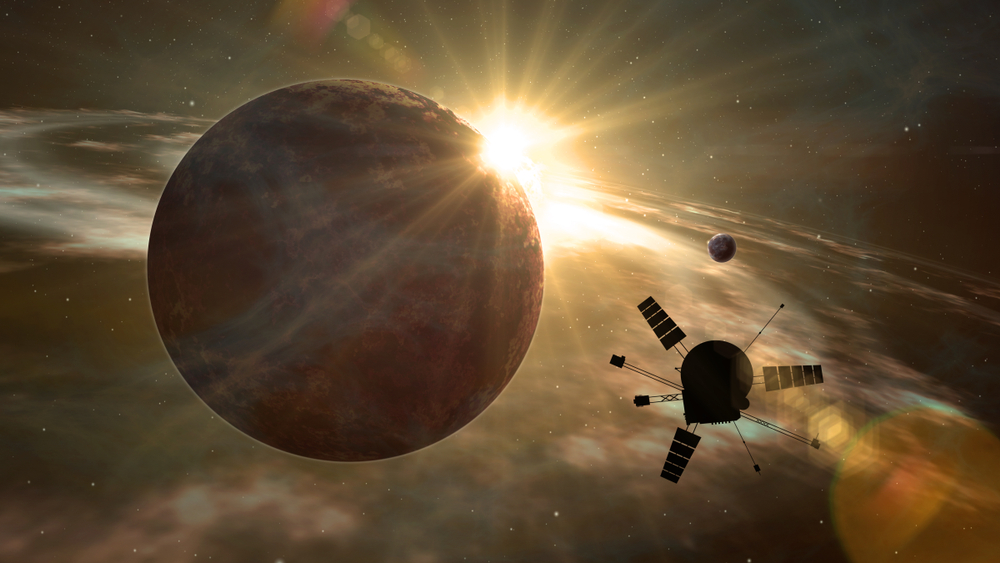
Voyager Discovers Scorching Boundary At The Edge Of The Solar System
The edge of our solar system has always been imagined as a quiet fading point where the Sun’s influence slowly disappears into interstellar darkness. But new interpretations of data from NASA’s Voyager spacecraft suggest that this boundary may be far more dramatic and intense than previously believed.
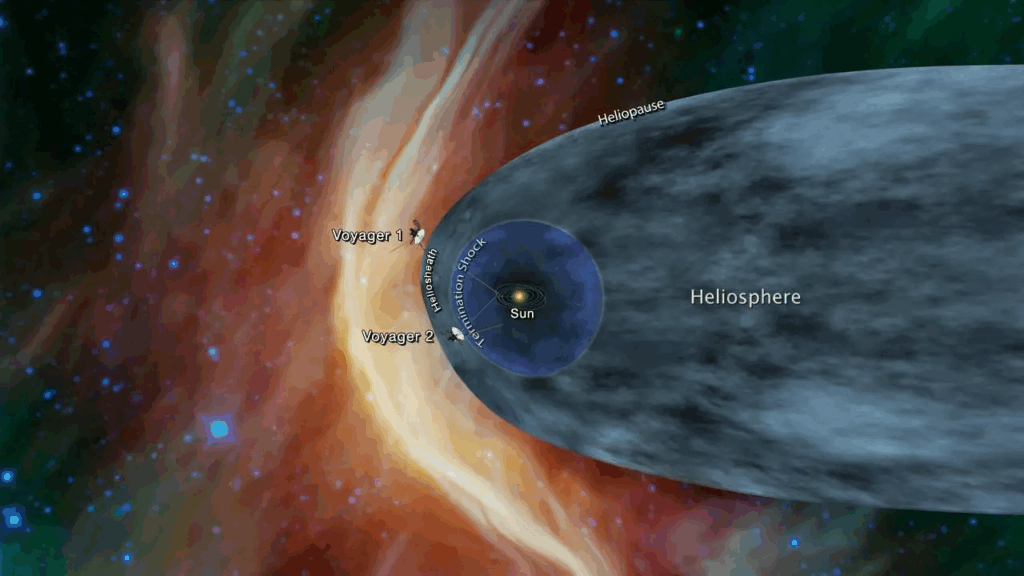
According to recent reports covered by USA Herald, Voyager has detected evidence of a scorching region sometimes described as a wall of fire or wall of plasma at the heliopause. This is the boundary where the solar wind finally collides with the interstellar medium beyond our system.
With estimated temperatures ranging between thirty thousand and fifty thousand Kelvin, the discovery has reignited fascination with the Voyager missions and raised new questions about what truly lies beyond the Sun’s protective bubble. It has also drawn connections to other long standing cosmic mysteries that have puzzled scientists for decades.
Rather than a literal wall, researchers emphasize that this is an invisible but extremely energetic boundary. Yet the idea of a superheated frontier surrounding our solar system has captured public imagination and challenged our understanding of how stars interact with the galaxy around them.
The Voyager Missions That Changed Space Exploration Forever
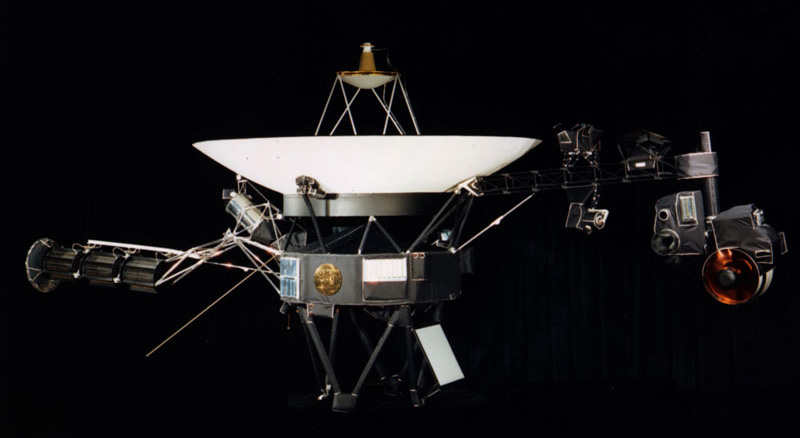
Launched in 1977, Voyager One and Voyager Two were originally designed for relatively short missions to study Jupiter and Saturn. At the time, few could have predicted that these spacecraft would still be sending back data nearly half a century later.
After completing their planetary flybys, both Voyagers continued traveling outward, powered by radioactive generators and guided by some of the most durable engineering ever achieved. Over the years, they became humanity’s farthest messengers, transmitting information from regions never before explored.
Voyager One officially entered interstellar space in 2012, followed by Voyager Two in 2018. This marked the first time a human made object crossed the heliopause and sampled the environment beyond the Sun’s influence directly.
According to NASA scientists cited by IFLScience, the data returned from these crossings continues to reveal unexpected details. The discovery of the intense thermal boundary shows that even decades old instruments can still revolutionize modern astrophysics.
What Is the 30,000 to 50,000 Kelvin Wall
The so called wall refers to a region of compressed plasma at the heliopause where solar wind particles slow down abruptly. As the Sun’s charged particles collide with interstellar material, energy builds up, creating a sharp increase in temperature.
Despite the extreme heat readings, this region would not burn a spacecraft or astronaut in the way fire does on Earth. The density of particles is incredibly low, meaning there is not enough matter to transfer heat efficiently.
Scientists quoted by USA Herald explain that the temperature describes the energy of individual particles rather than a solid or gaseous structure. In practical terms, Voyager can pass through this region without being destroyed, even though the numbers sound terrifying.
This distinction is crucial for understanding space physics. It highlights how temperature in space behaves very differently from our everyday experience and why cosmic environments often defy intuitive explanations.
How Voyager Detected the Boundary
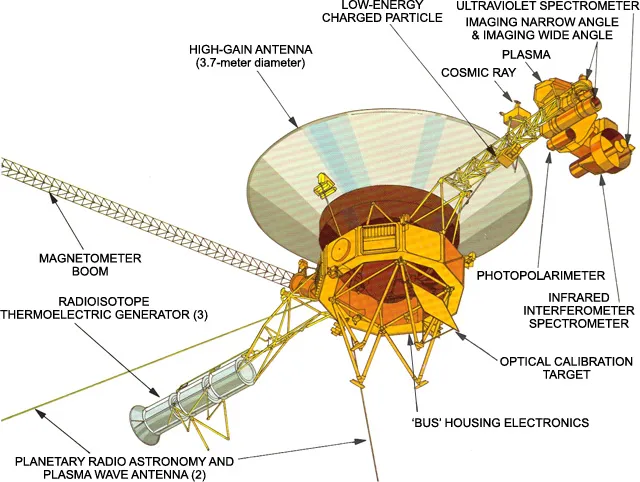
Voyager did not carry a thermometer capable of directly measuring plasma temperature. Instead, scientists inferred the heat of the region by analyzing particle behavior, magnetic fields, and changes in plasma waves. This indirect approach required combining data from multiple instruments to build a reliable picture of the surrounding environment. Over time, these methods proved remarkably effective despite the spacecraft’s limited onboard technology.
When Voyager crossed the heliopause, its instruments detected a sudden drop in solar particles and a rise in particles from interstellar space. At the same time, magnetic field readings showed a dramatic shift in intensity. These changes occurred over a relatively short distance, indicating a sharp boundary rather than a gradual transition. The consistency of these signals across different instruments strengthened scientists’ confidence in the interpretation.
According to IFLScience, these combined signals allowed researchers to calculate the energy levels of the plasma, leading to the estimated temperature range now being discussed widely in media reports. The calculations were refined through repeated analysis and comparison with theoretical models. This process demonstrated how legacy data can gain new relevance as scientific understanding evolves.
The findings demonstrate the value of indirect measurement in deep space exploration. Even with limited tools, careful analysis can reveal conditions in regions humans may never physically visit. Voyager’s success highlights the power of patience and scientific creativity when direct observation is impossible. It also sets a precedent for how future missions might study similarly remote environments.
Links to Interstellar Mysteries and the Wow Signal
One of the more intriguing aspects of the discussion comes from USA Herald, which draws connections between the heliopause discovery and other unexplained cosmic phenomena. These include the famous 1977 Wow Signal, a powerful radio burst that has never been conclusively explained. The coincidence of timing and mystery has long fueled curiosity among scientists and the public alike.
Some researchers speculate that interactions at the boundary between stellar systems could play a role in generating unusual signals or influencing the behavior of interstellar objects. These boundary regions may amplify or distort electromagnetic activity in ways not yet fully understood. While speculative, such ideas encourage broader exploration of how cosmic environments interact.
The article also mentions interest in a mysterious object known as 3I Atlas, which has shown unusual characteristics that do not fit neatly into existing models of comets or asteroids. Its trajectory and behavior suggest it may have originated outside our solar system. Objects like this offer rare opportunities to study material formed around other stars.
While no direct causal link has been established, the renewed focus on boundary regions highlights how much remains unknown about the interactions between stars and the space between them. These zones may hold clues to long standing astrophysical puzzles. Continued observation and improved models will be essential to uncovering their true role.
Why This Discovery Matters for Science
Understanding the heliopause helps scientists learn how solar systems protect planets from harmful cosmic radiation. The Sun’s magnetic bubble shields Earth from many high energy particles that could otherwise damage life. This protective effect plays a crucial role in maintaining a stable environment on our planet. Studying its limits helps clarify how resilient that protection truly is.
By studying this boundary, researchers can compare our solar system with others across the galaxy. This information may help determine which star systems are more likely to support habitable planets. Differences in boundary strength could significantly influence planetary climates and atmospheric stability. Such comparisons deepen our understanding of where life might arise.
These findings could also inform future interstellar missions by identifying challenges spacecraft may face when leaving stellar environments. Knowing what conditions exist at system boundaries allows engineers to design more resilient technology. This knowledge reduces uncertainty for missions venturing farther than ever before.
In the long term, insights from Voyager may shape humanity’s approach to deep space travel and influence how we search for life beyond Earth. Each discovery adds another piece to the puzzle of cosmic habitability. Voyager’s data will likely be referenced for decades as exploration continues.
Public Fascination and Media Reaction
The phrase wall of fire has understandably captured public attention. Media outlets have used vivid language to help translate complex physics into something people can visualize. Such phrasing makes abstract science feel immediate and dramatic. However, it also risks oversimplifying the underlying reality.
Scientists stress the importance of accuracy and caution against imagining a literal flaming barrier in space. The reality is far more subtle but no less fascinating. It involves invisible forces, particle motion, and magnetic fields rather than physical flames. Understanding this distinction deepens appreciation rather than diminishing wonder.
Public interest in the story reflects a growing appetite for space exploration news and a renewed appreciation for long running missions like Voyager. People are increasingly drawn to discoveries that challenge familiar ideas about the universe. Voyager’s longevity adds emotional weight to these revelations.
This response shows how scientific discoveries can inspire wonder while also reminding audiences of the importance of careful interpretation. Responsible communication helps balance excitement with understanding. It ensures curiosity leads to knowledge rather than misconception.
Featured Image Credit: Photo by Skorzewiak | Shutterstock