

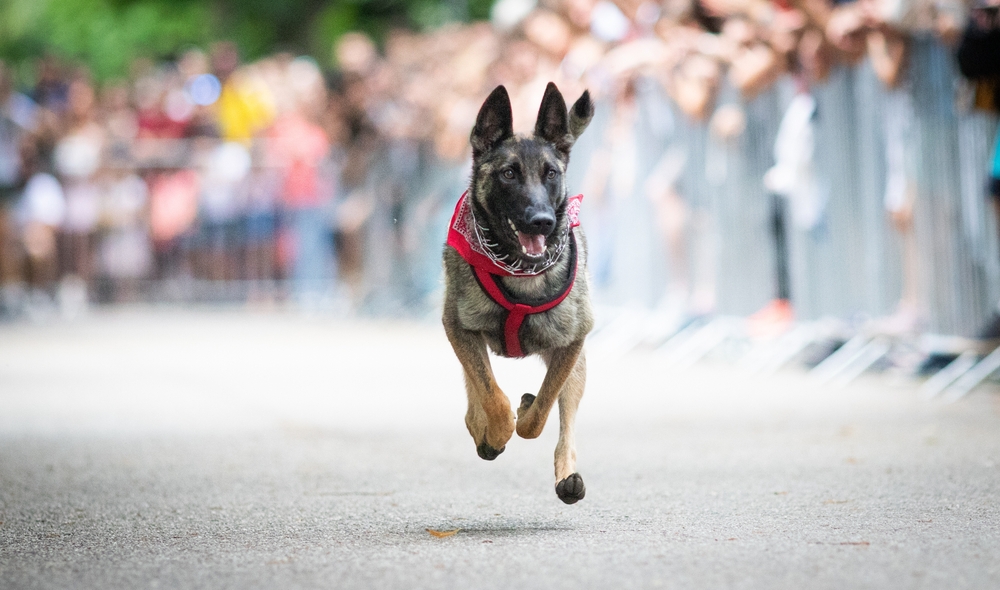
Watch This Dog Accidentally Enter an Olympic Race and Steal the Show
There are Olympic moments that stay with people because of records shattered, medals claimed in dramatic fashion, or careers defined in a matter of seconds. Then there are the moments that no one plans for, the kind that unfold so unexpectedly that they cut through the seriousness of elite sport and instantly become part of its folklore. During the women’s cross-country skiing team sprint qualifier at the 2026 Winter Olympics, athletes were digging into the final stretch of one of the most physically punishing events on the program. Cross-country skiers are known for collapsing beyond the finish line, utterly spent, their bodies pushed to extremes that most viewers can hardly imagine. The air was tense, the crowd focused, and every stride mattered as competitors fought to secure a place in the next round.
And then, in the middle of that intensity, just as skiers from Croatia and Australia powered toward the line, a completely unplanned participant entered the frame. A dog appeared on the course and began running alongside the athletes as if he had been waiting all morning for his cue. Not a mascot, not part of an opening ceremony, but a real two-year-old Czechoslovakian Wolfdog named Nazgul. Yes, Nazgul, like the Ringwraiths from The Lord of the Rings. Within seconds, one of the most serious sporting environments in the world transformed into something unforgettable, and millions watching were left blinking at their screens wondering if they had just seen what they thought they saw.
As the owner of a wolfdog, may I credit this wolfdog Nazgul as a Very Good Boy.
— Andrew Fox (@Mr_Andrew_Fox) February 18, 2026
Gatecrashing the Winter Olympics deserves an offal treat as the bare minimum. pic.twitter.com/2Any4Lsaeu
The Race Was Nearly Over When Everything Changed
The qualifier had unfolded exactly as expected until that point, with athletes carefully pacing themselves across the snow-covered course and conserving enough strength for the final sprint. Cross-country skiing demands relentless endurance, tactical awareness, and total focus, especially in a team sprint format where positioning and timing are critical. As competitors entered the homestretch, the physical toll was obvious in their movements, shoulders tense and strides heavy, each one chasing a qualifying time that could determine whether their Olympic dream continued.
Broadcast footage then captured something no one anticipated. A dog was suddenly galloping behind the skiers, closing the distance with surprising confidence and energy. Croatian skier Tena Hadzic later admitted she thought she might be hallucinating when she became aware of the movement near her. Argentina’s Nahiara Díaz González said she was too focused on finishing to process the sudden addition of a four-legged rival, her mind locked on the finish line rather than the spectacle unfolding behind her. Sweden’s Maja Dahlqvist described it as something she had “never seen ever before,” a sentiment that likely echoed through living rooms around the world.
On-course announcers tried to keep up with the unfolding scene in real time, injecting humor into the surprise. “Anybody lost their dog?” they joked, acknowledging the absurdity of the situation without escalating concern. They added, “It’s a fairly nice mutt there, not hindering anybody’s progress. One of those moments you have to laugh about.” Their commentary captured the mood perfectly. The dog was not disrupting the race or endangering anyone, and the fact that this happened during qualifying rather than a medal-deciding heat felt like a stroke of luck.
As exhausted athletes crossed the finish and dropped into the snow, lungs burning and legs trembling, Nazgul followed them straight through the line. For a few surreal seconds, the most prestigious winter sporting event in the world shared its stage with a very good boy who had simply decided to join in.
Doggo voleva solo avere la possibilità di competere alle Olimpiadi invernali. pic.twitter.com/3NaJC59KGh
— Roberto Avventura (@RobertoAvventu2) February 10, 2026
Meet Nazgul, the Two-Year-Old Gatecrasher
Nazgul is a two-year-old Czechoslovakian Wolfdog who lives with his humans at a nearby bed-and-breakfast close to the Olympic venue. According to NPR, he had been crying that morning after watching his owners leave, and it is believed that he likely just wanted to follow them. What began as a dog looking for his people turned into one of the most talked-about Olympic interruptions in recent memory, proving that sometimes the biggest stories come from the smallest decisions.
Described by his owners as “stubborn, but very sweet,” Nazgul showed no hesitation once he reached the course. Footage showed him pausing briefly near the cameras as if orienting himself, then spotting the skiers and sprinting toward the finish with clear determination. His powerful frame and wolf-like appearance made the visual even more striking, and for a split second some viewers might have genuinely wondered what exactly was chasing Olympic athletes down the snow.
After crossing the finish line, Nazgul did what many dogs would do in a new environment filled with interesting scents and people. He trotted over to sniff a few exhausted competitors who had collapsed onto the snow, then made his way toward the post-finish area. Volunteers greeted him with pets and belly rubs, and race officials eventually collared him and returned him safely to his owners, who are reportedly related to an event official. The situation was handled calmly, without panic or consequence, and the official results of the race remained unaffected.
For one spontaneous sprint, however, Nazgul had run alongside some of the best cross-country skiers in the world, and he did it with the kind of enthusiasm that most athletes can only dream of channeling in their own performances.
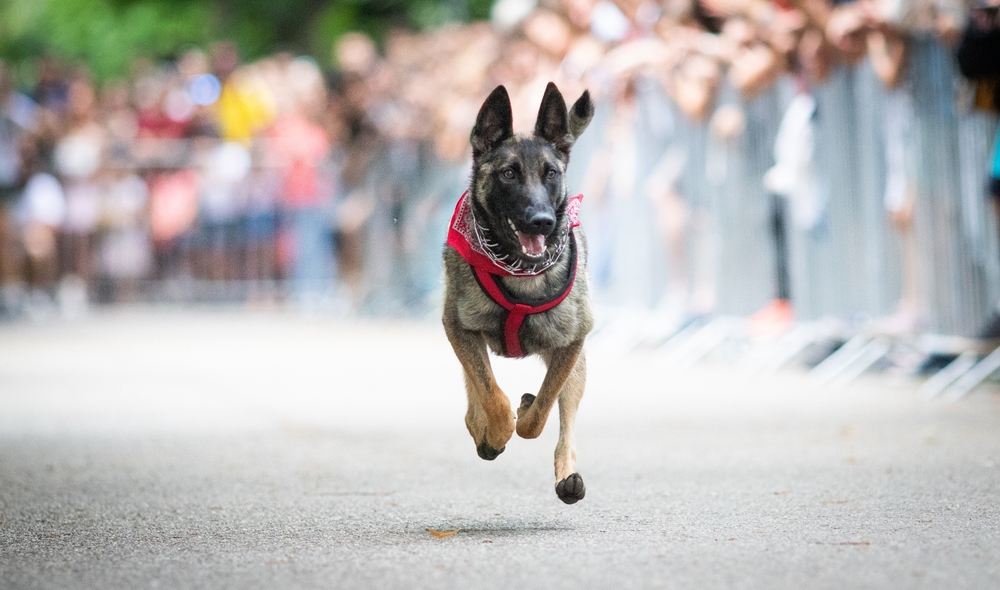
Image Credit: Shutterstock
An Official Olympic Photo Finish
If crossing the line was not enough to cement his place in Olympic lore, technology ensured that Nazgul’s moment would not be forgotten. The Games’ official timekeeper’s Scan’O’Vision ULTIMATE photo-finish camera automatically captured him crossing the finish line, just as it does for every athlete competing for medals and qualification spots. The same high-speed system used to determine thousandths of a second recorded Nazgul’s stride in crisp detail, snow kicking up beneath his paws.
That image quickly circulated online, adding legitimacy to what might otherwise have been dismissed as a fleeting interruption. There he was, frozen in motion, ears alert and body extended forward, looking every bit like a participant rather than an intruder. In a competition where margins are razor-thin and timing is everything, the camera treated him no differently than the Olympians he had followed.
Importantly, the race standings remained unchanged. Sweden’s Jonna Sundling and Maja Dahlqvist posted the fastest qualifying time at 6:29.94 and later secured gold in the final. Switzerland and Germany claimed silver and bronze, while Team USA’s Jessie Diggins and Julia Kern improved from seventh in qualifying to fifth overall. Nazgul did not alter the competition, delay a result, or interfere with a medal.
What he did alter was the emotional tone of the event. A tense qualifier that might have faded quietly into the broader Olympic schedule instead became a shared moment of laughter and surprise that spread far beyond the snow-covered course.
A Tale of Two Olympic Dog Stories
Nazgul’s joyful cameo unfolded during a Winter Games that also carried a far more emotional canine story. Alpine skier Lindsey Vonn endured a devastating crash during the women’s downhill final, suffering a complex tibia fracture that required multiple surgeries. Just one day after her accident, her beloved dog Leo passed away following a battle with lung cancer, compounding an already heartbreaking period in her life.
In a tribute shared publicly, Vonn wrote, “Leo has passed away.” She continued, “This has been an incredibly hard few days. Probably the hardest of my life. I still have not come to terms that he is gone.” She explained that Leo had recently been diagnosed with lung cancer after surviving lymphoma a year and a half earlier, and she added, “He was in pain and his body could no longer keep up with his strong mind.” The words reflected a grief that went far beyond sport or injury.
Vonn also described the moment she said goodbye, writing, “As I layed in my hospital bed the day after my crash, we said goodbye to my big boy.” Reflecting on their years together, she shared, “My boy has been with me since my second ACL injury, when I needed him most.” While Nazgul’s sprint delivered lightness in the middle of competition, Leo’s story reminded fans that athletes carry private heartbreak alongside public performance.
Together, these two very different dog stories revealed the emotional range of the Olympic experience. One moment sparked laughter on the course, while the other underscored how deeply animals shape the lives of the people who compete at the highest level.
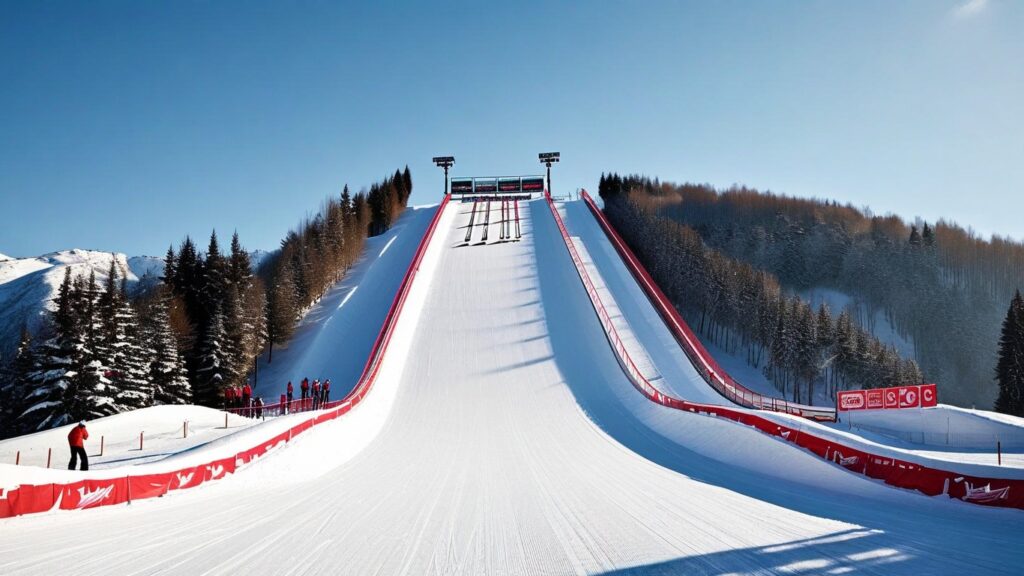
Image Credit: Shutterstock
Why Moments Like This Travel So Far
Animals interrupting sporting events is not new, but each time it happens the reaction feels fresh. Part of the reason is the contrast. Elite sport is built on preparation, structure, and discipline. Every movement is calculated, every second measured, every detail rehearsed. An unscripted moment slices through that structure instantly and reminds viewers that not everything can be controlled, no matter how carefully an event is planned.
Nazgul’s run resonated because it was harmless and perfectly timed. He did not collide with a skier or alter a result. Instead, he mirrored the athletes, running with them rather than against them, almost as if he believed he belonged in the pack. That visual contrast between intense Olympic focus and carefree canine enthusiasm created a moment that felt both absurd and strangely uplifting.
There is also something universal about a dog chasing movement in the snow. It requires no translation and carries no political or national tension. For a brief stretch of track, competitors from different countries and viewers from different backgrounds shared the same reaction. They laughed, they replayed the clip, and they passed it along to someone else with the simple instruction to watch.
In a Games defined by medals, injuries, triumphs, and setbacks, Nazgul’s sprint served as a reminder that sometimes the most memorable Olympic stories are the ones nobody planned for and nobody could have scripted better.
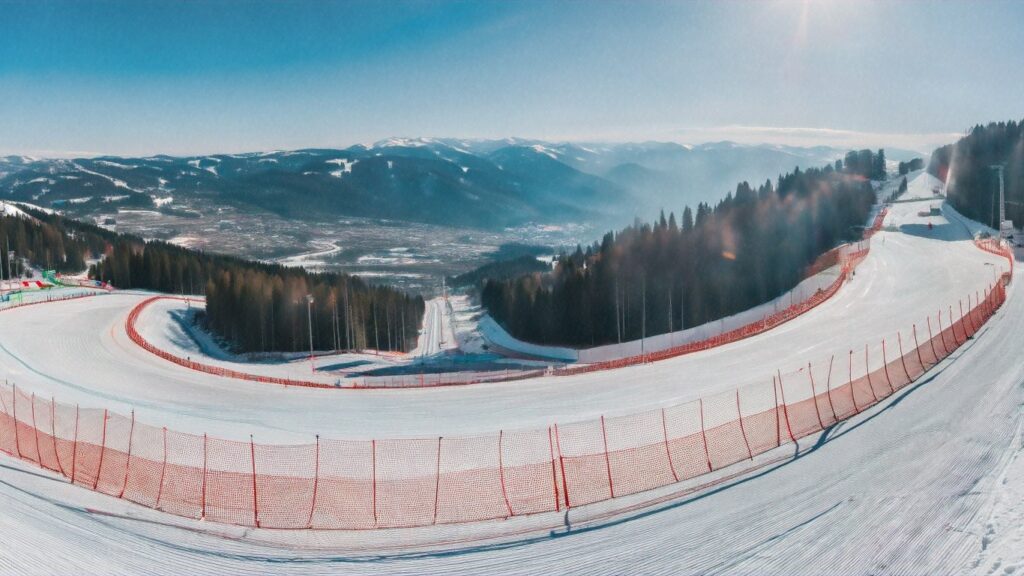
Image Credit: Shutterstock
The Finish Line That Belonged to Everyone
When Nazgul crossed the line, he was not chasing a qualifying time or thinking about podium placements. He was responding to instinct, curiosity, and the excitement of motion. Yet in doing so, he stepped into a moment that will likely be replayed long after the specific details of that qualifier fade from memory.
Athletes train for years for the opportunity to compete on that stage, sacrificing time, comfort, and often their physical well-being in pursuit of excellence. Moments like this do not diminish their effort. Instead, they add texture to it. They remind us that even at the highest level of competition, there is still room for surprise and shared humanity.
One day, fans may need to look up the exact times from that race or double-check the order of finishers. But many will remember the very good dog who decided to sprint down an Olympic course and cross the finish line like he had been preparing for it his entire life.
Featured Image Credit: Shutterstock