

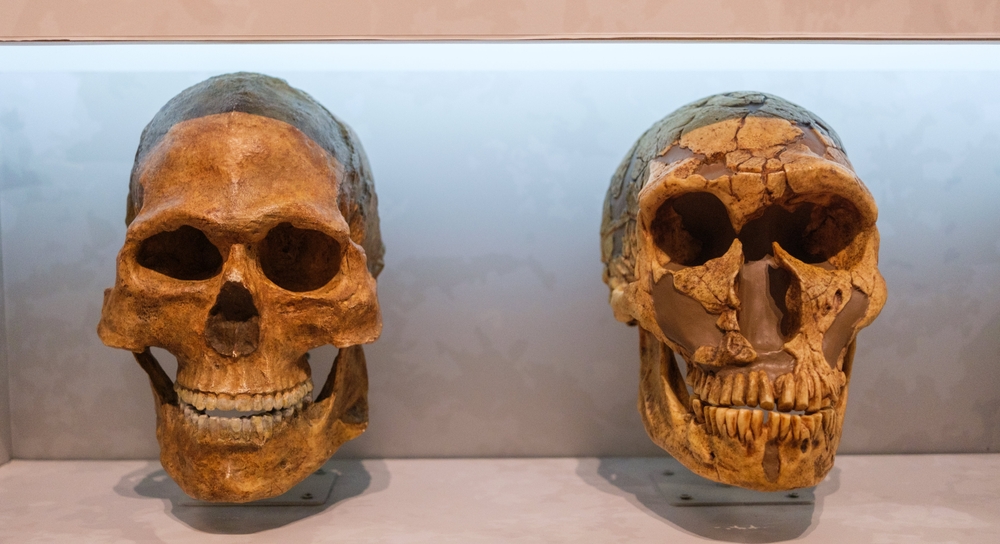
New Archaic Human Species Homo Juluensis Discovered in Asia
Human evolution has never been a straight line. For decades, scientists often described it as a gradual progression from primitive ancestors toward modern humans. New discoveries over the last several decades have shown that reality is far more complicated. Instead of a single path, the human story appears to be a tangled web of different species that lived at the same time, interacted with one another, and sometimes even interbred.
One of the newest and most intriguing additions to this expanding human family tree is a proposed species called Homo juluensis. The name translates roughly to “big head people,” referring to the unusually large skulls found in fossils associated with this group. According to researchers from the Chinese Academy of Sciences and the University of Hawai‘i, these ancient humans lived in eastern Asia between roughly 300,000 and 50,000 years ago.
If confirmed, Homo juluensis could help explain several long-standing puzzles in paleoanthropology. Fossils discovered across Asia have often been difficult to classify. Many remains appeared too advanced to belong to older species like Homo erectus but did not match the features of Neanderthals or modern humans either. For years, these fossils were simply placed into broad categories such as “archaic Homo sapiens,” which did little to clarify their true evolutionary identity.
The proposal of Homo juluensis offers a new way to organize these mysterious remains. It also reinforces an increasingly accepted idea among scientists: that the ancient world was once populated by multiple human species living side by side.
A Complex Human Family
Today, only one species of human remains on Earth: Homo sapiens. However, for most of our evolutionary history, humans were not alone. The planet once hosted a wide range of closely related hominin species that occupied different regions and adapted to different environments.
Neanderthals lived across Europe and parts of western Asia. Denisovans occupied areas of Siberia and possibly large portions of Asia. Smaller-bodied humans such as Homo floresiensis lived on the Indonesian island of Flores, while Homo luzonensis inhabited the Philippines. Fossil discoveries across Africa reveal even more branches of the human family tree.
Evidence now suggests that several of these species existed at the same time and occasionally interacted with each other. Genetic studies have confirmed that modern humans carry small amounts of DNA from Neanderthals and Denisovans. These genetic traces are reminders that ancient human populations sometimes mixed and exchanged genes.
The addition of Homo juluensis further complicates this picture in a fascinating way. Instead of a small handful of species, eastern Asia may once have hosted a remarkable diversity of human relatives.
The Discovery Behind Homo juluensis
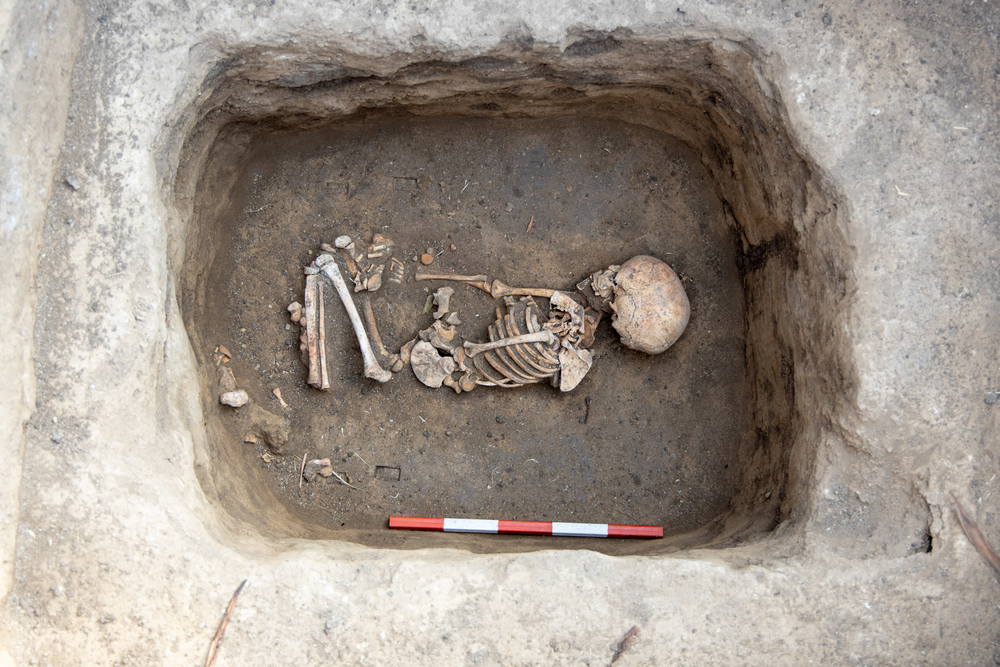
The story of Homo juluensis did not begin with a dramatic new fossil discovery. Instead, it emerged from scientists reexamining fossils that had already been discovered decades earlier.
Throughout the twentieth century, archaeologists uncovered a number of puzzling human remains across China and neighboring regions. Some of the most important specimens came from sites such as Xujiayao and Xuchang in northern and central China. These fossils included fragments of skulls, jaws, and teeth belonging to individuals who lived hundreds of thousands of years ago.
What made these fossils unusual was the combination of features they displayed. Some traits resembled those seen in older species like Homo erectus. Others appeared more similar to modern humans. The skulls themselves were large and thick, and the teeth showed distinctive shapes that did not easily match any known species.
For years, researchers struggled to classify these remains. Without a clear category, they were often placed into vague classifications that grouped together a wide range of unrelated fossils.
Christopher J. Bae of the University of Hawai‘i and Xiujie Wu of the Chinese Academy of Sciences decided to take a closer look. By comparing cranial features, jaw structures, and dental characteristics across multiple fossil sites, they noticed a consistent pattern. Several specimens shared a similar set of traits that suggested they might belong to a single, previously unrecognized human group.
Their analysis led them to propose a new species name: Homo juluensis.
The Meaning of “Big Head People”
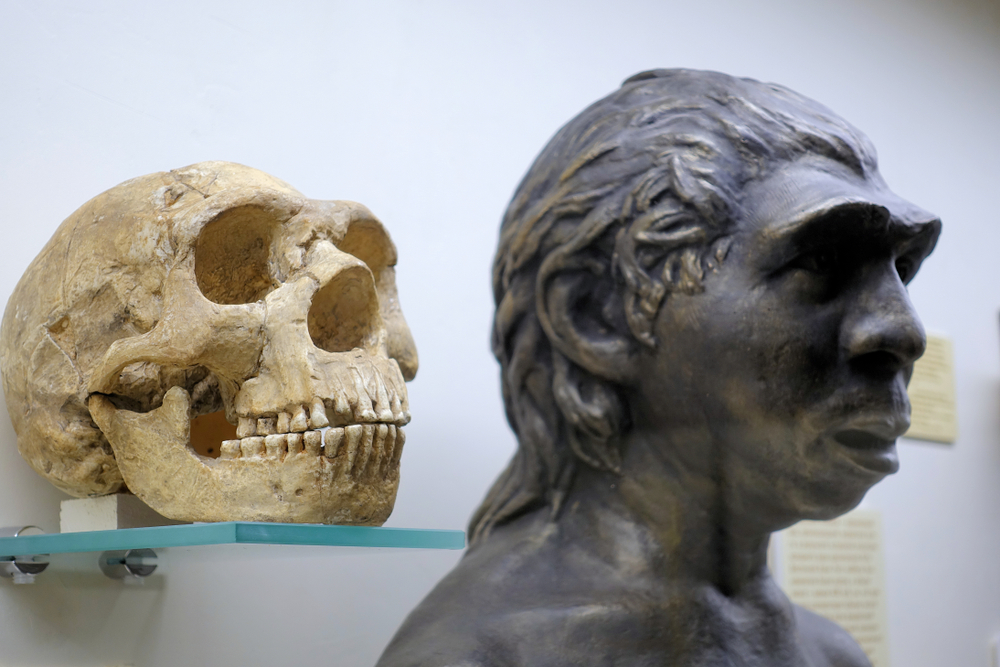
The name Homo juluensis comes from Chinese words meaning “big head.” This description refers to the large skulls associated with fossils attributed to this species.
Initial measurements suggest that the braincases of these individuals may have been significantly larger than those of modern humans. Some estimates indicate that their brain capacity may have exceeded that of Homo sapiens by as much as thirty percent.
Large brain size does not necessarily mean greater intelligence. Brain organization and structure are just as important as overall volume. However, the size of these skulls indicates that Homo juluensis possessed highly developed brains comparable to those of other advanced human relatives.
The skulls also display thick cranial bones and prominent facial features. Their teeth are notably large, with patterns that resemble those found in Denisovan fossils. This similarity has led some researchers to suspect that Homo juluensis may actually represent the physical appearance of the mysterious Denisovans.
A Possible Link to Denisovans
Denisovans are one of the most enigmatic groups in human evolution. Scientists first identified them in 2010 through DNA extracted from a small finger bone discovered in Denisova Cave in Siberia. Genetic analysis revealed that the bone belonged to a previously unknown group of ancient humans related to both Neanderthals and modern humans.
Despite this genetic breakthrough, very few Denisovan fossils have been found. Most of the evidence comes from fragments of bone and teeth, leaving scientists uncertain about what Denisovans actually looked like.
This is where Homo juluensis enters the picture. Some of the fossils associated with the proposed species share striking similarities with known Denisovan teeth and jaw fragments. If the connection is correct, these larger skulls may represent the missing physical description of Denisovans.
However, the evidence is not yet conclusive. DNA has not been successfully extracted from many of the fossils associated with Homo juluensis. Without genetic confirmation, the relationship between the two groups remains a hypothesis.
Future discoveries and genetic testing may eventually clarify whether Homo juluensis represents a distinct species or whether it is another name for the elusive Denisovans.
Life in Ice Age Asia
The fossils attributed to Homo juluensis date back to a time when much of the world was experiencing dramatic climatic shifts. The period between 300,000 and 50,000 years ago saw repeated cycles of glacial and interglacial periods.
Eastern Asia during this time included a mix of forests, grasslands, and river systems. Winters could be extremely harsh, especially in northern regions. Surviving in these environments required adaptability, cooperation, and technological skill.
Archaeological evidence suggests that Homo juluensis possessed many of these qualities. Stone tools discovered at associated sites indicate that these people were capable of shaping rocks into sharp cutting implements. Such tools would have been essential for hunting animals, preparing food, and crafting other survival equipment.
Researchers believe that Homo juluensis likely hunted large animals such as wild horses. The presence of horse remains near archaeological sites supports the idea that these ancient humans relied on cooperative hunting strategies.
Evidence also suggests that they may have processed animal hides, possibly to create clothing or shelter materials. In cold climates, the ability to produce protective coverings could mean the difference between survival and death.
These activities demonstrate that Homo juluensis was not a primitive or unsophisticated species. Like other human relatives, they were intelligent hunter-gatherers capable of adapting to challenging conditions.
The “Muddle in the Middle”

One reason the discovery of Homo juluensis is attracting attention is because it may help resolve a long-standing problem in paleoanthropology sometimes referred to as the “muddle in the Middle.”
This phrase describes the confusion surrounding human fossils from the Middle Pleistocene period. Many fossils from this era show mixtures of traits that make them difficult to classify. They do not neatly fit into established species categories such as Homo erectus, Neanderthals, or modern humans.
For decades, scientists often grouped these fossils together under broad labels that lacked precision. While convenient, these labels did little to explain how these populations were related to one another.
The proposal of Homo juluensis is an attempt to bring greater clarity to this part of the human evolutionary timeline. By identifying consistent patterns in skull shape, dental structure, and other anatomical features, researchers hope to organize these fossils into a more meaningful framework.
If the classification proves accurate, it could reveal that eastern Asia hosted multiple distinct human populations during the Middle and Late Pleistocene.
The Debate Among Scientists

Not everyone in the scientific community agrees that Homo juluensis should be recognized as a separate species. Some researchers argue that the evidence is still incomplete.
One concern is that the fossils associated with Homo juluensis come from different locations and time periods. Critics suggest that these remains might represent several different populations rather than a single unified species.
Others point out that the Harbin skull discovered in northeastern China has already been named Homo longi, sometimes referred to as “Dragon Man.” Some scientists believe the fossils attributed to Homo juluensis might actually belong to the same group as Homo longi.
If that interpretation is correct, scientific naming rules would give priority to the older name Homo longi.
Debates like this are common in paleoanthropology. The fossil record is incomplete, and interpretations often evolve as new discoveries are made. What matters most is the ongoing process of testing ideas, refining classifications, and gathering new evidence.
A World of Many Humans

Perhaps the most important lesson from discoveries like Homo juluensis is that the ancient world was far more diverse than previously imagined.
For a long time, many people assumed that modern humans gradually replaced earlier forms of humanity as they evolved. Today, scientists understand that multiple human species often lived at the same time.
Around 100,000 years ago, the planet may have been home to Neanderthals in Europe, Denisovans across parts of Asia, Homo floresiensis in Indonesia, Homo luzonensis in the Philippines, and modern humans spreading outward from Africa.
These populations likely encountered one another as their territories expanded and shifted. Genetic evidence shows that interbreeding occurred in several cases, leaving traces that still exist in modern human DNA.
In this context, Homo juluensis represents another piece of an already complex puzzle.
Why They Disappeared
Like many other ancient human species, Homo juluensis eventually vanished from the fossil record around 50,000 years ago.
The reasons for their disappearance remain uncertain. Scientists have proposed several possible explanations.
One possibility involves environmental changes. Ice Age climates were unstable, and small populations could have struggled to survive during extreme temperature shifts or habitat changes.
Another possibility involves competition with modern humans. As Homo sapiens spread into new territories, they may have competed with other human groups for resources such as food, shelter, and territory.
Interbreeding may also have played a role. Some extinct human populations may not have vanished entirely but were instead gradually absorbed into expanding Homo sapiens populations. Their genetic contributions would remain hidden within the DNA of later generations.
It is likely that a combination of factors influenced the fate of Homo juluensis and other ancient human relatives.
Rethinking Human Origins
Each new fossil discovery forces scientists to reconsider long-held assumptions about human evolution. The story that once appeared simple now appears layered, interconnected, and dynamic.
The proposed species Homo juluensis highlights how much remains unknown about our past. Fossils scattered across Asia hint at populations that lived, adapted, and disappeared long before recorded history began.
These discoveries remind us that modern humans are part of a much larger evolutionary family. Our species did not arise in isolation but emerged within a world already populated by other intelligent human relatives.
The search for new fossils, improved dating techniques, and advances in ancient DNA research will continue to refine this picture. Future discoveries may confirm Homo juluensis as a distinct species, link it more clearly with Denisovans, or reveal entirely new branches of the human family tree.
What remains certain is that the story of humanity is far more complex than once believed. The ancient world was not inhabited by a single type of human but by many, each adapting to different environments and challenges.
Homo juluensis, whether ultimately recognized as its own species or absorbed into another classification, represents an important reminder that our evolutionary history is still being uncovered. Each fossil fragment and each new analysis brings us closer to understanding the extraordinary diversity of the human journey.