

A Football-Sized Egg Sat in a Museum Drawer for a Decade. What Scientists Found Inside Changed Everything.
Something sat in a museum drawer for nearly a decade. Scientists picked it up, turned it over, and set it back down. Nobody could name it. Nobody could place it. And yet, what they held would eventually force paleontologists to rethink some of their most deeply held assumptions about prehistoric life.
Chilean researchers found it on Seymour Island, Antarctica, in 2011, during an expedition to one of the most remote stretches of land on Earth. Pulled from a seasonal stream, the object was crinkled and collapsed, its exterior folded in on itself in a way that made little sense. Nobody in camp had a framework for it. So they did what scientists sometimes do when they run out of answers: they gave it a nickname. Borrowed from a 1982 sci-fi horror film set in Antarctica, the name stuck. They called it “The Thing.”
For seven years, “The Thing” sat unlabeled and unstudied at Chile’s National Museum of Natural History in Santiago. Researchers walked past it. Some picked it up. None of them left with an answer. And then, in 2018, a paleontologist walked through the door.
A Deflated Football From 66 Million Years Ago
Julia Clarke, a professor of vertebrate paleontology at the University of Texas at Austin, had come to the museum for reasons unrelated to mystery fossils. During her visit, co-researcher David Rubilar-Rogers mentioned almost in passing that Antarctica had no known fossilized eggs on record. On a hunch, he pulled out “The Thing.”
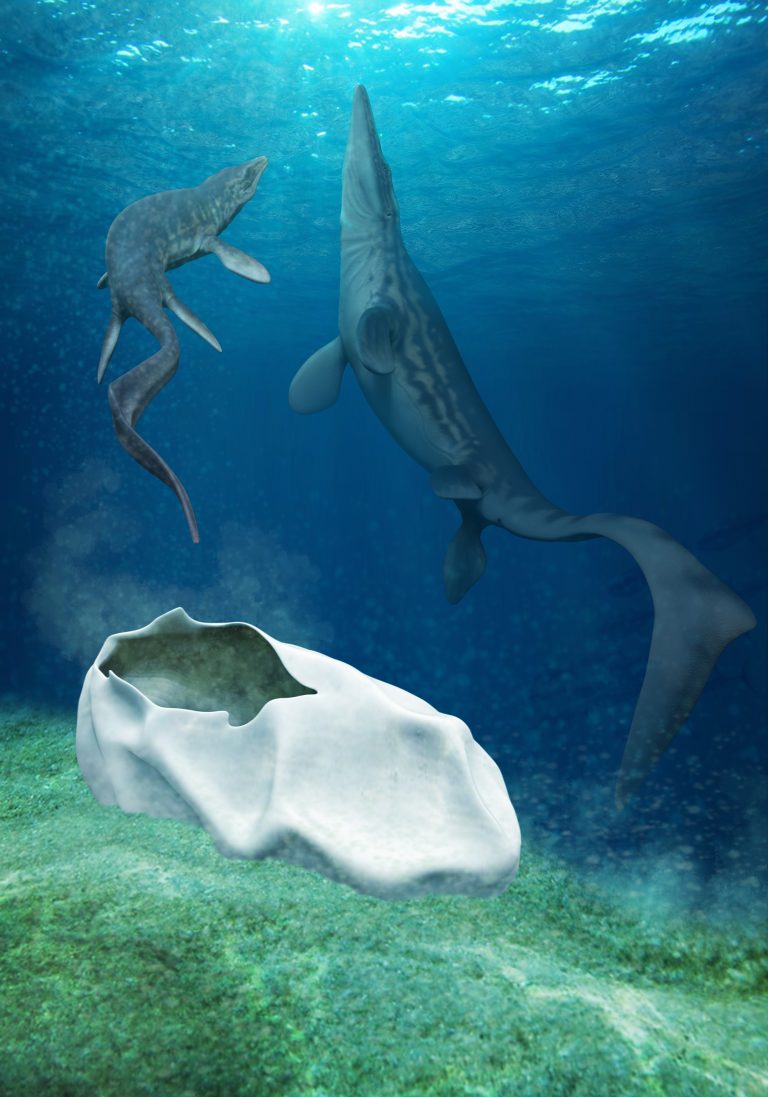
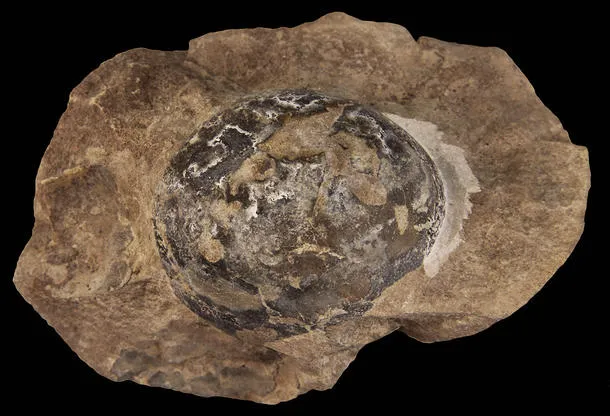
Clarke looked at it and knew at once. “To me, it looked exactly like a deflated football,” she recalled. But beneath that crumpled surface lay something far beyond expectation. Microscope analysis confirmed multiple membrane layers, placing the object in a category scientists had rarely seen survive the fossil record: a giant, soft-shelled egg.
Formally named Antarcticoolithus bradyi, a Greek phrase meaning “delayed Antarctic stone egg,” the specimen measured roughly 29 by 20 centimetres. At that size, it became the largest soft-shelled egg ever found and the second-largest animal egg in Earth’s history, behind only the egg of the extinct elephant bird from Madagascar. A study describing the find published in the journal Nature on June 17, 2020. “There’s no known egg like this,” said Clarke. “This egg is exceptional in both its size and its structure.”
What Was Inside
Here is where the story gets murkier. No embryo or hatchling survived inside the egg. What researchers found instead was sediment and, of all things, an ammonite. Without a skeleton to identify, the team had to work backward from the egg itself to figure out which creature had produced it.
Soft shells are common among modern reptiles. Lizards, snakes, and certain turtles all lay eggs with flexible, membrane-heavy shells. A fossil egg of this structure most closely resembles the eggs of lepidosaurs, the broader group that includes lizards and snakes. Yet in both scale and geological age, nothing about it fit neatly into a known category.
Lead researcher Lucas Legendre, a postdoctoral researcher at UT Austin’s Jackson School of Geosciences, put it plainly: “It is from an animal the size of a large dinosaur, but it is completely unlike a dinosaur egg. It is most similar to the eggs of lizards and snakes, but it is from a truly giant relative of these animals.”
Who Laid It
To identify the mother, Legendre built a data set comparing body size to egg size across 259 living reptile species. His findings pointed to a mother at least 20 feet long from snout to body, not counting the tail. And when researchers examined what lived near Seymour Island during the Late Cretaceous period, one candidate rose above all others.
About 200 metres from where the egg was found, another excavation had already unearthed the remains of Kaikaifilu hervei, a mosasaur measuring roughly 33 feet long. Mosasaurs were ocean predators of the Late Cretaceous, enormous marine reptiles that dominated warm seas across the planet. They fall within the lepidosaur family, the same group that the egg’s structure points toward. No known Late Cretaceous Antarctic dinosaur or pterosaur was large enough to have produced an egg of this scale.
None of this proved the connection with certainty. “The identity of the animal that laid the egg is unknown,” the researchers wrote in their paper. But the weight of evidence pointed to a mosasaur, making Antarcticoolithus bradyi what could be the only mosasaur egg ever found.
Everything Scientists Assumed Was Wrong
For decades, most researchers assumed large marine reptiles gave live birth. Mosasaurs spent their entire lives at sea. Coming ashore to lay eggs seemed anatomically impossible for animals built for water. So the prevailing idea held that they bypassed eggs altogether and delivered live young, much like modern whales and dolphins. A soft-shelled egg sitting 200 metres from a mosasaur’s remains made that assumption hard to defend.
Two competing theories exist for how the egg ended up where it did. One idea suggests hatching happened in open water, much as some sea snake species deliver young in the ocean. Another theory proposes that the mother dragged her tail end onto shore while keeping most of her body submerged, depositing the egg on a beach before hatchlings made their way to sea, like baby sea turtles today. Clarke acknowledged the limits of current knowledge on the matter: “We can’t exclude the idea that they shoved their tail end up on shore because nothing like this has ever been discovered.”
Either way, soft-shelled eggs cannot survive long in open air. Soft shells lose moisture fast and break down without burial. If hatching happened in water, sediment would have filled the cavity afterward, which matches what researchers found inside.
Why Soft-Shelled Eggs Rarely Survive
Hard shells contain calcium carbonate, a mineral that holds its structure over millions of years. Soft shells are mostly membrane. They collapse, rot, and vanish. What made “The Thing” survivable was a combination of rapid sediment infill after hatching and the specific rock conditions of the Antarctic formation where it lay.
After the egg opened, sediment rushed in and preserved its shape from within. Over tens of millions of years, the shell folded and contracted, producing the crinkled, deflated appearance that baffled researchers for so long. Scientists identified it as an egg only after examining it under microscopes and finding the distinct membrane layering that lepidosaur eggs share.
Mary Caswell Stoddard, an evolutionary biologist at Princeton University who had no involvement in the research, captured the rarity of the find: “A soft-shelled fossil egg like this is a rare gem. The lack of soft-shelled fossil eggs, which are extraordinarily rare, makes it challenging to flesh out a detailed picture of egg evolution in vertebrates. This discovery helps provide one critical piece of the puzzle.”
What Antarctica Looked Like Then
Antarctica today is a frozen, largely barren continent. During the Late Cretaceous period, roughly 66 to 145 million years ago, it bore almost no resemblance to what it is now. Warm, shallow seas covered much of the Antarctic Peninsula. Life was dense and rich.
Seymour Island sits within a geological formation called Lopez de Bertodano, which has produced fossils of fish, ammonites, early birds, plesiosaurs, and mosasaurs. Baby mosasaurs and plesiosaurs have also turned up in the same area, leading some researchers to suggest the site may have functioned as a nursery, a sheltered shallow cove where young animals grew before moving to open water.
Soft Shells Were More Common Than Anyone Thought
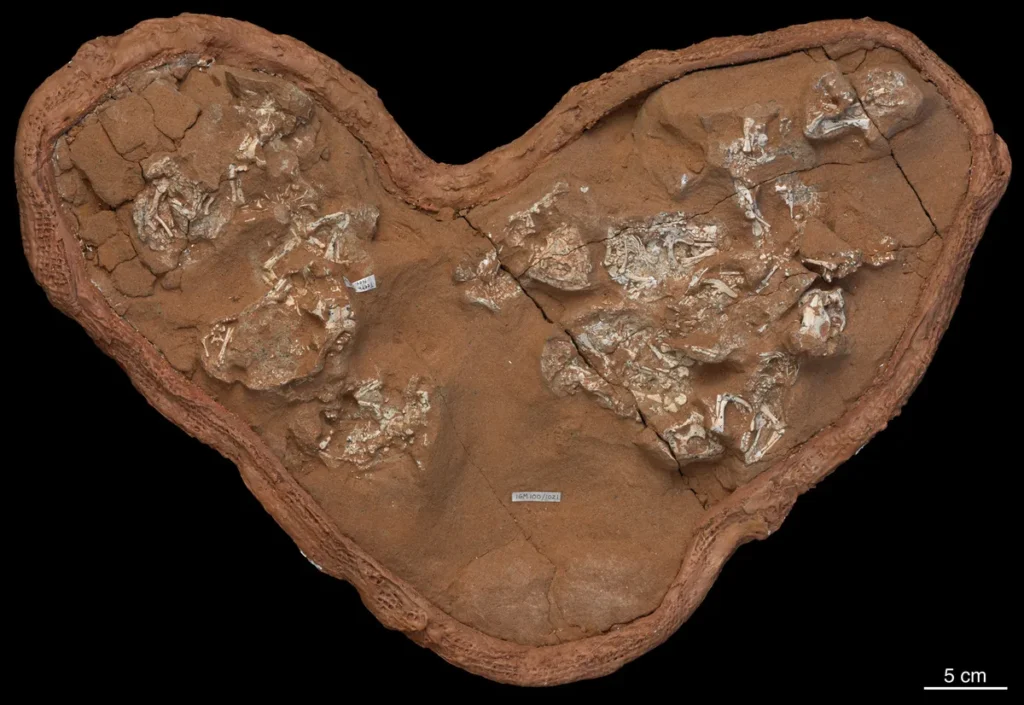
Published alongside the Antarctic egg in the same June 2020 issue of Nature, a second study threw yet another assumption into question. A research team led by Mark Norell of the American Museum of Natural History reported soft-shelled eggs in two plant-eating dinosaur species: Protoceratops, a sheep-sized relative of Triceratops found in Mongolia, and Mussaurus, a long-necked species from Argentina.
Chemical analysis by molecular paleobiologist Jasmina Wiemann of Yale University confirmed the soft-shell signature in both sets of fossilized embryos. Scientists had noticed subtle halos surrounding the embryos in the rock. When they compared the chemical makeup of those halos against modern hard and soft-shelled eggs, the match came back soft.
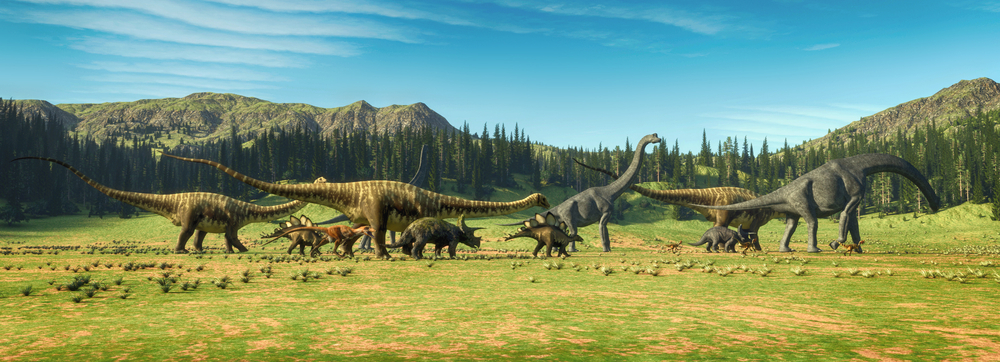
Before these discoveries, most researchers assumed dinosaurs laid hard-shelled eggs. That assumption rested partly on what had already been found and partly on the fact that modern crocodilians and birds, two of the closest living relatives of dinosaurs, lay hard-shelled eggs. But the fossil record had always had a glaring gap. Eggs from most dinosaur species had never been found at all.
Norell believed that absence was not random. Many dinosaurs likely buried soft-shelled eggs, which broke down before they could fossilize, leaving nothing behind. Hard-shelled eggs, he and his team proposed, likely evolved at least three separate times independently across different dinosaur lineages, rather than once at the origin of the group.
What Gets Asked Next
Knowing soft shells were far more widespread in ancient reptiles reopens questions scientists thought were settled. Researchers may now re-examine fossils once dismissed as soil disturbances or sediment anomalies. Subtle chemical halos around embryo remains, once ignored, could carry the signature of soft shells that vanished before anyone knew to look.
For mosasaurs, the egg raises questions that go beyond reproduction. If these animals did lay eggs, their life history would look different from what textbooks have assumed. Reproduction links to where a species needed to be at certain times of year, how it raised its young, and how tied it was to specific places and conditions. A nursery site in ancient Antarctic waters, populated by babies and adults together, hints at a level of behavioural depth that science is only beginning to register.
The Lesson in the Drawer
For seven years, one of the most significant fossil discoveries in recent paleontological history sat in a museum drawer. Researchers picked it up, examined it, and moved on. Nobody had the reference point to understand what they were holding.
Sometimes the most important answers are not buried deeper in the ground. Sometimes they wait in a drawer for someone to walk in with fresh eyes.
“The Thing” forced a rethink of how ancient sea creatures reproduced, how common soft-shelled eggs once were, and what life looked like in an Antarctica that no longer exists. If one decade-old mystery fossil can do all of that, it raises a question worth sitting with: how many other answers are already collected, already catalogued, already resting on a shelf somewhere, waiting for the right person to ask the right question?
Source: Legendre, L. J., Rubilar-Rogers, D., Musser, G. M., Davis, S. N., Otero, R. A., Vargas, A. O., & Clarke, J. A. (2020). A giant soft-shelled egg from the Late Cretaceous of Antarctica. Nature, 583(7816), 411–414. https://doi.org/10.1038/s41586-020-2377-7
Featured Image Source: John Maisano / Jackson School of Geoscienceswww.jsg.utexas.edu/news/2020/11/monster-eg