

Beyond the Sun’s Last Breath, Voyager Found a Wall of Fire
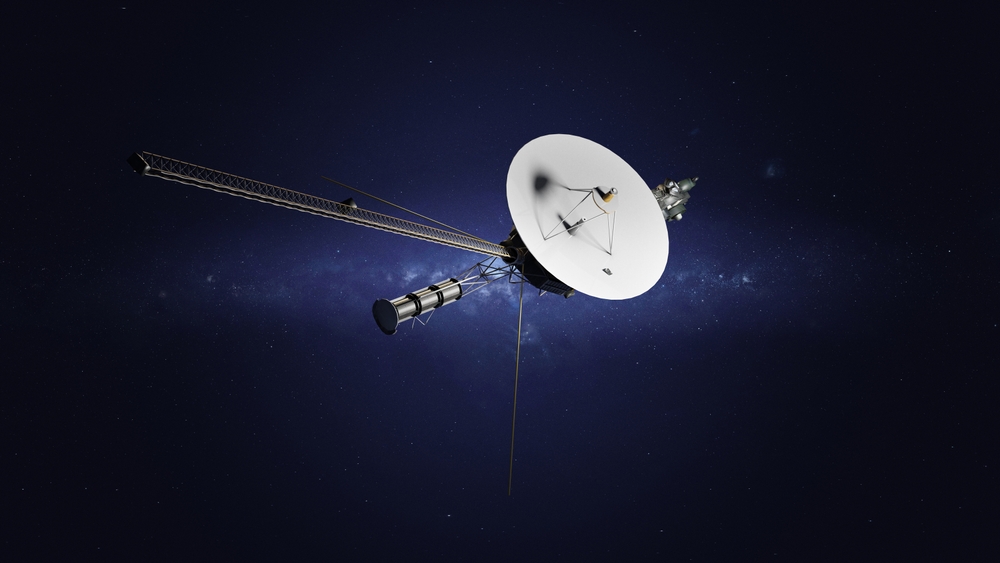
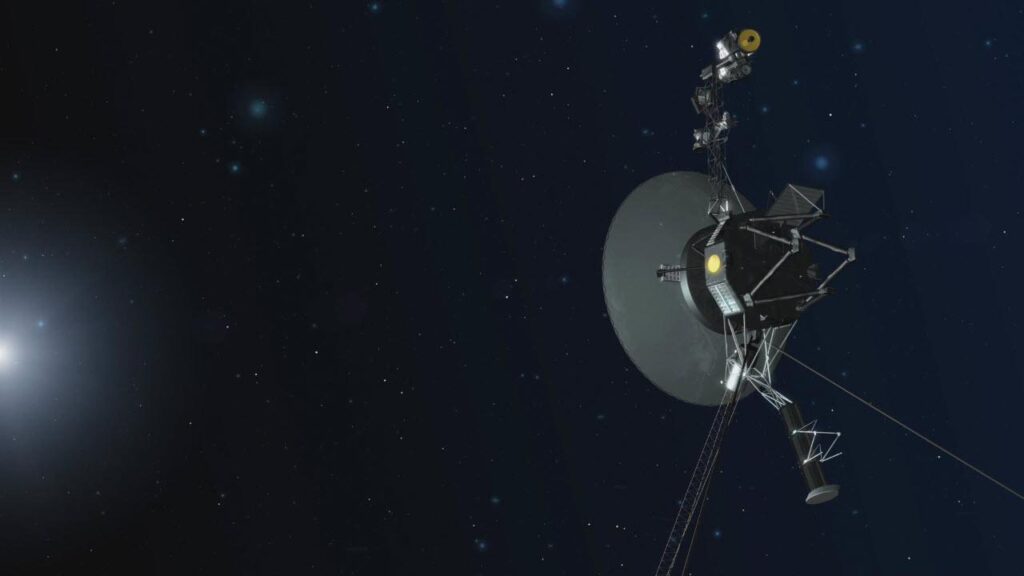
In 1977, NASA launched two spacecraft on a mission that would outlast every prediction. Voyager 1 and Voyager 2 left Earth to study the outer planets, but their journey never stopped. Decades later, Voyager 1 had traveled farther than any human-made object in history, drifting through regions of space no instrument had ever sampled. And somewhere out there, at the bleeding edge of our solar system, it ran into something nobody saw coming.
Instruments aboard Voyager 1 picked up readings that sounded more like fantasy than science. A region of superheated plasma. Temperatures are soaring between 30,000 and 50,000 Kelvin, which translates to 54,000 to 90,000 degrees Fahrenheit. Scientists began calling it the “wall of fire.”
But here’s what makes it strange. Voyager survived. It passed through and kept going, sending signals back across billions of kilometers of space. How does a spacecraft built with 1970s technology survive a wall of fire? And what does that wall mean for everything we thought we knew about where our solar system ends?
What Even Is the Edge of the Solar System?
Defining where our solar system “ends” depends on who you ask. Some draw the line at Neptune’s orbit, where the planets stop. Others place it at the Oort Cloud, a distant shell of icy objects still bound by the Sun’s gravity. But for physicists, the real edge lies somewhere else.
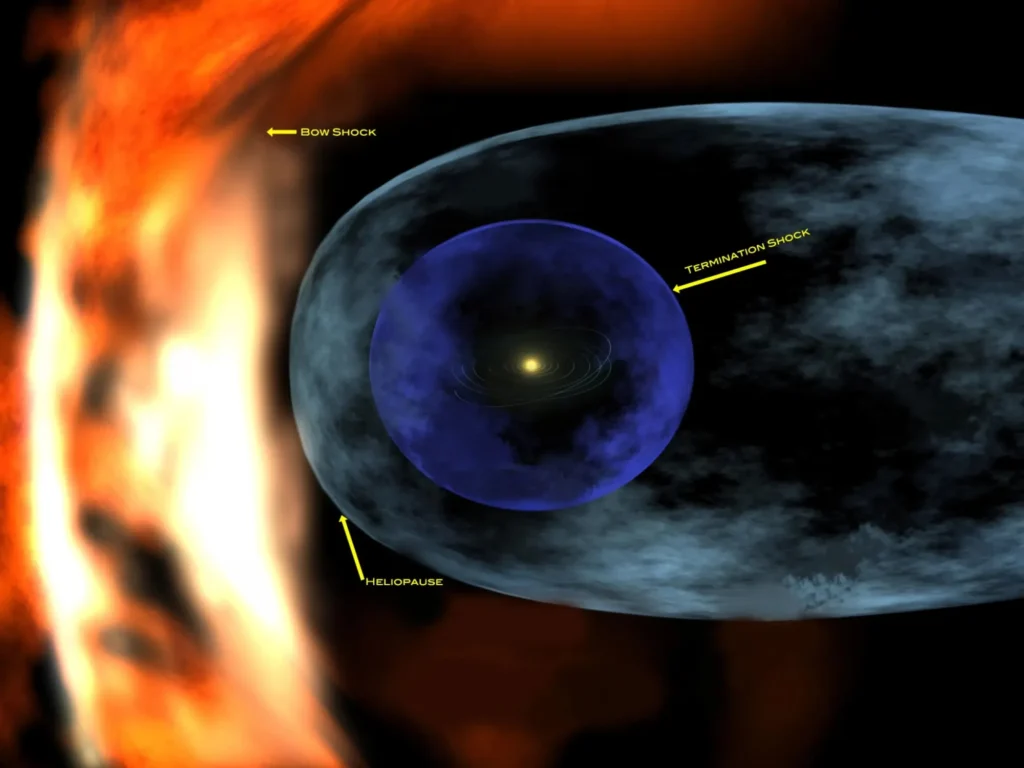
Our Sun blasts a constant stream of charged particles into space, known as the solar wind. It races outward past Mercury, past Earth, past Jupiter, past Pluto, and keeps going. All that outward pressure forms a giant protective bubble around our Sun and its planets, known as the heliosphere. But every bubble has a limit. At some point, the solar wind runs into resistance from interstellar gas and plasma drifting between stars. Where those two forces reach a balance, the solar wind turns back on itself. Scientists call that boundary the heliopause.
Picture it like a boat on the water. As NASA puts it, “As the heliosphere plows through interstellar space, a bow shock forms, similar to what forms as a ship plowing through the ocean.” Our Sun carves through the galaxy, and the heliosphere is the wave it pushes ahead of itself. And it was right there, at the heliopause, that Voyager ran into the wall of fire.
Why Our Invisible Shield Matters More Than You Think
Before we get to what Voyager found, it helps to understand why the heliosphere matters at all. Galactic cosmic radiation bombards everything in interstellar space. Without the heliosphere, that radiation would slam straight into our planet. Earth gets a second layer of protection from its own magnetic field, the magnetosphere, which blocks both solar and cosmic particle radiation while also preventing the solar wind from stripping away our atmosphere.
Not every planet got so lucky. Mars and Venus have no magnetic shields. Solar wind has eroded their atmospheres over billions of years, and both planets evolved in ways that make them hostile to life as we know it. Our heliosphere acts as a first line of defense, a bubble that softens the blow before it ever reaches Earth’s own magnetic armor.
So when Voyager 1 approached the edge of that bubble, it wasn’t just crossing a line on a map. It was probing the boundary that keeps our corner of space livable.
Crossing a Line Nobody Knew How to Find
For decades, scientists built models and ran simulations, but nobody knew where the heliopause sat. Voyager 1 gave them the answer on August 25, 2012, when it became the first spacecraft to cross the boundary. Voyager 2 followed in 2018.
Here’s where it gets interesting. Both probes crossed at different distances from the Sun. A NASA statement confirmed what many had theorized. “Scientists expected that the edge of the heliosphere, called the heliopause, can move as the Sun’s activity changes, sort of like a lung expanding and contracting with breath.”
Our solar bubble breathes. It swells when the Sun is active and contracts when it quiets down. Voyager 1 and 2 happened to cross at different moments in that cycle, which is why they hit the boundary at different points.
But before Voyager 1 made its official crossing, something bizarre happened. In the weeks leading up to August 2012, the spacecraft entered a region scientists had never predicted. Low-energy ions that Voyager had tracked for six straight years vanished. At the same time, cosmic ray particles from outside the heliosphere came flooding in. Yet magnetic field readings showed the probe had not left the heliosphere. It had entered a kind of magnetic highway, a strange corridor where particles from inside streamed out and particles from outside streamed in, all while the spacecraft remained inside our solar bubble.
Voyager 1 crossed a sharp, distinct boundary five times over roughly 30 days. Scientists expected a slow, gradual transition. What they got was an abrupt threshold, more like a door slamming open and shut than a gentle fade.
So What Is the “Wall of Fire”?
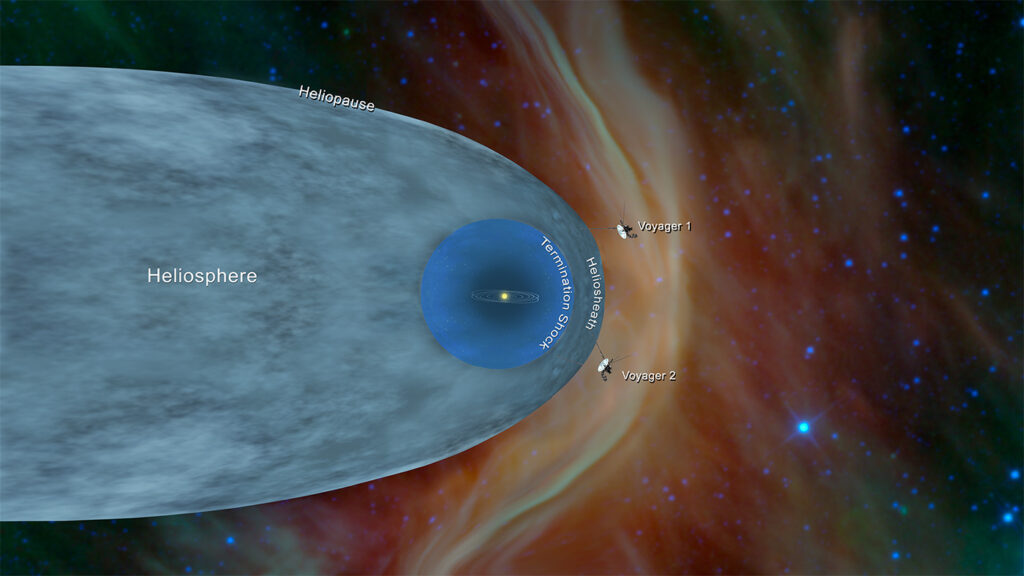
Now we arrive at the headline. When both Voyager spacecraft crossed the heliopause, their instruments recorded temperatures between 30,000 and 50,000 Kelvin. For reference, the surface of our Sun sits at about 5,500 Kelvin. At first glance, those numbers sound like a death sentence for any spacecraft.
But temperature in space follows different rules than it does on Earth. Near the heliopause, charged particles get trapped and compressed, bouncing around at extreme speeds. Speed translates to temperature at the particle level. However, particle density in that region is so low that collisions between particles and the spacecraft are rare. Not enough energy transfers to heat the probe’s surface. Voyager passed through a region hot enough to melt steel on paper, yet felt next to nothing.
What struck scientists even more was the pattern. Some zones blazed at extreme temperatures while nearby regions stayed cooler, creating a patchwork of hot and cold plasma. Nobody expected that kind of variation. Instead of a uniform boundary, Voyager found a wild, patchy frontier where energy concentrated in unpredictable pockets. Scientists gave it the nickname “wall of fire” because the image fit. Two opposing forces, solar wind and interstellar medium, collide and create something fierce at the collision point.
Magnetic Surprises Beyond the Boundary
Temperature readings alone would have rewritten textbooks. But Voyager 1 brought back another surprise. Near the heliopause, Voyager 1 detected magnetic field lines that appeared stronger and more organized than any model had predicted. Interstellar magnetic fields seemed to press against the heliosphere with more force than scientists assumed, warping and bending the boundary like a balloon squeezed under pressure.
An even stranger finding emerged from the data. When Voyager 1 crossed the boundary multiple times in 2012, the magnetic field direction did not change. Inside and outside the heliosphere, the fields ran parallel. With only one probe’s data, scientists couldn’t rule out a coincidence. But when Voyager 2 crossed in 2018, it settled the debate. As NASA reported, “Voyager 2’s magnetometer observations confirm the Voyager 1 finding and indicate that the two fields align.”
Two probes, six years apart, at different distances from the Sun, and both found the same thing. Whatever force aligns those magnetic fields operates on a scale far larger than our solar system alone.
A Strange Hum and Cosmic Rays from Beyond
Once past the wall, Voyager 1 entered true interstellar space and picked up something eerie. A persistent, low-frequency hum, steady and constant, unlike anything recorded inside the heliosphere.
Instruments also measured galactic cosmic ray spectra down to energies never sampled before. Hydrogen and helium nuclei showed broad energy peaks between 10 and 40 million electron volts per nucleon, and electron intensity kept climbing at lower energies. For the first time, humanity had a direct sample of the particles that fill the space between stars. Every previous measurement of cosmic rays had been filtered through the heliosphere. Voyager stripped that filter away and delivered raw data from the galaxy itself.
What All of It Means for Us Back on Earth
Every signal Voyager 1 sends now travels more than 24 billion kilometers before it reaches a receiver on Earth. Each transmission carries a fragment of the answer to a question humanity has asked since we first looked up at the night sky. Where does our home end, and what lies beyond?
We now know the answer is not simple. Our solar system does not fade into darkness. It crashes into a fierce, turbulent border zone where fire and magnetism and cosmic rays all collide. Understanding that borders tell us how stars carve out protective bubbles in the galaxy, why some planets keep their atmospheres while others lose them, and what conditions a world needs to support life.
Voyager 1 and Voyager 2, both nearly 50 years old, remain the only human-made objects to have crossed the wall of fire. Every new reading they send back rewrites a chapter of what we thought we understood about our place in the cosmos. And somewhere out there, still drifting, still transmitting, two small machines from the 1970s continue to prove that the greatest discoveries wait at the edge of everything we know.