


Sam Kaplan had already raised five children, built businesses, worked several jobs, and written two books before he ever sat through a college class. For most of his life, higher education had simply remained somewhere beyond the horizon, overshadowed by work, family, and the daily responsibilities that filled the years. Yet the stories he carried with him never disappeared, and neither did his desire to understand how to turn them into something larger.
Then, at 68, he heard a radio advertisement while driving outside Atlanta. Four years later, Kaplan stood among hundreds of graduates at the age of 72, receiving his bachelor’s degree with summa cum laude honors. Waiting in the audience was his 99-year-old mother, Virginia, who had come to watch her son become the first of her eight children to earn a college degree.

A Decision Made on an Ordinary Drive
Kaplan’s path back to education began without a long period of planning. He was driving along Highway 316 when he heard an advertisement for Georgia Gwinnett College and a program connected to scriptwriting. The opportunity caught his attention because writing had always been part of his life. He later explained that he had been carrying stories for years and wanted to understand how to shape them for the screen.
“I was riding down 316 and heard on the radio that Georgia Gwinnett College was offering a degree that involved script writing,” Kaplan said. He described what happened next with humor, explaining that his car seemed to have developed automatic steering as he pulled off on Collins Hill Road. Within minutes, he was registering for the fall semester.
There was something deeply human about the speed of that decision. Many people carry ambitions for years while waiting for the perfect moment to begin. Kaplan had already lived most of his adult life without a college degree, and there were plenty of reasons he could have given himself to keep driving. Instead, he took the next exit and gave an old dream a new place in his life.
He knew what he was hoping to gain. “I’ve always liked to write, I love to tell stories,” he said. “I thought I could turn my stories into screenplays, but I needed to have the foundation of what to do.” He had already gathered the raw material through decades of living. What he wanted now was the knowledge to shape those experiences into the kind of work he had imagined for years.
A Life Full of Stories Before College
Kaplan graduated from high school in 1969 and moved into a life that quickly filled with responsibility. He raised five children and worked across several different professions, building a cleaning service and later running a telemarketing company. He also worked in customer service for an electronics wholesaler and drove a taxi part time when the family needed additional income.
Those years were not empty space between high school and college. They were the substance of a whole life. Work brought him into contact with different people, different pressures, and different versions of success and disappointment. Family life brought its own demands, and like many adults, Kaplan had to make decisions based on what needed to be done rather than what he might have chosen in an ideal world.
Somewhere within all of that, he continued writing. He completed two books despite never having attended college or received formal training in the craft. The fact that he wrote them at all suggests that his interest in storytelling was never dependent on a classroom. Writing had already found its place in his life, even when education had not.

The Experiences He Brought With Him
By the time Kaplan entered college, he had spent decades gathering the experiences that often give stories their emotional depth. His path included:
- Raising five children while building a working life.
- Running both a cleaning service and a telemarketing company.
- Working in customer service and driving a taxi part time.
- Writing two books before earning his first degree.
- Returning to education because he wanted to develop his skills further.
For Kaplan, college did not replace the life he had already lived. It became another part of it. At an age when many people begin looking back on their accomplishments, he was still looking ahead and asking what else might be possible.

Becoming the First Graduate in His Family
Kaplan’s graduation carried meaning beyond his own ambitions. “This is my first undergraduate degree,” he said. “I’m the first of my seven siblings to earn a degree.” He came from a family of eight children, and despite the many different paths those lives had taken, none had previously earned a college degree.
That detail gave the ceremony a significance that extended across generations. Families often measure success in many ways, through the people they raise, the work they do, and the communities they build. A diploma is only one kind of achievement, but for Kaplan’s family, this particular milestone had remained untouched for decades.
His mother had watched all eight of her children grow from childhood into adulthood. She had seen their careers, families, challenges, and accomplishments unfold across nearly a century of life. By the time Kaplan graduated, she was 99 years old, and this was the first time she had watched one of her children walk across a stage to receive a college degree.
The image carries a quiet reversal of the usual timeline. Parents often sit in graduation ceremonies when their children are beginning adult life. Virginia Kaplan was there near the end of her first century, watching her 72-year-old son begin something new. The years between them had not made the moment less meaningful. If anything, they gave it a depth that a conventional graduation ceremony rarely carries.

Finding His Place Among Younger Students
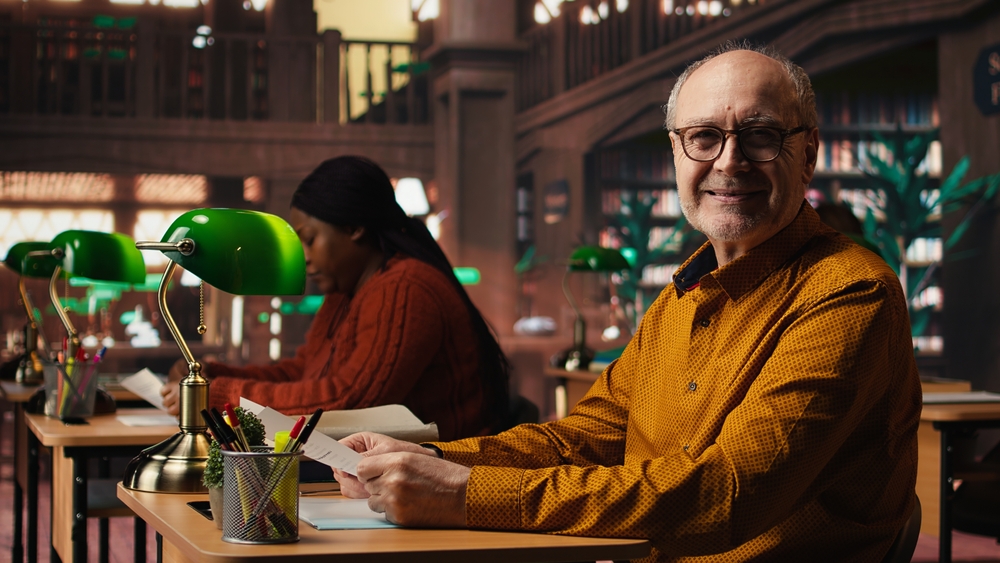
Going back to college at 68 meant Kaplan was surrounded by students who were often young enough to be his grandchildren. The difference in age could have made the classroom feel isolating, but his experience developed differently. He became interested in the people around him and made a habit of asking his classmates what they wanted to do with their lives.
That question may seem simple, yet it reflects the perspective of someone who has already had time to see how unpredictable a life can become. At 18 or 20, the future can feel like something that must be mapped immediately. Kaplan had lived long enough to understand that careers change, businesses begin and end, families grow, and interests that seem distant can return decades later.
His relationships with other students became an important part of his college experience. “I think I have a good relationship with them,” Kaplan said. “I got hugs from a lot of them on the last day of classes.” The warmth of that farewell suggests that the age difference became less important once people spent time learning alongside one another.
Film professor Kate Balsley also noticed what Kaplan brought to the classroom. She said he regularly participated and offered advice and assistance to his classmates. He was willing to share photographs and stories about his life and family, giving younger students a perspective shaped by experiences they had not yet lived. Kaplan came to college hoping to learn the mechanics of screenwriting, but the people around him were also learning from the life he brought into the room.
Four Years of Learning and Persistence
Kaplan’s return to education was not presented as an effortless achievement. He had been away from a formal classroom for decades, and studying again required adjustment. College demanded that he develop routines and skills that had not been part of his daily life since his youth.
He later described the experience honestly. “It was exciting, nervous, but it was a challenge,” he said. Learning how to study again was part of the process, and so was adapting to a new social environment. Yet Kaplan also found genuine enjoyment in being surrounded by students and returning to a setting built around curiosity and growth.
Four years after hearing that radio advertisement, the work led him to Georgia Gwinnett College’s spring commencement ceremony. On May 11, 2023, Kaplan crossed the stage alongside more than 650 other graduates and received a bachelor’s degree in cinema and media arts.
He completed his degree with summa cum laude honors. The recognition reflected years of academic work that began when he was already 68 years old. Kaplan had not returned to school for the sake of proving that age could be overcome. He returned because he wanted to learn, and the honors became part of the result.
A Mother Watching Her Son Graduate
Among the hundreds of people gathered for the commencement ceremony was the person whose presence mattered most to Kaplan. His mother, Virginia, had come to watch him graduate at 99 years old. She had already spent a lifetime watching her children find their way through adulthood, but this was a milestone she had never seen before.
Speaking about her son’s achievement, she expressed the kind of pride that needs little explanation. “I am so proud of him,” she said. “He had many challenges, but he persevered, and I am so pleased, delighted and very, very proud.” Her words held the history of someone who had watched her son through many stages of life before seeing him reach this one.
Then she added a joke that brought a lighter touch to the occasion. Thinking about what her son’s new degree might lead to, she said, “With his new degree, he’s going to be so successful in anything he does. And, who knows, I might even be in the movies.”
The humor felt fitting for a family celebrating a degree in cinema and media arts. Kaplan had spent years wanting to turn stories into screenplays, and his mother was already imagining herself somewhere inside the next chapter. He described her as excited, happy, and proud, and the moment between them became one of the most memorable parts of his graduation.
The Work Still Waiting Ahead
Kaplan returned to college because he wanted a foundation for screenwriting. By the time he graduated, he had gained that education, completed his degree with high honors, and become the first of his siblings to earn a college diploma. Yet the degree was never meant to be the final destination.
The books he had written were already part of his past. The screenplays he hoped to create remained part of his future. That distinction gives his story much of its power. Graduation is often treated as the closing scene of an educational experience, but Kaplan seemed to view it as preparation for work he still wanted to do.
When asked how it felt to reach the milestone, he answered simply: “I’m very excited, and I feel proud of myself for doing this.” After 50 years away from the classroom, there was no need to turn the achievement into something more complicated.
At 72, Kaplan had given himself permission to begin again. And with his mother watching from the audience, he stepped off the graduation stage carrying the same thing that had first led him to take that exit off Highway 316: a collection of stories and the belief that there was still time to tell them.