

The Stories Our Brains Create May Be the Closest Thing We Have to a Life
You did not keep yesterday exactly as it happened. What remains is a version of it, shorter and more selective, with forgotten hours falling away while certain moments gather meaning. Repeat that process across decades and something remarkable begins to take shape: the story you understand as your life.
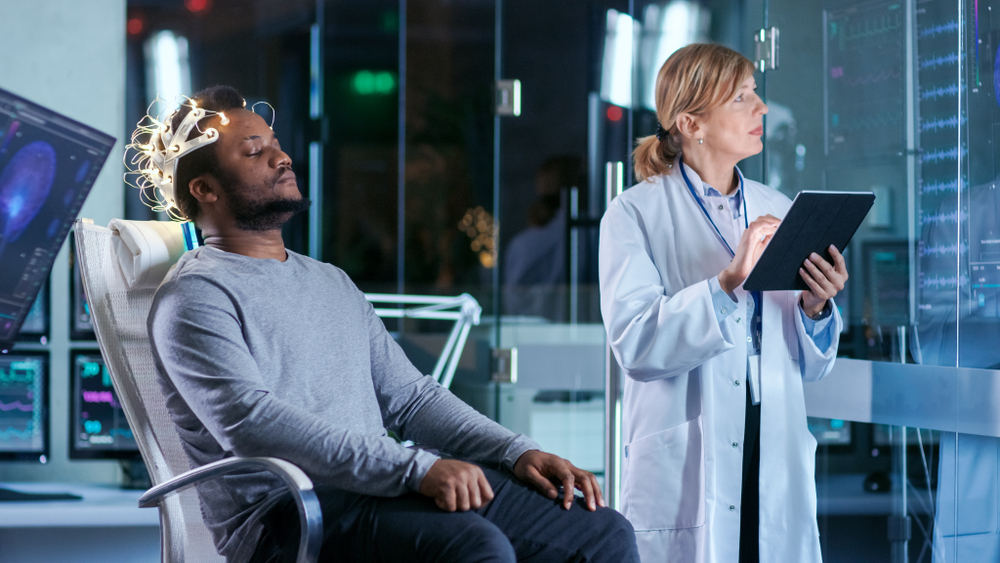
For much of human history, this private act of editing remained invisible. Then neuroscience began asking a different kind of question. Instead of studying the brain through isolated sounds, images, and word lists, researchers started examining what happens when people experience stories, remember them, interpret them, and share them with one another.
Five Brains Watching the Same Story
In the early 2000s, Uri Hasson became dissatisfied with how disconnected many laboratory experiments seemed from ordinary life. Simple stimuli produced clean data, but human experience rarely arrives as a single sound or image. Hasson and his colleagues wanted something closer to life itself, so they placed five people in brain scanners and showed them half an hour of The Good, the Bad and the Ugly.
The result challenged expectations. Their brains did not produce meaningless noise. Activity rose and fell in similar patterns across participants, extending beyond visual and auditory areas into regions associated with language and meaning. As scenes changed and dialogue unfolded, separate minds appeared to organize the experience along a shared structure.
The finding opened a new way of thinking about narrative. A story could move through several minds and produce patterns of understanding that were strikingly aligned. For anyone who has ever sat silently beside another person and been moved by the same scene, the science offers a fascinating possibility: stories may bring separate inner worlds closer together than we once realized.
The Brain Edits Before Memory Begins
Later research explored what happened after the story ended. Janice Chen and her colleagues examined people watching an episode of Sherlock and then describing it from memory. Their brains showed shared patterns during viewing, and related patterns appeared again when they recalled the episode, but memory was clearly not a perfect replay of what they had seen.
The brain had reorganized the experience before storing it. What appeared to survive most reliably was structure, particularly the links between cause and effect. Scenes connected strongly to many other parts of the story became more deeply embedded in patterns associated with memory and meaning, while other details quietly disappeared.
This may explain something familiar about remembering a difficult year, a childhood, or an important relationship. The mind does not hand us the raw footage. It gradually builds a version that helps us understand how one moment led to another, which events changed us, and which memories still seem to belong in the story we carry forward.
The Scripts Already Waiting Inside You
Experience also arrives in a mind that is far from empty. Walking into an airport usually brings expectations before anything unusual happens. There will be an entrance, security, waiting, a gate, and eventually a flight. A restaurant carries its own familiar sequence, and these patterns may help the brain understand new experiences before every detail has even appeared.
Christopher Baldassano, Hasson, and Kenneth Norman explored this idea by studying 44 people taking in 16 short stories through video and spoken narration. Some followed the structure of an airport visit, while others followed a restaurant visit. The characters and specific events differed, yet the brain repeatedly recognized the deeper pattern beneath them.
Their findings suggest that the mind meets each new experience with an enormous library of earlier ones. Experience teaches the brain what kinds of events tend to follow others and where attention may be useful. Every ordinary moment may add something to that invisible library, shaping how the next unfamiliar place, conversation, or turning point is understood.
When One Mind Shares a Story With Another
Stories become even more remarkable when they move between people. In one experiment, researchers scanned a speaker as she told a story and compared her brain activity with that of people listening. Across many regions, the listeners’ activity tracked the speaker’s with a delay of roughly one to three seconds.
Some regions appeared to anticipate where the story was going, and greater anticipatory alignment was associated with better understanding. The connection disappeared when communication broke down. Listening, these findings suggest, is an active process in which the brain continually predicts, organizes, and reconstructs what another person means.
Language allows someone to arrange experience into a sequence and offer that sequence to another human being. The details may belong to one person, yet understanding becomes partly shared. For a brief period, two separate lives can become organized around the same imagined world.
- The speaker shapes experience into a sequence of meaning.
- The listener predicts and reconstructs that sequence in real time.
- Understanding grows when both minds form similar interpretations.
The Same Events Can Become Different Realities
Shared information does not guarantee shared understanding. In another experiment, two groups heard the same recorded adaptation of a J. D. Salinger story. One group received context suggesting that a wife was having an affair, while the other was led to believe that her husband was paranoid and imagining events.
The recording itself never changed, yet the interpretations did. Brain activity diverged across higher-level regions involved in language and meaning, and the degree of difference reflected the degree to which participants understood the story differently. People who shared an interpretation tended to show more similar patterns of response.
This offers a scientific glimpse of something people encounter throughout life. Two people can spend the same afternoon together and later describe experiences that barely resemble one another. The same may happen within families, where siblings share a home and many of the same events but carry forward entirely different versions of what those years meant.

The Story You Build From Difficult Years
Psychologist Dan McAdams has spent much of his career studying what happens when this process turns toward the self. In research involving 157 adults, participants were asked to describe their lives almost as if they were novels, identifying chapters, defining scenes, important characters, and recurring themes.
One pattern appeared repeatedly among people who showed strong generativity, a quality associated with caring for others and contributing beyond oneself. McAdams described this pattern as the redemptive self. People often told stories in which hardship eventually became connected to growth, responsibility, compassion, or a purpose larger than themselves.
This does not mean suffering becomes good simply because someone later finds meaning after it. A painful event remains part of what happened. Yet people continually decide how past experiences connect to the present, and identity may depend partly on this ongoing act of interpretation.
The Cut Is Still Being Made
There are important limits to this research. Several of the studies involved relatively small groups, and fMRI measures changes in blood flow rather than recording individual neurons directly. No experiment can explain an entire human life or prove that one particular story will create one particular identity.
Still, these findings point toward something deeply fascinating about human experience. We search for patterns across what happens to us, preserve certain connections, anticipate what may come next, and share our interpretations with other minds. Memory is not a perfect archive, and perhaps it was never designed to be one.
Nobody gets to keep the raw footage of a life. The ordinary hours fade, details shift, and meaning changes as new experiences arrive. The moments ahead have not yet been assigned their place in the sequence, and that may be one of the most human freedoms we possess.
Sources:
- Hasson, U., Nir, Y., Levy, I., Fuhrmann, G., & Malach, R. (2004). Intersubject synchronization of cortical activity during natural vision. Science, 303(5664), 1634–1640. https://doi.org/10.1126/science.1089506
- Stephens, G. J., Silbert, L. J., & Hasson, U. (2010). Speaker–listener neural coupling underlies successful communication. Proceedings of the National Academy of Sciences, 107(32), 14425–14430. https://doi.org/10.1073/pnas.1008662107