


NASA’s Perseverance rover was sent to Mars to do one of the most ambitious jobs in modern space science: hunt for clues that the Red Planet may once have supported life. Instead, in one of the mission’s stranger moments, it ended up stumbling across something much more familiar.
Lying on the dusty Martian surface was a torn fragment of thermal blanket material from the very spacecraft system that helped deliver Perseverance to the planet. It was not where scientists expected it to be, and perhaps more importantly, they do not know exactly how it got there.
At first glance, it sounds almost funny. NASA sends a robot millions of miles away to search for alien history, only for it to find a piece of its own trash. But the moment quickly became more than a novelty. Combined with a series of other recent discoveries, including a skull-shaped rock, strange dark “float” stones, and a rock sample carrying what scientists call a potential biosignature, Perseverance is painting a picture of Mars that is at once exciting, messy, mysterious, and deeply human.
A Mission Built to Look for Ancient Life Found a Piece of Itself Instead
The spacecraft fragment was identified as part of the thermal blanket from Perseverance’s descent stage, the rocket-powered system that lowered the rover onto the Martian surface in February 2021. That descent stage was always expected to crash after doing its job. Once Perseverance touched down safely, the flying platform was programmed to veer away and smash into the planet at a safe distance.
NASA later confirmed that the descent stage came down roughly two kilometers away from where the rover was exploring. That is what makes the discovery so odd. The thermal blanket scrap showed up somewhere scientists did not necessarily expect to find it.
When the agency shared the image, even NASA openly admitted the object’s location was puzzling. Did the material land there during the crash and remain unnoticed until now? Or was it moved across the surface by Martian winds over time?
Those questions may sound small compared with the search for life, but they matter more than they seem. Every object left behind on Mars tells scientists something about landing systems, impact behavior, weather conditions, and how hardware survives on another world. In a place where future missions may need to land humans, habitats, supplies, and return vehicles, even a torn scrap of insulation becomes data.
There is also something undeniably surreal about it. Humanity has now reached the point where we can leave debris on another planet and then send a robot to photograph it years later. It is a scene that feels almost cinematic, but it is real. Mars is no longer just a distant symbol in science fiction. It is becoming a place with a growing archaeological record of human exploration.
Mars is Starting to Look Less Like a Blank World and More Like a Story in Progress
The spacecraft fragment is not the only thing Perseverance has found that appears out of place.
As the rover continued its journey through Jezero Crater and down the slopes of Witch Hazel Hill, mission scientists began documenting a collection of strange loose rocks scattered across the landscape. One of them quickly stood out enough to earn a nickname: “Skull Hill.”
The rock caught attention because it looked dramatically different from the lighter-toned terrain around it. It was dark, angular, and pitted, as though it had been dropped there from somewhere else. NASA scientists described it as one of several “float” rocks in the region, meaning stones that likely did not form where they currently sit.
That may not sound dramatic on Earth, where rocks are constantly moved by water, glaciers, erosion, and landslides. But on Mars, each displaced rock can carry a record of ancient environmental conditions. If a rock is out of place, it means something moved it, and on a planet whose wetter past is one of the biggest scientific puzzles in planetary science, that matters a lot.
Researchers believe many of these rocks could have been transported long ago, back when Mars may have had active rivers, lakes, and a far more dynamic surface. As softer material eroded over billions of years, tougher rocks could have remained stranded on the surface like clues from a vanished world.
Skull Hill is especially intriguing because scientists are not yet certain what it is made of. Its dark appearance initially raised the possibility that it might be meteoritic, but early chemical readings from Perseverance’s instruments suggested it does not fit the profile of a typical meteorite. Another possibility is that it has a volcanic origin, perhaps excavated from deeper layers by ancient impacts or exposed after surrounding rock eroded away.
In other words, even a strangely shaped rock on Mars can open up a much bigger conversation about the planet’s geological history.
The Weirdest Part is That Mars May Also Be Hiding Something Far More Important
As strange as spacecraft debris and skull-like rocks are, they are not the discoveries drawing the most serious scientific attention.
One of Perseverance’s most significant finds came from a rock sample collected in Jezero Crater from an area called the Bright Angel formation. The rock, nicknamed “Cheyava Falls,” contained chemical and mineral patterns that NASA scientists say may represent a potential biosignature.
That phrase matters, because it does not mean NASA has found life on Mars. It means the rover found something that could, under the right interpretation, be linked to ancient microbial activity.
The sample, called “Sapphire Canyon,” came from an ancient dry riverbed environment, exactly the kind of place astrobiologists have long wanted to explore. On Earth, fine-grained sedimentary rocks rich in clay and silt are among the best natural archives for preserving traces of microbial life. The Bright Angel formation appears to contain that kind of material.
More intriguingly, the rock also appears rich in organic carbon, sulfur, phosphorus, and oxidized iron. That combination has scientists interested because those ingredients can create chemical environments capable of supporting microbial metabolisms. In simple terms, the rock seems to preserve the sort of chemistry life might have used.
When Perseverance examined the rock more closely using instruments like PIXL and SHERLOC, it identified unusual mineral patterns and spots within the rock. Some of those “leopard spot” features carried the signatures of minerals such as vivianite and greigite, both of which can, under some circumstances on Earth, be associated with biological processes.
That does not make them proof of life. But it does make them compelling.
For NASA and the wider scientific community, this is one of the most tantalizing Mars findings in years because it narrows the gap between “interesting chemistry” and “possible biological relevance.” That gap is still wide, but it is no longer abstract.
Why Scientists Are Excited, but Also Refusing to Overhype It

If this all sounds like the kind of discovery that should trigger global headlines declaring life on Mars has been found, there is a reason NASA has been careful with its language.
Scientists have seen this pattern before. A signal appears promising, public excitement explodes, and then follow-up analysis reveals there may be a much more ordinary explanation.
That is exactly why the Perseverance findings are being treated with such caution.
While the rock sample from Cheyava Falls contains what researchers describe as a potential biosignature, there are still non-biological ways those same minerals and chemical patterns could have formed. Geological heat, water-rock interactions, acidic environments, and other abiotic processes can sometimes mimic what looks like a biological fingerprint.
A separate scientific debate has already emerged around some of Perseverance’s earlier detections of organics. The rover’s SHERLOC instrument, designed to help identify organic molecules, picked up signals that many initially interpreted as evidence of carbon-based compounds. That alone was a major moment, because organic molecules are one of the key ingredients for life.
But some scientists have since argued that the signals may not be organic at all, or at least not entirely. Alternative interpretations suggest that some readings could instead come from inorganic materials, including certain mineral defects or unusual chemical states that can produce similar spectroscopic signatures.
That might sound disappointing, but in reality it is exactly how science is supposed to work.
Mars exploration is difficult because Perseverance is essentially trying to do high-level chemistry and geology using miniaturized instruments mounted on a robot millions of miles away. These tools are remarkably advanced, but they are still limited compared with what researchers can do in laboratories on Earth.
So when a result is ambiguous, scientists do not simply choose the most exciting explanation. They test alternatives, challenge assumptions, and push each finding until only the strongest interpretation survives.
That process can feel frustrating from the outside, especially when the public wants a clean answer. But if humanity is ever going to claim it found evidence of life on another planet, that claim will need to survive scrutiny at the highest possible level.
Perseverance is Doing Exactly What It Was Sent to Do
It is easy to look at these discoveries one by one and see them as disconnected oddities: a blanket scrap here, a dark skull-shaped rock there, a few suggestive mineral signatures in an ancient riverbed.
But together, they tell a much more important story.
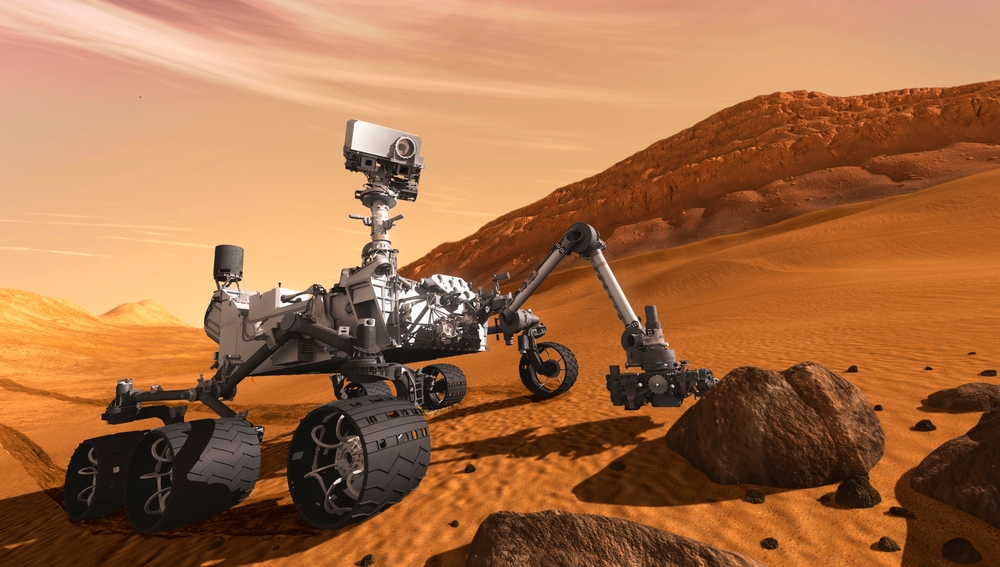
Perseverance was never sent to Mars to produce one dramatic movie-style reveal. It was sent to slowly build a case, piece by piece, layer by layer, sample by sample. And that is exactly what it is doing.
The rover is currently exploring terrain on the rim of Jezero Crater that appears to expose some of the most scientifically valuable rock units the mission has encountered so far. According to mission updates, the pace of discoveries has accelerated significantly in recent months, with the rover collecting multiple new samples, studying several more rocks in detail, and remotely analyzing dozens of others.
That matters because Jezero Crater is not just any random patch of Martian ground. Scientists believe it once hosted a lake and river delta system billions of years ago. If Mars ever supported microbial life, a place like Jezero would be one of the best locations on the planet to preserve signs of it.
And unlike earlier Mars missions that focused largely on habitability, Perseverance was designed to go a step further. Its job is not only to ask whether Mars could once have supported life, but whether there is any preserved evidence that life may actually have existed.
That is a much harder question, and it is why every weird rock, every chemical reading, and every unexpected object matters.
The Real Problem is That the Best Answers Are Still Sitting on Mars

For all the excitement around Perseverance’s findings, there is one unavoidable truth hanging over nearly every major discovery it makes: the rover can only take the science so far.
The most definitive answers are likely locked inside the samples Perseverance has already collected and cached for possible return to Earth.
That is where things become frustrating.
Mars Sample Return, the long-discussed effort to bring those sealed cores back to Earth for full laboratory analysis, has faced major uncertainty because of cost, engineering complexity, and schedule concerns. Scientists widely agree that this mission would be the single most important next step in determining whether Mars ever hosted life. Yet it remains one of the most technically and politically difficult projects in planetary exploration.
Without those samples in Earth labs, researchers are forced to work with the limits of rover-based science. They can identify patterns, propose explanations, and narrow possibilities, but they often cannot fully resolve the biggest questions.
That is why discoveries like Cheyava Falls generate so much attention. They are not final answers. They are invitations to look closer.
And in some ways, that may be what makes Perseverance’s mission so compelling. It is not delivering certainty. It is delivering evidence that Mars is more complex, more dynamic, and potentially more biologically interesting than many people assumed.
There is Something Unexpectedly Human About All of This
There is something unexpectedly human about all of this. For all the chemistry, geology, and technical language, there is a quieter emotional layer running through Perseverance’s mission that helps explain why these moments resonate so strongly. A robot built by humans is driving across another planet, photographing the wreckage of its own arrival, studying stones that may have been shaped by vanished rivers, and collecting samples that could one day help answer one of the oldest questions our species has ever asked: Are we alone? That question does not need to be shouted in every headline to be present; it is there in the thermal blanket scrap blowing across Mars, the eerie silhouette of Skull Hill, and the faint chemical traces inside a rock that has not been touched for billions of years.
What Perseverance keeps finding on Mars is not just “weird stuff,” but evidence that exploration rarely unfolds in a straight line. Sometimes the path to a profound discovery runs through confusion, false starts, damaged hardware, strange rocks, and frustratingly ambiguous data. And maybe that is fitting, because Mars has never really been a place that gives up its secrets easily. It teases, hints, and complicates. It gives scientists just enough to keep going, but never enough to stop asking.
That enduring mystery may be exactly why the world keeps watching. Somewhere between the debris of a crashed landing system and the possibility of a biosignature preserved in stone, Mars has become more than a destination. It has become a mirror for how science actually works: curious, imperfect, methodical, and stubbornly hopeful. For now, NASA may not know how that piece of spacecraft ended up where it did, but in a strange way, that uncertainty captures the spirit of the entire mission. Perseverance is not just finding answers on Mars; it is finding the edges of what we know, and showing us how much farther there still is to go.
Image Source: Shutterstock