

The Surgeon Who Turns Children’s Bandages Into Works of Art
A child can wake from surgery surrounded by unfamiliar voices, medical equipment, and the lingering anxiety of a hospital room. Then they look down and find SpongeBob, Buzz Lightyear, a butterfly, or even a cheeseburger waiting for them.
For more than 10,000 young patients, pediatric surgeon Dr. Robert Parry has turned an ordinary surgical dressing into something personal. The artwork takes about five minutes, but some families remember those drawings for years.
A Small Ritual After Major Surgery
Dr. Robert Parry is a pediatric surgeon at Akron Children’s Hospital in Ohio, where his work often involves serious operations on children. When an operation ends and a patient needs a dressing, he frequently reaches for colored pens.
He draws on the dressing that will cover the child’s incision, usually finishing before the patient wakes up.
“I’ve operated on more than 10,000 children, and all of them that needed a dressing got a drawing,” Parry said.
If time runs short, he simply adapts. “If I’m slow, I just walk to the recovery room and put it on there,” he explained.
The Tradition Started With A Shark
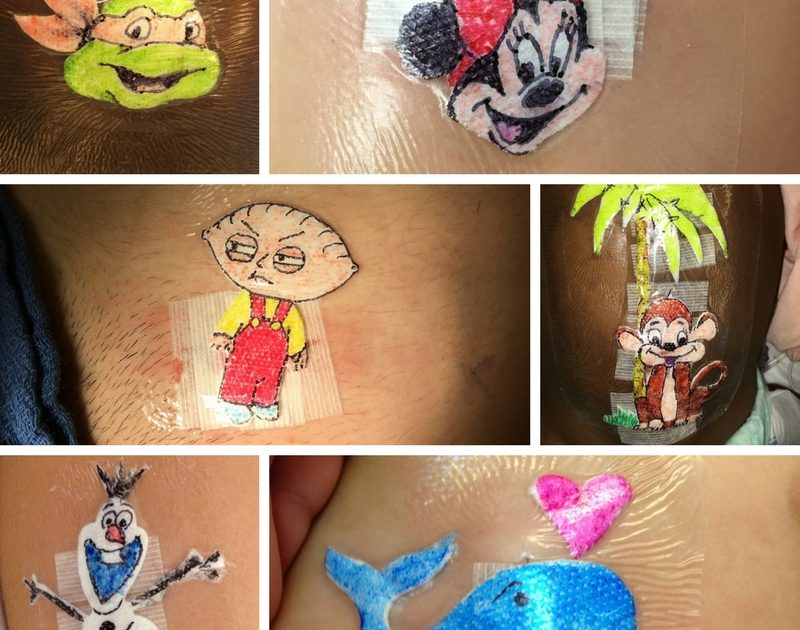
Image Credits: Website @Akron Children’s Hospital
Parry did not originally set out to create artwork for his patients. He first encountered the idea while training at the naval hospital in Bethesda, Maryland.
There, he watched another pediatric surgeon, Dr. Perry Stafford, cut shapes into surgical dressings. “There was a pediatric surgeon, Dr. Perry Stafford, when I was training at Bethesda,” Parry recalled.
Stafford created shark silhouettes and other shapes that were warmly received by patients and their families. Parry initially found the practice unusual, but he quickly understood its appeal.
“My first reaction when I initially saw him cut out these hearts and sharks was, ‘What is he doing? Hey, that’s kind of neat.'” He began experimenting with similar designs and eventually developed the practice into something much more personal.
From Cutouts To Custom Drawings
Parry initially made simple shapes, including sharks and hearts. Over time, the cutouts became detailed drawings, and children began making requests based on their favorite characters and interests.
He also worked out a method for adding color without interfering with the sterile surgical process. The requests continued, and Parry kept drawing.
From SpongeBob To A Cheeseburger
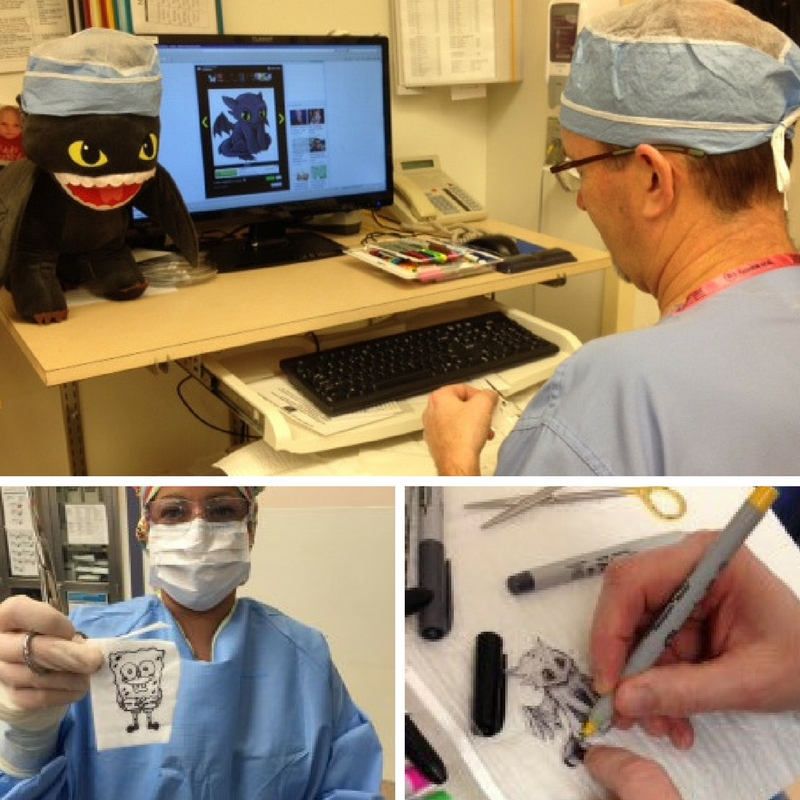
Image Credits: Website @Akron Children’s Hospital
The collection of designs Parry has created is enormous. His artwork has included Mickey Mouse in surgical scrubs, Snoopy, Tom and Jerry, football helmets, Thanksgiving turkeys, and countless SpongeBobs.
“I can’t even count how many Sponge Bobs I’ve made,” Parry said. “That’s a very popular request.”
Sometimes the drawings respond to something a child wants but cannot have after surgery. One young girl wanted a cheeseburger, but she was unable to eat after her operation.
A Request Answered With Ink
Parry found another way to give her what she wanted. “There was a girl once who really wanted a cheeseburger but couldn’t eat after surgery,” he explained, so she woke up to find one drawn on her bandage.
His designs can also work with the shape of the surgical dressing. Long vertical stitches, for example, can be incorporated into a giraffe, with the animal’s long neck covering the line.
The details may seem small beside the seriousness of surgery. Yet they offer children something familiar in a place where very little may feel familiar.
Buzz Lightyear In The ICU
For some families, the artwork becomes part of a memory attached to one of the hardest days of their lives. Jackson Kunze was three when surgeons removed tumors from his vena cava, gallbladder, and liver.
His mother, Heather Vincent, walked into the ICU and saw her son surrounded by tubes and medical equipment. The sight was overwhelming after such a major operation.
“It was such a major surgery and to see him in the ICU with tubes coming out of him and a drain up his nose was overwhelming,” Vincent said. Then a nurse asked her to look beneath Jackson’s hospital gown.
An Instant Happy Distraction
The drawing was Buzz Lightyear. “When a nurse said, ‘I want to show you something’ and lifted up Jackson’s gown to show me Buzz Lightyear, it was an instant happy distraction from everything else that was going on,” Vincent said.
The artwork did not change the seriousness of Jackson’s condition or erase what his family was facing. It gave his mother something different to see during a moment dominated by fear.
Butterflies And A Rose Garden
Parry sometimes makes promises to children before they enter surgery. Kennedy was seven years old when she underwent hernia surgery, and Parry promised her that she would receive a butterfly.
Her mother, Christina Potts Whipkey, described the stress that accompanies a child’s illness. “There is an incredible amount of stress any time a child is ill,” she said.
After surgery, Kennedy had her promised butterfly waiting for her. Her mother said, “Kennedy was so proud of the pretty bandage and not concerned about any scars.”
A Personal Surprise For Rose
Another patient, an 11-month-old girl named Rose, faced a liver transplant. Her family did not know beforehand that Parry created personalized artwork for his patients.
Rose emerged from surgery wearing a dressing decorated as a rose garden, complete with a bee hovering above the flowers. Her mother, Samantha Manning, said the family was deeply moved by the unexpected gesture.
“We had no idea ahead of time that this was Dr. Parry’s special trademark. We were really moved by it,” Manning said. “It shows how much they care and really lifted our spirits.”
Some Children Receive A Simple Heart

Parry does not approach every difficult situation with a cartoon character. For children who are critically ill, he sometimes draws a simple red heart instead.
“Those are tough,” he said. “You don’t want to pretend that nothing else is going on.”
The heart acknowledges a reality that no cheerful drawing can erase. Some families are facing circumstances where distraction would feel insufficient or dishonest.
Care Can Also Mean Acknowledgment
Parry has spoken openly about the sadness of situations medicine cannot fully fix. “When there’s something that you can’t fix, that’s super sad,” he said.
He added, “But thankfully, for most of them, we can redirect the bus a bit and help them along.” His artwork does not deny pain; it offers comfort within it.
A Snowman For A Newborn
One of the most memorable drawings was created for a patient who would never remember receiving it. Susan McFrederick’s son Witt was born in 2011 and needed surgery for a ruptured intestine within hours of his birth.
For his mother, the experience was frightening and unfamiliar. She had barely had time to know her newest child before he entered an operating room.
After surgery, she noticed what had been created on his dressing. It was a detailed winter scene featuring snow-covered hills, a pine tree, and a snowman.
A Memory His Mother Kept
“There were rolling hills of snow, a pine tree and a snowman with a hat and broom, cut out separately and put down layer by layer,” Susan said. Witt was too young to understand the gesture, but his mother never forgot it.
“It was extremely touching and comforting to know that somebody had taken the time to do that for my family,” she said. “It was a moment I’ll never forget.”
The bandage was temporary, and the snowman eventually disappeared with it. The memory remained because someone had taken a few extra minutes during an experience the family would always remember.
What Five Minutes Can Give A Family

Hospitals depend on expertise, speed, and carefully organized systems. Parry’s drawings show that personal attention can still exist within those systems, even during the busiest and most demanding moments.
The artwork appears to offer families several things beyond a colorful image:
- Familiarity: Favorite characters can bring comfort into an unfamiliar environment.
- Personal attention: A custom design shows that someone noticed the individual behind the medical chart.
- A gentler memory: Families may remember the artwork alongside an otherwise frightening experience.
- A brief distraction: Humor and imagination can interrupt intense worry.
- Human connection: A small gesture can communicate care without needing a long explanation.
None of these things replace skilled medical treatment. They exist beside it, adding a personal dimension to a process that can otherwise feel intimidating and impersonal.
A Little Piece Of The Surgeon
Parry has offered a simple explanation for why he continues drawing after so many operations. “You’re not just someone I’ve operated on,” he said.
“You’re actually a human being. Here’s a little piece of me with it.”
More than 10,000 children have received that small piece of creativity. Most of the drawings are gone now, but a SpongeBob, a butterfly, a rose garden, or a snowman can remain in a family’s memory long after the bandage has been removed.
Five minutes may be a small part of a surgeon’s day, but for a family living through one of its most frightening moments, those minutes can leave something behind that medicine alone cannot measure.