


She Hid a 3,000-Word Letter Behind Her Mirror. Her Father Found It After She Was Gone.
Grief asks impossible things of people. It asks you to sort through a life that has ended while your own continues. It asks you to open drawers, touch folded clothes, and decide what to keep and what to release, all while carrying a weight that no preparation makes lighter. For a parent, there is perhaps no harder task than standing in a child’s bedroom after that child is gone, looking at the ordinary objects of an ordinary life that ended far too soon.
Dean Orchard stood in his daughter’s room in Leicester, England, in the days after her death, doing what grieving parents are somehow expected to do. He was tidying. He was sorting. He was trying to hold himself together long enough to get through each small task.
When he moved a full-length mirror that had always leaned against the bedroom wall, he saw something that stopped him completely.
Athena Orchard, Age 13
Before anything else, know who Athena was. She was thirteen years old, the eldest daughter in a large and close-knit family, six sisters, three brothers, two parents who loved her without limit. She grew up in Leicester with what her father described as a spiritual quality that went far beyond her years. She thought about things deeply. She asked questions that adults struggled to answer. She carried an interior life that most people never glimpse in someone so young.
“She was a very spiritual person,” Dean told People magazine. “She’d go on about stuff that I could never understand — she was so clever.”
Athena was the kind of child who made people feel that something larger was moving through her. She wrote songs and kept them in a box. She thought carefully about love, about purpose, about what made a life worth living. She was thirteen, and she understood things that many people spend their entire adult lives trying to reach.
A Lump, a Diagnosis, and What Followed

Around December 2013, Athena discovered a small lump on her head. What followed moved with a cruelty that no family should face.
Doctors diagnosed her with osteosarcoma, one of the most aggressive forms of bone cancer, and one of the most common in adolescents. By the time her family understood what they were dealing with, the disease had spread beyond its original point. Cancer appeared in her spine, her left shoulder, and her head. She underwent intense rounds of chemotherapy. Surgeons operated on her spine in a procedure that lasted seven and a half hours. She wore a wig to cover the hair that the treatment had taken from her.
Through all of it, Athena kept going. She did not retreat from her family or from life. She remained present, deeply felt, and almost unbearably alive even as her body fought something it would not be able to defeat. On May 28, 2014, Athena Orchard died. She was thirteen years old.
What Dean Found When He Moved the Mirror
A full-length mirror had stood in Athena’s room for as long as the family could remember. It leaned against the wall at an angle, as bedroom mirrors do, and no one had ever thought to look behind it. There was no reason to. It was simply part of the room, part of the furniture of a life, unremarkable and constant.
When Dean moved it during those first devastating days after Athena’s death, he found the back of it covered in writing. Black marker pen, running all the way down the surface. Words filled every available space with a density and intention that made clear this had not been written quickly or carelessly. Athena had chosen to write here, behind something that no one would move until she was gone, in a place where her words would wait until the exact moment her family needed them most.
“When I moved the mirror after she died I couldn’t believe it — I saw all this writing,” Dean said. “It must have been about 3,000 words. It’s so touching. When I first saw it, it just blew me away. I started reading it but before long I had to stop because it was too much, it was heartbreaking.”
Alongside the mirror, Dean found a box of songs Athena had written herself, a second hidden gift, tucked away with the same quiet deliberateness. A dying girl who had spent her remaining time leaving things behind for the people she loved.
What She Wrote
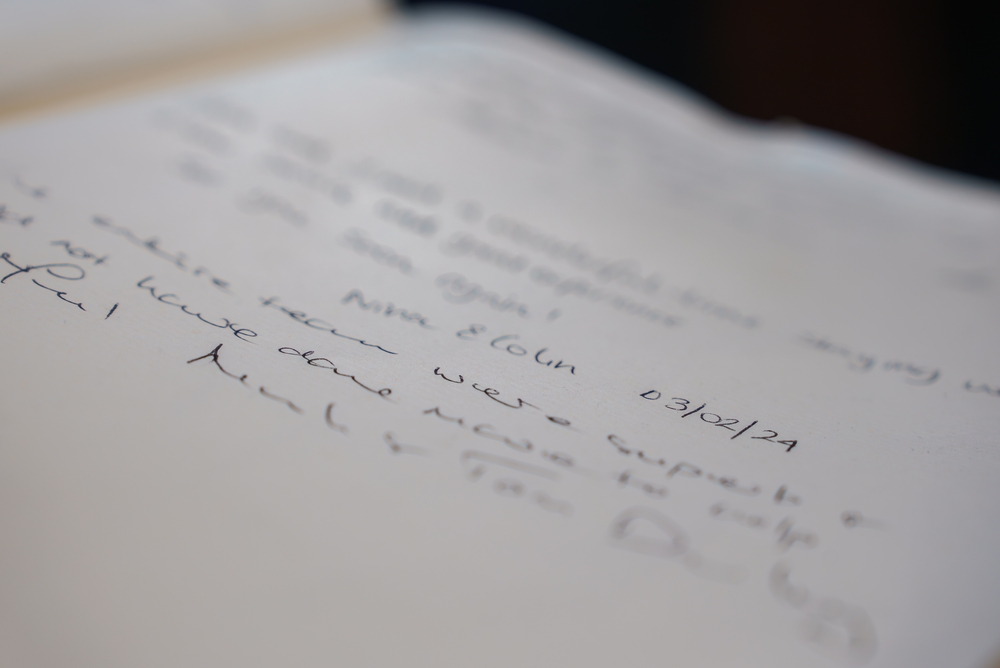
Three thousand words is not a note. It is not a farewell scrawled in a moment of sentiment. Three thousand words is a document a considered, careful record of everything a thirteen-year-old girl had worked out about being alive, written by someone who knew that her time to work anything else out was running short.
Athena wrote about happiness first. Not as a feeling to chase but as a choice to make. “Happiness depends upon ourselves,” she wrote. “Maybe it’s not about the happy ending, maybe it’s about the story.” She understood, at thirteen, while fighting a disease that was killing her, that a life does not have to end well to have meant something. She knew that the story itself was where the value lived.
She wrote about purpose. “The purpose of life is a life of purpose. The difference between ordinary and extraordinary is that little extra.” She wrote about direction rather than destination, about gratitude, about the importance of treating each day as something real and precious rather than a placeholder for a future that might not arrive. “Every day is special, so make the most of it,” she wrote. “You could get a life-ending illness tomorrow so make the most of every day. Life is only bad if you make it bad.”
She was not speaking in the abstract. She had already received the diagnosis that most people only imagine when they read sentences like that one. Athena wrote about love with a raw honesty that would be striking coming from anyone, let alone a girl in her early teens. She understood that love was not about declaration but about proof. She knew that love could shatter like glass, that it was as real and intangible as wind. She wrote about wanting to find someone she could open her heart to completely, and about the difference between a person you can imagine a future with and a person you simply cannot imagine living without.
She wrote about judgment, about being seen only partially by people who believed they understood her. “You know my name, not my story,” she wrote. “You have heard what I’ve done, but not what I’ve been through.” She asked not to be defined by what was visible from the outside. She asked people to remember that every person carries a private weight that others rarely see.
And toward the end, she wrote about standing firm. “People gonna hate you, rate you, break you — but how strong you stand, that’s what makes you… you.”
A 13-Year-Old Who Understood Something Most Adults Don’t

Stop for a moment and consider what it takes to write those words. Athena wrote this message after her diagnosis. She sat in her bedroom, took a black marker, turned a mirror to face the wall, and spent what must have been many hours recording everything she had learned and believed and hoped, knowing that the people who found it would be the people who loved her most and that they would be reading it in grief.
She did not write about her fear, though she must have felt it. She did not write about the unfairness of a thirteen-year-old facing what she faced, though no one would have argued with her if she had. She wrote outward, toward the people she was leaving. She wrote as someone who had already made peace with her own story and wanted to make sure the people in it would be okay. Most adults never get there. Athena got there at thirteen, in a bedroom in Leicester, with a marker and a mirror and whatever time she had left.
“We’re Keeping the Mirror Forever”

When Caroline Orchard, Athena’s mother, spoke about what her husband had found, she said something that carries its own quiet wisdom.
“We’re keeping the mirror forever, it is a part of her we can keep in the house, it will always be in her room,” Caroline said. “Just reading her words felt like she was still here with us, she had such an incredible spirit.”
Athena’s words did not take away the grief of losing her. Nothing could do that. What they did was give the grief somewhere to land, a place where the family could return, again and again, to hear from the daughter and sister they lost, in her own voice, on her own terms.
What Athena Knew
Athena Orchard wrote her message for her family. But she could not have known how far those words would travel, or how many strangers would read them and feel something shift.
She wrote: “Every day is special, so make the most of it — you could get a life-ending illness tomorrow so make the most of every day.” She was not being dramatic. She was not offering the kind of motivational language that people pass around without really meaning. She was a thirteen-year-old girl who had received the diagnosis, gone through the surgery, lost her hair, and kept writing. She knew precisely what she was saying.
Most of us read words like those and feel them briefly before returning to the ordinary friction of daily life. Athena lived them, and she left them behind so that we might try a little harder to do the same.